Ibn Arabi’s Inclusivity
The Islamic ideal of inclusivity is not a modern invention. It is deeply rooted in the Qur’an, nurtured by the Prophetic tradition, reflected in the wisdom of the early Muslim community, and embodied by generations of Muslim scholars. Ibn ʿArabī stands among its most profound exponents. His life of travel, learning, and spiritual inquiry demonstrates that seeking wisdom wherever it may be found is not a departure from Islam, but one of its enduring intellectual and spiritual ideals.
The Qur’an repeatedly invites believers to reflect upon the signs (āyāt) of Allah in creation and within themselves. The Prophetic tradition encourages the pursuit of knowledge, while the famous saying attributed to Ḥazrat ʿAlī (RA) reminds believers that, “Wisdom is the lost property of the believer; wherever he finds it, he has the greatest right to it.” Together, these teachings cultivated an intellectual tradition that valued sincere learning, reflection, and openness to wisdom without compromising faith.
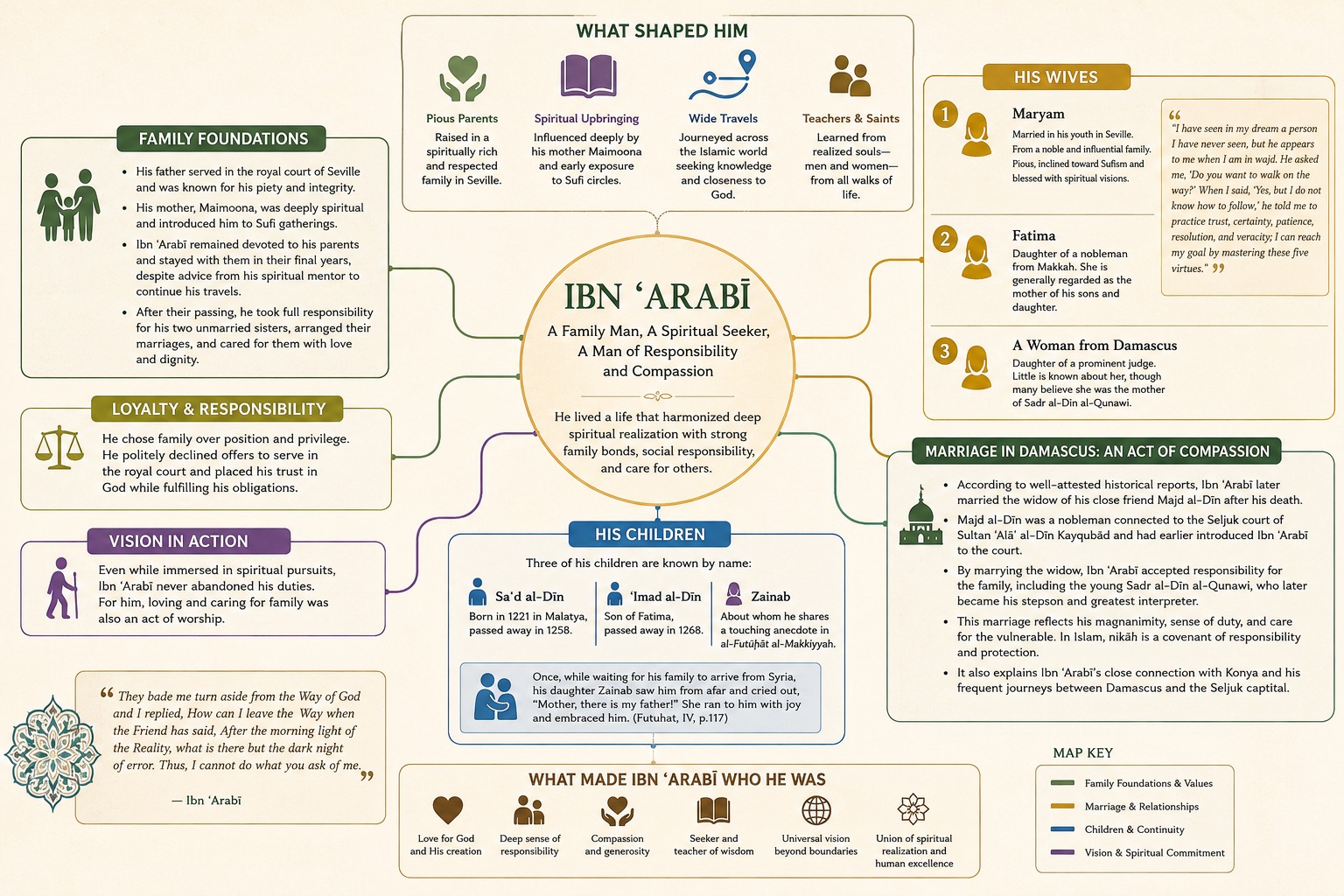
Ibn Arabī embodied this ideal throughout his life. His journeys across al-Andalus, North Africa, the Ḥijāz, Anatolia, and the Levant were not merely geographical travels but a lifelong search for knowledge and spiritual realization. He met scholars, jurists, Sufis, saints, philosophers, and ordinary believers, listening carefully and learning from a remarkable diversity of people. His confidence in Islam enabled him to engage with different perspectives without fear or hostility.
At the heart of Ibn ʿArabī’s vision lies Wahdat al-Wujūd (the Unity of Being). Since all creation ultimately derives from Allah, every aspect of existence reflects something of Divine Reality. This understanding encouraged him to recognize wisdom wherever it appeared, while remaining firmly rooted in tawḥīd. Diversity, therefore, was not a threat to unity ut one of its manifestations.
This expansive vision is beautifully expressed in his celebrated lines:
" My heart has become capable of every form: it is a pasture for gazelles and a convent for Christian monks, a temple for idols and the Kaʿbah of the pilgrim. I follow the religion of Love; whichever way Love's camels turn, that is my religion and my faith."
These verses do not suggest that every belief is identical or equally true. Rather, they express the spiritual capacity of a heart transformed by the love of Allah—a heart spacious enough to encounter others with wisdom, compassion, and humility.
Muslim Secularism – The Way Forward
Banking upon principles of Ibn Arabi’s inclusivity, following principles for Islamic Secularism may be chalked out:
Equality of All Religious Sects
In this framework, no single religious sect is elevated over others. This would be in line with the “pluralist nature” of Ibn Arabi's thought, where every path is seen as a reflection of the same divine truth. By not allowing one sect to dominate, it ensures “spiritual and religious equality”, recognizing the value of diverse interpretations of faith.
Human Values and Universal Truth
The foundation of such a society would be based on “human values” like justice, mercy, and compassion, which are universal principles. These values transcend sectarian boundaries and are meant to ensure the “welfare of all citizens”, regardless of their faith or background. The ideals of “universal truth”, rooted in the divine oneness that Ibn Arabi preached, would provide a framework where every individual's dignity and rights are respected.
Justice and Fairness
The emphasis on “justice” is key. Ibn Arabi’s metaphysical system is built on the idea of “balance and fairness” in creation. In this secular model, social, political, and legal systems would focus on being fair to all communities, treating everyone equitably and ensuring that “social justice” prevails. Such a state would focus on ensuring that every individual, regardless of “religion, race, caste, or socio-economic status”, is given their rights and is treated with fairness and dignity.
Transcendence of Sectarianism
In this vision, “sectarianism”—which historically led to division and conflict—is seen as a superficial barrier that must be overcome. By fostering a spirit of unity and understanding, the state would operate on the principle that all paths lead to the same divine source, much like Ibn Arabi’s view of different religious and spiritual traditions. This would promote “interfaith dialogue”, mutual respect, and harmony among diverse groups.
Social Justice for All Communities
The goal is to provide “social justice” that is blind to divisions of faith, race, or socio-economic status. This would involve the creation of “laws and policies” that prioritize the well-being of all citizens, ensuring equal access to resources, opportunities, and protections under the law. Such a state would embody the “ethical ideals of Islam”, while being inclusive of non-Muslims and ensuring that everyone’s rights are safeguarded.
By promoting “human values, fairness, and social justice” over sectarianism, this vision for Muslim secularism reflects the essence of what Ibn Arabi and similar thinkers might have imagined—a society where diversity is not only accepted but celebrated as a part of the divine order. This creates a space where “creativity, open-mindedness, and mutual respect” can flourish, allowing the “Muslim world” to live in harmony and prosperity, while setting a model for peace and coexistence in the global context.
May all of us make a little contribution to the peace and sanity of this world?.