Modern Scholarship
These scholars are considered foundational in modern Akbarian scholarship, having translated key works or authored definitive biographies:
1. William C. Chittick: Unpacking the Metaphysical Language
William Chittick’s monumental contribution lies in systematically unpacking Ibn ‘Arabi’s dense technical terminology and vast corpus—most notably the 37-volume Al-Futuhat al-Makkiyya (The Meccan Openings).
The Metaphysics of Imagination ('Alam al-Mithal):
Chittick demonstrated how imagination in Ibn 'Arabi’s thought is not merely a mental faculty, but an intermediate reality (a barzakh or "isthmus") connecting the invisible spiritual world to the physical sensory world.
Self-Disclosure (Tajalli)
Chittick’s work highlights how the universe is in a constant state of renewal, where God continuously discloses Himself through the cosmos.
Key Works
The Sufi Path of Knowledge: Ibn al-'Arabi's Metaphysics of Imagination (1989) and The Self-Disclosure of God (1998) serve as essential English references for Akbarian terminology.
2. Claude Addas: Historical Context & The Lived Path
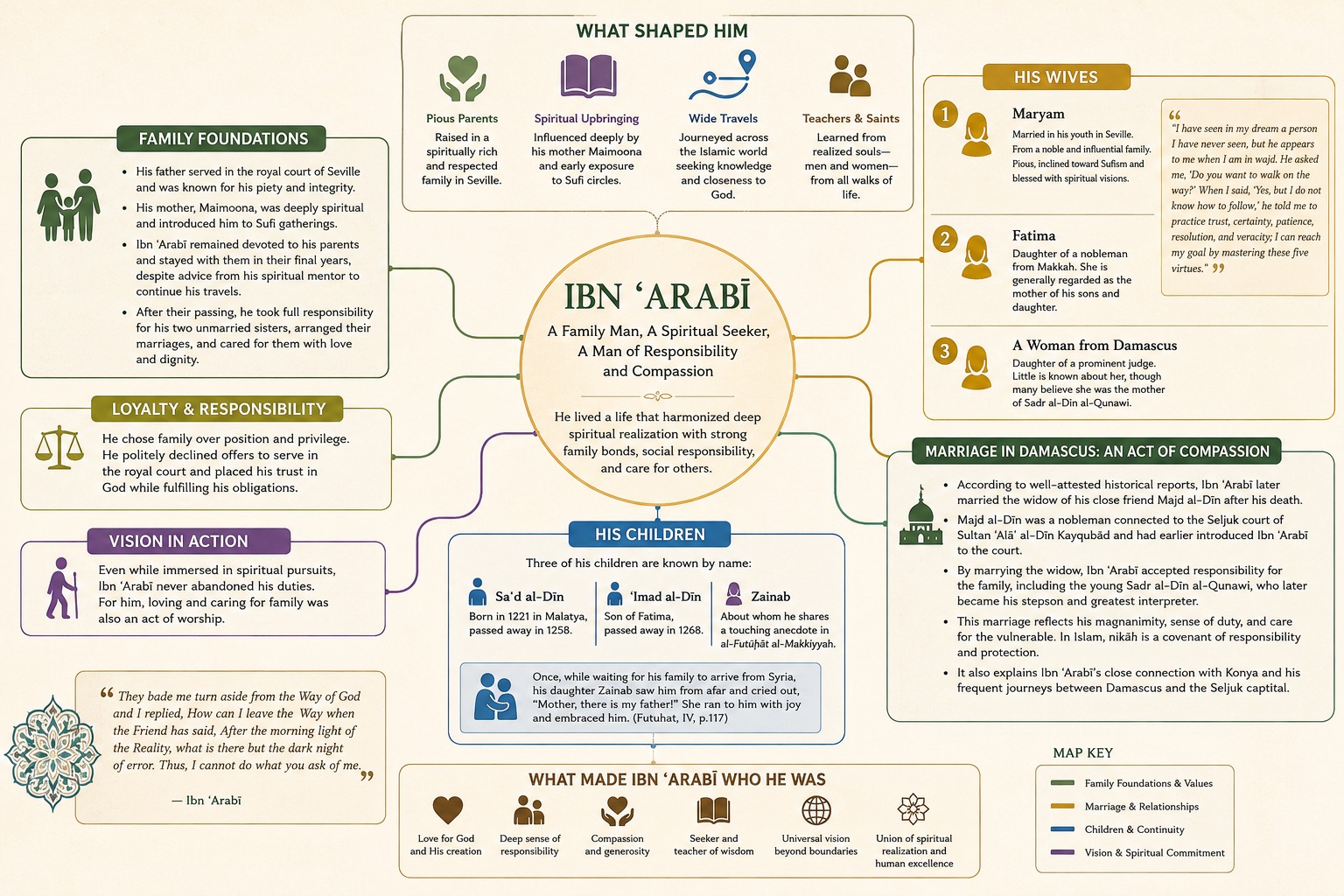
Claude Addas brought historical and biographical rigor to Akbarian studies. Before her research, Ibn ‘Arabi was often treated purely as a theoretical philosopher separated from his historical reality.
Reconstructing the Biography
Utilizing primary manuscript sources and autobiographical references embedded in the Futuhat, Addas traced Ibn 'Arabi's physical journeys from Islamic Spain (Andalusia) to North Africa and the Middle East alongside his "inner journeys".
Reconstructing the Biography
Utilizing primary manuscript sources and autobiographical references embedded in the Futuhat, Addas traced Ibn 'Arabi's physical journeys from Islamic Spain (Andalusia) to North Africa and the Middle East alongside his "inner journeys".
Key Works
Quest for the Red Sulphur: The Life of Ibn 'Arabi (1993) remains the primary biography of the master.
3. Michel Chodkiewicz: Scriptural Foundations & Legal Theory
Michel Chodkiewicz challenged the view held by some 20th-century critics that Ibn ‘Arabi was an antinomian or heterodox mystic who discarded traditional Islamic practices.
Grounding in Quran & Hadith
Chodkiewicz proved that every line of Ibn 'Arabi’s esoteric philosophy is directly rooted in exegesis of the Quran and Hadith (prophetic traditions).
Sainthood & Authority
His seminal book Seal of the Saints mapped Ibn 'Arabi's complex spiritual hierarchy—explaining the role of the "Seal of the Muhammadan Saints" (Khatm al-Walaya) in relation to universal prophethood.
Key Works
Seal of the Saints: Prophethood and Sainthood in the Doctrine of Ibn 'Arabi (1993) and An Ocean Without Shore: Ibn 'Arabi, the Book, and the Law (1993).
4. James W. Morris: Experiential Pedagogy & Interreligious Dialogue
James W. Morris emphasizes how Ibn ‘Arabi wrote not just to inform, but to transform the reader.
Rhetoric and Pedagogy
Morris explores how Ibn 'Arabi uses shifting stylistic modes—ranging from dense legal prose to poetry and visionary narrative—to disrupt habitual thinking and guide the reader toward direct spiritual realization (tahqiq).
Universal Hermeneutics
His research examines how Akbarian perspectives on the diversity of beliefs can foster interreligious understanding without erasing particular religious contexts.
Key Works
The Reflective Heart: Discovering Spiritual Intelligence in Ibn 'Arabi's "Meccan Illuminations" (2005).
4. Titus Burckhardt (1908–1984)
played a major role in bringing the Akbarian understanding of ’Ilm al-Ḥurūf (the Science of Letters or Letter Mysticism) to Western readership, framing it as a sacred cosmological science rather than mere sorcery or magic.
1. Decoding 'Ilm al-Huruf in Mystical Astrology According to Ibn 'Arabi
In his famous translation and commentary, Mystical Astrology According to Ibn ‘Arabi (Clé spirituelle de l’astrologie musulmane d’après Mohyiddin Ibn Arabi), Burckhardt analyzed Ibn ‘Arabi’s complex cosmological scheme.
He illustrated how Akbarian cosmology maps three distinct registers onto one another:
The 28 Letters of the Arabic Alphabet
(the phonetic/linguistic realm).
The 28 Mansions of the Moon
(the macrocosmic astronomical realm).
The Divine Names and Manifestation Degrees
(the ontological/metaphysical realm).
Burckhardt showed how, according to Ibn ‘Arabi, the universe is created through the “Breath of the Compassionate” (Nafas al-Rahman). Just as human breath produces sounds and letters through vocal points of articulation, the Divine Breath articulates the “letters of creation” across cosmic degrees. Before Burckhardt (and later traditionalists/scholars), ‘Ilm al-Huruf was often dismissed by Western Orientalists as low magic, numerology, or superstition. Burckhardt framed ‘Ilm al-Huruf as a metaphysical and aesthetic science:
- Letters as Cosmic Principles: Letters are non-physical prototypes or visual/auditory signs (āyāt) of reality.
- Calligraphy as Sacred Art: In his seminal work Art of Islam: Language and Meaning, Burckhardt linked letter symbolism directly to Islamic calligraphy. Arabic script became understood not just as decorative writing, but as a visual projection of divine speech into geometry.
3. An Introduction to Sufi Doctrine
In his widely influential text An Introduction to Sufi Doctrine (first published in French in 1959), Burckhardt relied heavily on Ibn ‘Arabi to explain Sufi metaphysics. He dedicated sections to explaining how linguistic elements, root letters, and symbolism key hermeneutic tools are for unlocking the inner (bāṭin) meanings of the Qur’an.
- Other Research
These researchers focus on Ibn ‘Arabi’s metaphysics, ontology (Wahdat al-Wujud), epistemology, and hermeneutic methods:
- Caner Dagli: Associate Professor at College of the Holy Cross. His work (such as Ibn ‘Arabi and the Islamic Translation of Culture) focuses on Akbarian metaphysics and philosophical theology.
- Alexander Knysh: Professor at the University of Michigan. Author of Ibn ‘Arabi in the Later Islamic Tradition, which charts how Ibn ‘Arabi’s ideas were received, debated, and defended across the centuries.
- Reza Shah-Kazemi: A prominent Islamic scholar who focuses on comparative religion, Sufism, and Akbarian philosophy (e.g., Paths to Transcendence: According to Shankara, Ibn ‘Arabi, and Meister Eckhart).
- Eric Geoffroy: French Islamic scholar and professor at the University of Strasbourg specializing in Sufism and contemporary expressions of Akbarian spirituality.
- Mahmud al-Ghurab: An independent Syrian scholar who dedicated decades to reading, compiling, and topical indexing of Ibn ‘Arabi’s original manuscripts in Arabic.
- Bakri Aladdin: A specialist in Akbarian studies and Syrian Sufism who has edited critical Arabic editions of key texts and studied later Akbarian commentators.
- Jane Clark: Co-founder of the Muhyiddin Ibn ‘Arabi Society (MIAS) research initiatives and a leader in digital archival efforts of manuscript collections.
- Ian Almond: Professor of World Literature at Georgetown University in Qatar. Author of Sufism and Deconstruction, comparing Ibn ‘Arabi with Jacques Derrida.
- Gregory A. Lipton: Author of Rethinking Ibn ‘Arabi, which critically reassesses how 20th-century Western and Perennialist interpretations framed Ibn ‘Arabi’s universalism versus his strict Islamic grounding.
- Samer Akkach: Professor at the University of Adelaide, examining the intersection of Ibn ‘Arabi’s cosmology, architecture, and spatial theory.
️ Institutional Hubs for Ongoing Research
- Muhyiddin Ibn ‘Arabi Society (MIAS): Based in Oxford and Berkeley, MIAS publishes an academic journal (Journal of the Muhyiddin Ibn ‘Arabi Society) dedicated exclusively to research on his work.
- MIAS Interdisciplinary Research Hub (IRH): A platform showcasing emerging PhD students and early-career researchers exploring intersections of Ibn ‘Arabi with modern psychology, literary studies, and environmental ethics.
Expanding on the work of these key scholars helps illustrate how they transformed modern scholarship on Ibn ‘Arabi (Shaykh al-Akbar). Each introduced distinct methodologies, moving the field away from surface-level polemics toward rigorous manuscript analysis, translation, and contextual understanding.