The Ottoman Reception of Ibn ʿArabī
Traces of the continuous journey of Ibn ʿArabī’s ideas from Seljuk Anatolia to the heart of the Ottoman Empire are found in history.
Many readers first encounter Ibn ʿArabī through popular historical dramas such as Diriliş: Ertuğrul, where he is portrayed as a spiritual guide to Ertuğrul Ghazi. Whether or not this particular relationship belongs to history or dramatic imagination, it reflects a deeper historical truth: Ibn ʿArabī was closely connected with the intellectual and spiritual world of pre-Ottoman Anatolia, and his influence became deeply embedded in the foundations of the Ottoman Empire.
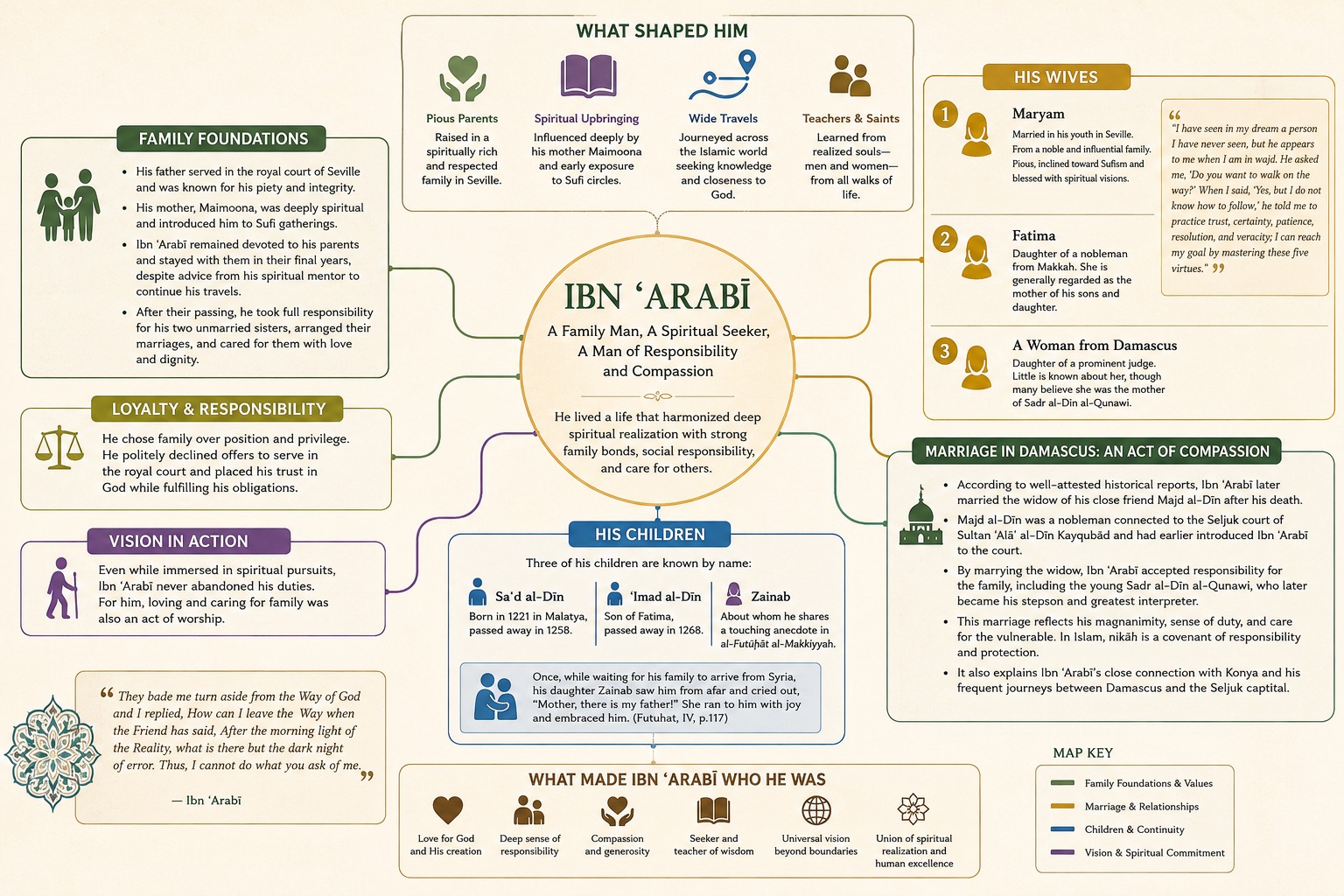
During his final years, Ibn ʿArabī travelled a lot in Anatolia under the Seljuk Sultanate, where he established enduring relationships with scholars, rulers, and spiritual leaders. His connection with Seljuq court was already established through his friend Majd al Din, and it reached new heights through his stepson, Ṣadr al-Dīn al-Qūnawī.
Ṣadr al-Dīn al-Qūnawī: Intellectual Heir and Hub of Ibn ʿArabī’s Legacy
Ṣadr al-Dīn al-Qūnawī was not only his principal interpreter and transmitter of his teachings, through al-Qūnawī, Ibn ʿArabī’s intellectual legacy took root in Konya and gradually spread throughout Anatolia. Al-Qūnawī’s zāwiyah, library, and circle of scholars became one of the most important centres of learning in the Muslim world. It was here that Ibn ʿArabī’s writings were studied, taught, and systematically explained. The Akbarian tradition that developed around this centre profoundly influenced later generations of scholars and laid the intellectual foundations upon which the early Ottoman scholarly tradition was built.
When the Ottoman state emerged in north-western Anatolia, it inherited this rich intellectual legacy. Rather than creating a new scholarly tradition from the beginning, the Ottomans adopted and expanded the institutions, libraries, endowments (awqāf), and scholarly networks that had already flourished under Seljuk patronage.
Ibn ʿArabī’s writings present an extraordinarily rich vision of reality—bringing together Qur’anic revelation, metaphysics, cosmology, spirituality, psychology, and the nature of the human being. His ideas often unfold through symbols, spiritual unveilings, commentary, and interconnected discussions rather than through a single linear philosophical system. Qūnawī helped bring greater conceptual clarity to this vast body of thought, drawing out its relationships between Al-Ḥaqq, existence, divine Names, manifestation (tajallī), knowledge, the human being, and spiritual realization.
His contribution was therefore not simply to preserve Ibn ʿArabī’s teachings but to make their underlying architecture more visible. Through his own writings, correspondence, teaching, and intellectual relationships, Qūnawī became a meeting point for the transmission of Ibn ʿArabī’s metaphysical vision. His influence extended beyond his immediate circle and helped establish the conceptual language through which later generations would read and interpret Ibn ʿArabī.
Among the earliest architects of Ottoman scholarship were Dāwūd al-Qayṣarī and Mullā Shams al-Dīn al-Fanārī, both deeply influenced by the teachings of Ibn ʿArabī through the school of Ṣadr al-Dīn al-Qūnawī.
Dāwūd al-Qayṣarī carried this inheritance into a new intellectual environment. A major commentator on the Fuṣūṣ al-Ḥikam, he developed the Qūnawī line of interpretation and helped establish Akbarian metaphysics within the emerging Ottoman scholarly world. His appointment as the first mudarris of the Ottoman madrasa at İznik was especially significant: Ibn ʿArabī’s ideas were now entering an institutional setting of formal Islamic learning. He also wrote a commentary on the Fuṣūṣ al-Ḥikam.
Molla Fanārī: Bringing Akbarian Thought into Ottoman Scholarship
Molla Fanārī (d. 834/1431) is significant because he was not simply a Sufi commentator on Ibn ʿArabī. He was a major Ottoman scholar, jurist, theologian, logician, and later Shaykh al-Islam, and he helped bring the metaphysical ideas associated with Ibn ʿArabī into the broader intellectual culture of the Ottoman state. His Miṣbāḥ al-Uns, a major work on Sufi metaphysics, is a commentary on Qūnawī’s Miftāḥ al-Ghayb. Fanārī represents a transition:
Ibn ʿArabī → Qūnawī → Dāwūd al-Qayṣarī → Molla Fanārī → Ottoman intellectual tradition
The first Ottoman madrasas, together with many of the Empire’s earliest professors, judges, and muftis, were shaped by this intellectual tradition. As a result, the Akbarian school became one of the formative influences on Ottoman religious and philosophical thought.
Ibn ʿArabī’s influence soon extended beyond the classroom into the political imagination of the Ottoman Empire. Ottoman writers increasingly portrayed him as a saint whose spiritual vision anticipated the rise of the Ottoman dynasty. One of the most famous examples appears in الشجرة, a work of Ottoman prophetic literature, which contains the well-known prediction:
"When the Sīn enters the Shīn, the tomb of Muḥyī al-Dīn will appear."
The letter Sīn was understood to represent Sultan Selim I, while Shīn referred to Shām (Damascus). After Selim conquered Damascus in 1516, Ibn ʿArabī’s long-neglected tomb was rediscovered and restored. Many regarded this event as the fulfilment of the prophecy, further strengthening the spiritual bond between the Ottoman dynasty and Ibn ʿArabī’s legacy.
With the Ottoman conquest of Syria and Egypt, however, the intellectual landscape changed significantly. The incorporation of Damascus and Cairo brought the Ottoman scholars into direct contact with long-standing theological debates surrounding Ibn ʿArabī’s writings. Questions that had occupied scholars in the Arabic-speaking heartlands for centuries now entered Ottoman scholarly discourse. His teachings continued to be widely studied and respected, but they were also subjected to closer theological scrutiny.
Despite these debates, the Akbarian tradition continued to flourish. Among its greatest Ottoman representatives was ʿAbdullāh al-Bosnawī (d. 1644), whose commentary on فصوص الحكم remains one of the masterpieces of Ottoman Akbarian scholarship. At the same time, leading Ottoman jurists continued to express profound respect for Ibn ʿArabī. A celebrated fatwā commonly attributed to Ibn Kemāl describes him as “the greatest shaykh” and advises that those unable to understand his writings should refrain from criticizing them.
By preserving his manuscripts, cultivating his intellectual tradition, and producing generations of distinguished commentators, the Ottoman Empire became the principal guardian of Ibn ʿArabī’s legacy. Through its scholars, educational institutions, Sufi orders, and manuscript culture, the Akbarian school continued to shape Islamic theology, philosophy, spirituality, literature, and political thought for centuries.
And there are several more worth mentioning later—Kutb al-Dīn al-Iznīqī, Muḥammad b. Ḥamza ʿAq Shams al-Dīn, Badr al-Dīn al-Simāwī, and much later Ismāʿīl Ḥaqqī Bursevī. The Ottoman Akbarian tradition was quite extensive; one scholarly survey identifies around thirty Ottoman Sufis who wrote on Ibn ʿArabī and his teachings.
Editor’s Note
This article has been developed primarily from Ahmed Zildžić's doctoral dissertation, Friend and Foe: The Early Ottoman Reception of Ibn ʿArabī, together with additional historical studies on the transmission of the Akbarian tradition in the Ottoman world.