External Links
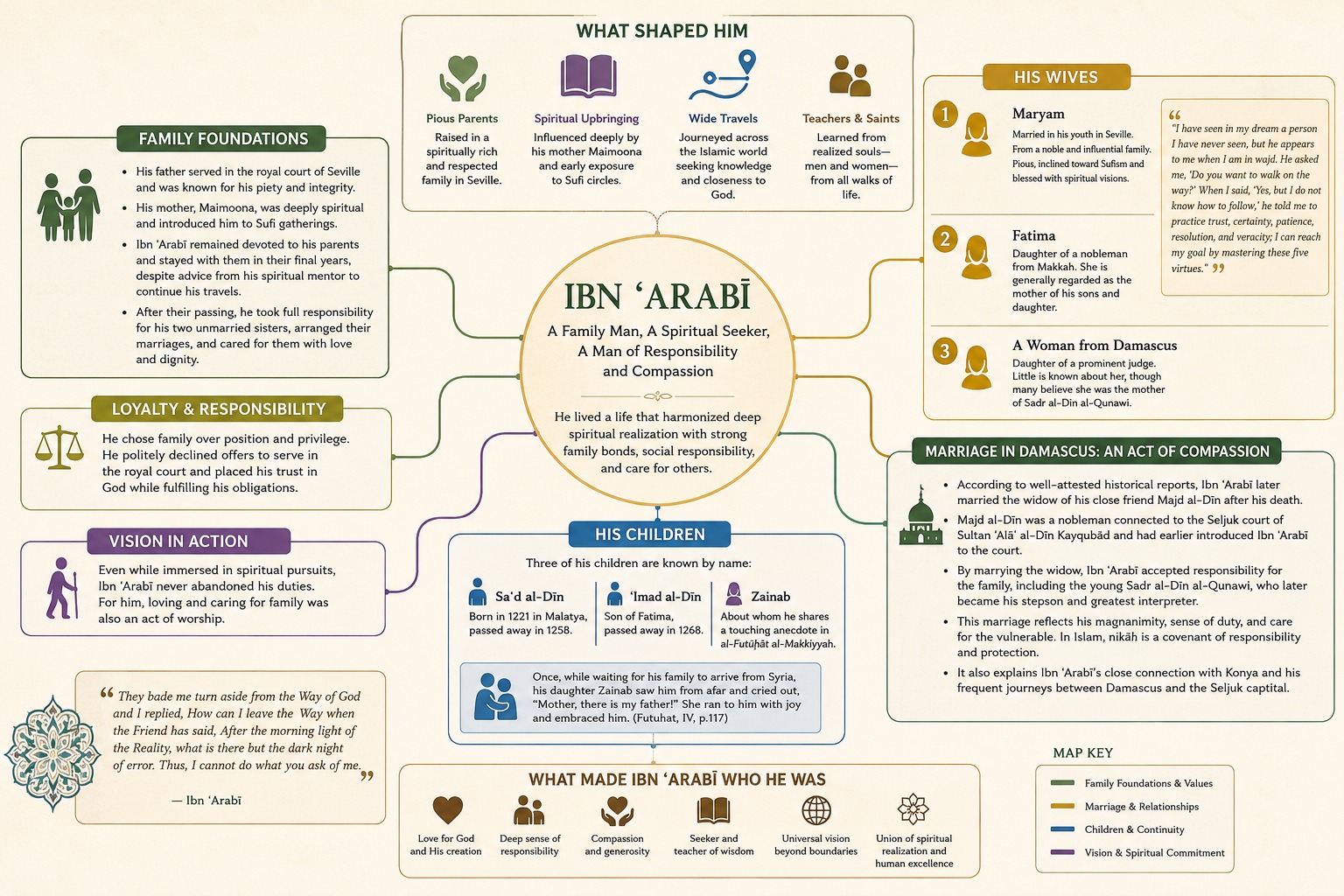
Ibn ʿArabī grew up in a respected and religious family. His father served in the royal court of Seville and was known for his piety and integrity. Although Ibn ʿArabī spent his early years in the cultured environment of the court, his spiritual temperament appears to have been shaped more deeply by his mother, Maimūna, whose devotion and association with spiritually inclined women left a lasting impression on him.
Despite his growing reputation as a mystic, Ibn ʿArabī remained devoted to his family. While performing Hajj in Makkah, he received news of his parents’ illness. Although he was engaged in advanced spiritual training, he chose to return to care for them during their final years. After his father’s death, his mother lived for another six years, and following her passing, Ibn ʿArabī assumed responsibility for his two unmarried sisters. Rather than accepting a prestigious position at the royal court, he declined respectfully, later moving with his family to Fez, where he arranged the marriages of his sisters before continuing his spiritual journey.
His commitment to the Sufi path was not always understood by those closest to him. Concerned about his responsibilities toward the family, relatives urged him to leave the life of spiritual devotion and pursue a more conventional career. One of his cousins, speaking out of genuine affection, pleaded with him to return to worldly affairs for the sake of his dependents.
In response, Ibn ʿArabī composed these impromptu verses:
They bade me turn aside from the Way of God, and I replied:
How can I leave the Way when the Friend has said,
After the morning light of Reality, what remains but the dark night of error?
Thus, I cannot do what you ask of me.
This episode illustrates the delicate balance Ibn ʿArabī sought to maintain between family responsibilities and spiritual commitment. He fulfilled his obligations toward his parents and sisters with sincerity, yet remained unwavering in his pursuit of divine knowledge. For him, worldly duties and spiritual devotion were not opposing paths, but responsibilities that had to be fulfilled with wisdom, trust in God, and steadfastness.
Marriage and Children
Like many scholars of his time, Ibn ʿArabī married more than once and regarded marriage as a natural part of religious and social life. Although details of his family life are limited, historical sources confirm the names of three wives.
Maryam
Ibn ʿArabī’s first known wife was Maryam, whom he married in his youth in Seville. She belonged to a respected family and was known for her piety and deep interest in Sufism. In Al-Futūḥāt al-Makkiyyah (The Meccan Openings), Ibn ʿArabī speaks of her with admiration and recounts one of her spiritual dreams.
Maryam told him that during a state of spiritual ecstasy she saw a mysterious figure who asked, “Do you wish to walk the spiritual path?” When she replied that she desired to do so but did not know how, she was instructed to cultivate five virtues: trust in God, certainty, patience, determination, and truthfulness. Ibn ʿArabī preserved this account as an example of sincere spiritual aspiration.
Fatimah
His second known wife was Fatimah, the daughter of a distinguished family in Makkah. She is generally regarded as the mother of Ibn ʿArabī’s children, including his two sons and his daughter, Zaynab.
His Damascus Marriage
Ibn ʿArabī married the mother of Ṣadr al-Dīn al-Qūnawī, widow of his close friend Majd al-Dīn, a nobleman with strong connections to the Seljuk court. By then, Ibn ʿArabī was about sixty-five years old, and the marriage appears to have enabled him to provide care, protection, and stability for the bereaved family, including the young Ṣadr al-Dīn al-Qūnawī, who would later carry his legacy and become foremost interpreter of Ibn Arabi’s teachings.
Majd al-Dīn had earlier introduced Ibn ʿArabī to the court of the Seljuk Sultan ʿAlāʾ al-Dīn Kayqubād. The family connection that followed also helps explain Ibn ʿArabī’s close relationship with Konya and his frequent journeys between Damascus and the Seljuk capital, where Ṣadr al-Dīn al-Qūnawī later emerged as one of the greatest transmitters of his intellectual and spiritual legacy.
His Children
Only three of Ibn ʿArabī’s children are clearly documented:
- Saʿd al-Dīn, born in Malatya in 1221.
- ʿImād al-Dīn.
- Zaynab, about whom Ibn ʿArabī records a particularly touching memory.
In Al-Futūḥāt al-Makkiyyah, Ibn ʿArabī describes waiting to receive his family as they arrived with a caravan from Syria. Before anyone else recognized him, his young daughter Zaynab spotted him from a distance and joyfully cried, “Mother, there is my father!” She ran toward him and embraced him with delight. This simple but moving episode offers one of the rare glimpses into Ibn ʿArabī’s affectionate relationship with his children and reveals the warmth that existed alongside his life of scholarship and spiritual devotion.
Reflection
Although Ibn ʿArabī is remembered primarily as a great mystic and philosopher, he also lived as a husband, father, and guardian of his family. His writings show that spiritual excellence did not require withdrawal from family life. Instead, he viewed family relationships as another arena in which faith, compassion, responsibility, and love could be expressed.
In the Islamic tradition, nikāḥ is understood as a solemn covenant that establishes mutual rights and responsibilities. It is not simply a social or physical relationship but a commitment to care, protection, and family life. Ibn ʿArabī’s marriage is therefore seen by many scholars as reflecting his generosity, sense of duty, and willingness to assume responsibility for the welfare of others.