Life & Philosophy
Fusus Al Hikam
Why study Ibn Arabi
Ibn Arabi’s Inclusive Approach
Ibn Arabi’s Philosophy
Ibn Arabi’s Teachings
Ibn Arabi’s Wisdom
Ibn Arabi’s Imaginal World
Ibn Arabi’s Quotes
Fusus al Hikam
Stories of Prophets
In the life of Ibn Arabi there were many spiritual teachers and companions. They affected his works and philosophy; he has written about his spiritual masters. Thus, his relation with women in his life shows the socially different gender roles and their acceptance in the medieval era. Ibn Arabi used feminine symbols and word throughout his work. There were many female masters with whom he engaged himself as a disciple in the spiritual path.
Fatima bint alMuthamma (Cordaba)
She was the most influential of the women in Ibn Arabi’s life. The Sufi Ibn Arabi mentions his meeting with Fatima bint al-Muthanna in chapter 178 of the Illuminations of Mecca, entitled “Treatise on Love”. Ibn Arabi relates that he put himself at his service for two years. Together, they regularly recited the first surah of the Qur’an (Al-Fatiha), and Ibn Arabi was in awe of al-Muthanna’s level of spiritual elevation.
Shams, the Mother of the Poor (Marchena)
Yasmina Umm al-Fuqara (Shams) was an eighty year old woman who lived in Marchena. she was regarded one of the Lamenting Saints. Ibn Arabi says that God has taken this kind of awliyaa for the lamenting due to the sorrow they find in their hearts in response to their lack of perfection and connection [Futuhat: II.35].
Nizam bint Makin al- Din
A Persian Sufi, Nizam bint Makin al- Din is one of the most interesting characters among the women mentioned in the writings of Ibn Arabi. Nizam appears to have had an unique ,transformative and metamorphic impact on him during his spiritual journey. She was unmarried, spoke in public, had friendships with unrelated males, didn’t wear hijab and dressed in a way in which her beauty was apparent, yet was modest, independent and self- assured. She proved to be the inspiration for Ibn Arabi’s most spiritual and elemental love poetry which is compiled in Tarjuman al ashwaq.
Moreover, Ibn Arabi’s appreciation of Sufi women was not specific to his teachers but at times he enthusiastically describes a number of his female cohorts. The text Ruh al- quds describes some remarkable personalities of his times. One of them is Qasim al Daula, an incognito slave girl whom he describes as the unique one of that time. According to the anecdote she was gifted with supernatural abilities. She was able to communicate with the trees and mountains, and had the ability to cover great distances in no time. She was arduous in self-discipline of spiritual practices, used to fast and chant verses for an unbelievable period. She earned the title of most spiritually chivalrous and pious lady of that time.
Ibn Arabi writes about a number of female students in the series of introductory short poems in his Diwan, Ibn Arabi quotes fourteen people by name to whom he had offered khirqa (Sufi cloak) as a mark of his spiritual successors. Interestingly there were thirteen women among the fourteen khirqa receivers. These personalities in his time influenced him a lot. He was engaged with women who did not observe traditional veil. They spoke in public about religious matters because it was not a taboo for a woman to be knowledgeable and outspoken. Moreover, they played the role of spiritual masters. Ibn Arabi’s engagement with such women and activities show his gender inclusive pattern. It provides us the margin to develop an alternative Islamic feminism.

Relationship with family
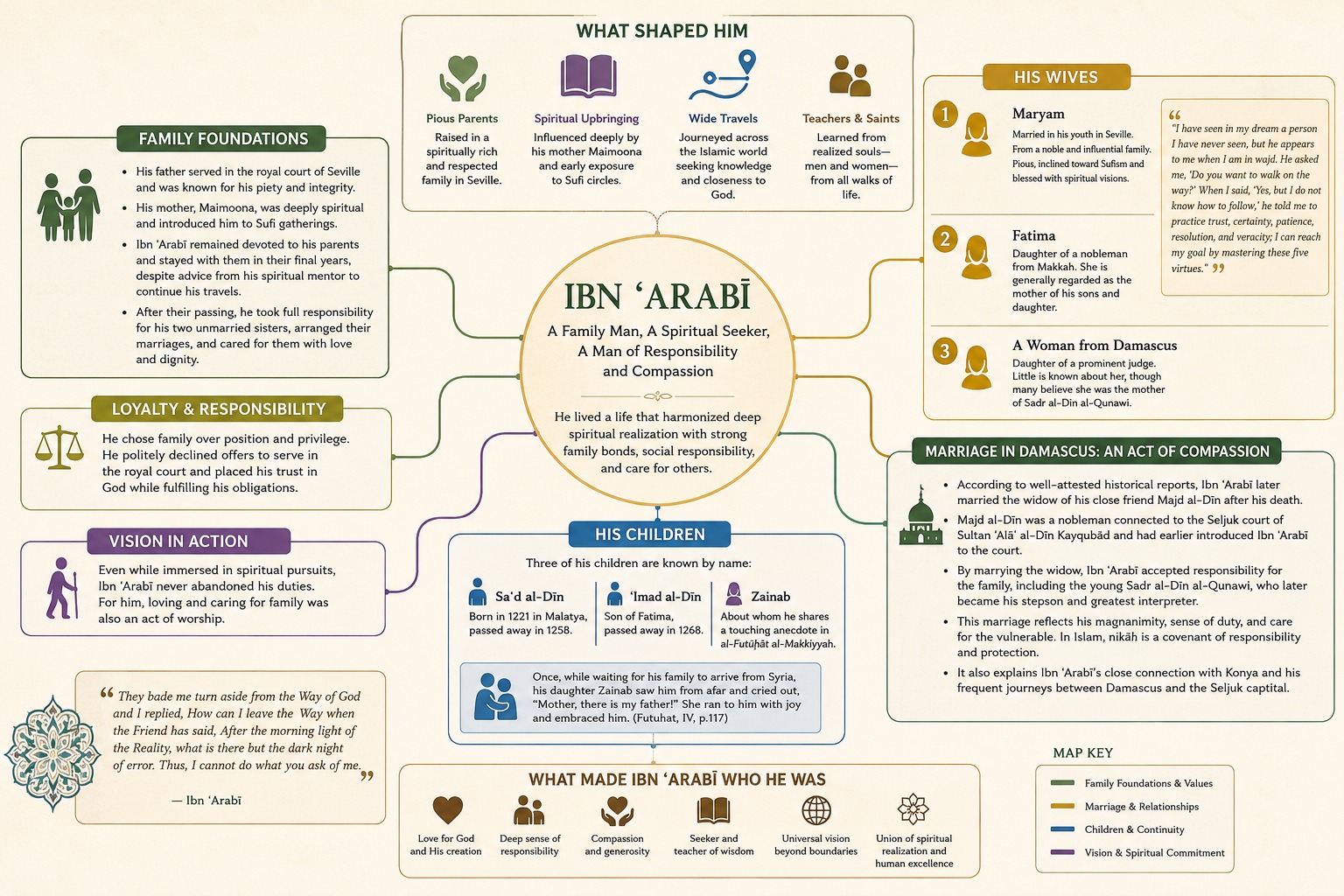
Ibn Arabi’s Father served in the Royal Court, he was very pious and well-respected person and Ibn Arabi’s childhood was spent in the Royal court of Seville. However, his bent of mind was quite sufistic like his mother Maimoona. He used to attend women Sufi gatherings with his mother in childhood. He was in Mecca for Hajj when he received the news of his parents’ illness. Though he was engaged in serious spiritual mentorship, he planned to return,
Ibn Arabi had a close relationship with his family. He respected and loved his parents and remained with them in their last days despite warning of his spiritual mentor. His mother passed away after six years of his father’s death. He took sole responsibility for his two unmarried sisters. He remained with the family in Seville but rejected politely to serve in Royal court. He moved with his family to Fez; there he married his two sisters and then continued his spiritual path.
Ibn Arabi was pressured by his family to reconsider his path. They urged him to leave the Sufi way and focus on providing for his dependents. His cousin, out of genuine concern and kindness, approached him and pleaded with him to return to the practical world for the sake of the family.
In response to this plea, Ibn Arabi composed two impromptu verses, declaring his unwavering commitment to the spiritual path:
They bade me turn aside from the Way of God and I replied, How can I leave the Way when the Friend has said, After the morning light of the Reality, what is there but the dark night of error. Thus, I cannot do what you ask of me.
This episode demonstrates Ibn Arabi’s delicate balance between his familial duties and his spiritual commitments, illustrating the tension between the material and spiritual worlds. It also highlights his steadfastness in adhering to the Sufi path, despite the pressures of family and society, underscoring the importance of spiritual grace and divine guidance in his life.
Ibn Arabi had more than one wife. following three women are confirmed to have been his wives:
- **Maryam**, whom Ibn Arabi married at a young age. She came from a noble family in Seville and is held in high esteem by Ibn Arabi. In *Futuhat al-Makkiyah*, Ibn Arabi describes her as pious, possessing a strong inclination toward Sufism, and blessed with spiritual visions. Maryam, belonged to an influential Seville family and was very interested in Sufi practices. Once, she related her dream to Ibn Arabi,
“I have seen in my dream a person I have never seen, but he appears to me when I am in wajd (spiritual ecstasy). He asked me, “Do you want to walk on the way?” When I replied, .”” Yes, I am, but I do not know how to follow.” He told me I should practice trust, certainty, patience, resolution, and veracity; I can reach my goal by mastering these five virtues.
- **Fatima**, the daughter of an unnamed Meccan nobleman. Fatima bore Ibn Arabi two sons and a daughter.
- **An unnamed woman**, the daughter of a prominent judge in Damascus. While little is known about this wife, it is speculated that she may have been the mother of Sadr al-Din al-Qunawi, the renowned disciple and stepson of Ibn Arabi.
It appears that Ibn Arabi’s first wife, Maryam, did not bear him any children. His second wife, Fatima, was likely the mother of his sons and daughter. His third wife, it is speculated, may have been the widow of his close friend Majd al-Din, who had close connections with Seljuk Sultan, and Majd al Din introduced him to the court of the Seljuk Sultan Alauddin Keykaous. Ibn Arabi assumed responsibility for Sadr al-Din al-Qunawi after Majd al-Din’s death.
Regarding his children, though he may have had more, only two sons and one daughter are explicitly documented. These are:
– **Saad al-Din**, born in 1221 in Malatya, who passed away in 1258.
– **Imad al-Din**, son of Fatima, who died in 1268.
– **Zainab**, his daughter, about whom there are a few recorded anecdotes.
In *Futuhat al-Makkiyah*, Ibn Arabi recounts an encounter with his daughter, **Zainab**. He was to receive them from a Caravan travelling from Syria. So he went with some disciples in search of them. However, his daughter spotted him from a distance and exclaimed, “Mother, there is my father!” Upon seeing him, she rushed to embrace him, laughing with joy. This touching incident is one of the few glimpses we have of Ibn Arabi’s interactions with his children, particularly with his daughter Zainab. (Fatuhat 1V, p.117)
This is valuable material. For a website, however, I’d recommend emphasizing family life rather than presenting a list of wives. The page should answer the question: What kind of husband and father was Ibn ʿArabī? The names and historical details can then support that narrative.
I would also distinguish between well-established facts and scholarly speculation. For example, the identity of Sadr al-Dīn al-Qūnawī’s mother remains uncertain, so it is better to state that carefully.
Here’s a refined version:
Marriage and Children
Like many scholars of his time, Ibn ʿArabī married more than once and regarded marriage as a natural part of religious and social life. Although details of his family life are limited, historical sources confirm the names of three wives.
Maryam
Ibn ʿArabī’s first known wife was Maryam, whom he married in his youth in Seville. She belonged to a respected family and was known for her piety and deep interest in Sufism. In Al-Futūḥāt al-Makkiyyah (The Meccan Openings), Ibn ʿArabī speaks of her with admiration and recounts one of her spiritual dreams.
Maryam told him that during a state of spiritual ecstasy she saw a mysterious figure who asked, “Do you wish to walk the spiritual path?” When she replied that she desired to do so but did not know how, she was instructed to cultivate five virtues: trust in God, certainty, patience, determination, and truthfulness. Ibn ʿArabī preserved this account as an example of sincere spiritual aspiration.
Fatimah
His second known wife was Fatimah, the daughter of a distinguished family in Makkah. She is generally regarded as the mother of Ibn ʿArabī’s children, including his two sons and his daughter, Zaynab.
His Damascus Marriage
Historical sources also mention another wife, the daughter of a prominent judge in Damascus. Very little is known about her, although some scholars have suggested that she may have been connected with the family of Ṣadr al-Dīn al-Qūnawī, Ibn ʿArabī’s celebrated disciple and later one of the foremost interpreters of his teachings. This identification, however, remains a matter of scholarly discussion.
His Children
Only three of Ibn ʿArabī’s children are clearly documented:
- Saʿd al-Dīn, born in Malatya in 1221.
- ʿImād al-Dīn.
- Zaynab, about whom Ibn ʿArabī records a particularly touching memory.
In Al-Futūḥāt al-Makkiyyah, Ibn ʿArabī describes waiting to receive his family as they arrived with a caravan from Syria. Before anyone else recognized him, his young daughter Zaynab spotted him from a distance and joyfully cried, “Mother, there is my father!” She ran toward him and embraced him with delight. This simple but moving episode offers one of the rare glimpses into Ibn ʿArabī’s affectionate relationship with his children and reveals the warmth that existed alongside his life of scholarship and spiritual devotion.
My suggestion
I would end this page with a short reflection, similar to the one we added to the previous section:
Reflection
Although Ibn ʿArabī is remembered primarily as a great mystic and philosopher, he also lived as a husband, father, and guardian of his family. His writings show that spiritual excellence did not require withdrawal from family life. Instead, he viewed family relationships as another arena in which faith, compassion, responsibility, and love could be expressed.
I think this concluding reflection is especially important because many readers imagine great mystics as detached from ordinary life. Ibn ʿArabī’s biography presents a different picture: a man who combined profound spirituality with family responsibilities, friendships, travel, teaching, and writing. That balance is one of the most inspiring aspects of his life.
I think this is actually a much stronger story than simply saying, “he married another wife.” It reveals Ibn ʿArabī’s character and explains an important historical relationship. At the same time, because there are differing scholarly views, I’d recommend presenting the interpretation as supported by some historical sources, rather than as an undisputed fact.
Here’s how I would rewrite it:
His Marriage in Damascus
Some historical sources relate that, in his later years, Ibn ʿArabī married the widow of his close friend Majd al-Dīn, a nobleman with strong connections to the Seljuk court. If this account is correct, the marriage was not merely a personal union but an act of responsibility and compassion. By then, Ibn ʿArabī was about sixty-five years old, and the marriage appears to have enabled him to provide care, protection, and stability for the bereaved family, including the young Ṣadr al-Dīn al-Qūnawī, who would later become his stepson and the foremost interpreter of his teachings.
In the Islamic tradition, nikāḥ is understood as a solemn covenant that establishes mutual rights and responsibilities. It is not simply a social or physical relationship but a commitment to care, protection, and family life. Ibn ʿArabī’s marriage is therefore seen by many scholars as reflecting his generosity, sense of duty, and willingness to assume responsibility for the welfare of others.
Majd al-Dīn had earlier introduced Ibn ʿArabī to the court of the Seljuk Sultan ʿAlāʾ al-Dīn Kayqubād. The family connection that followed also helps explain Ibn ʿArabī’s close relationship with Konya and his frequent journeys between Damascus and the Seljuk capital, where Ṣadr al-Dīn al-Qūnawī later emerged as one of the greatest transmitters of his intellectual and spiritual legacy.
I like this version because it does three things:
- It presents the marriage as an ethical act, not merely another biographical detail.
- It naturally introduces Ṣadr al-Dīn al-Qūnawī, one of the most important figures in preserving Ibn ʿArabī’s thought.
- It explains the historical connection between Ibn ʿArabī and the Seljuk court without overextending the evidence.
One small scholarly point: I would replace “Seljuki Prince” with “Seljuk nobleman” unless the source explicitly identifies Majd al-Dīn as a prince (shāhzāda). Most academic works describe him as a high-ranking official or noble connected to the Seljuk court rather than a royal prince. That wording is safer while preserving the significance of his status.