Ibn ʿArabī spent the final years of his life in Damascus, where he passed away in 1240 CE (638 AH). His earthly journey, which had begun in Murcia in al-Andalus and carried him across North Africa, the Hijaz, Anatolia, Iraq, and Syria, came to rest in one of the oldest continuously inhabited cities in the world.
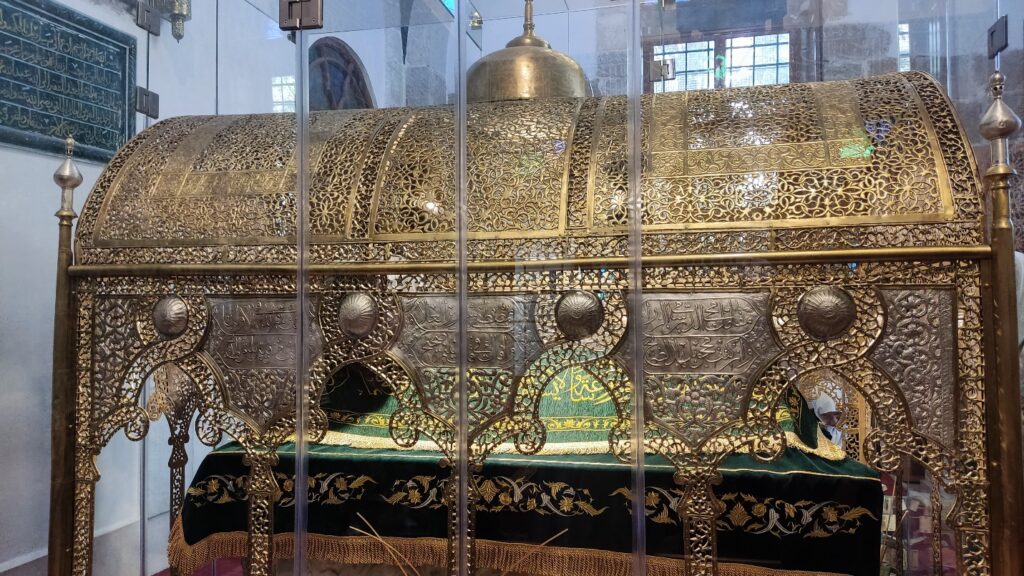
That his journey ended in Damascus invites spiritual reflection. Whether by divine providence or personal preference, his final resting place lies in one of Islam’s most revered regions. The Levant (al-Shām) has long been regarded in the Islamic tradition as a blessed land, associated with many prophets and righteous servants of Allah. It is also the land where Prophet ʿĪsā (Jesus), peace be upon him, is prophesied to descend before the Day of Resurrection. Within this sacred landscape, Ibn ʿArabī’s tomb continues to draw visitors from across the world who seek to remember one of Islam’s greatest spiritual masters.
Like the sun that disappears beneath the horizon only to illuminate another part of the world, Ibn ʿArabī’s influence has never truly set. Across centuries and continents, each generation has rediscovered his writings, finding in them new meanings and fresh illumination. His works continue to inspire scholars, seekers, poets, philosophers, and students of spirituality in every corner of the globe. Those who follow his teachings have regarded him as the “Pole of His Time” (Quṭb al-Zamān), and many within his own spiritual tradition have understood him to occupy the unique station of the Seal of Muhammadan Sainthood—a doctrine that is explored elsewhere on this website.
Like every soul, Ibn ʿArabī’s life unfolded according to the eternal knowledge and wisdom of Allah. Although his earthly journey came to an end in Damascus, the intellectual and spiritual legacy he left behind continues to live in his books and in the hearts of those who study them. Through the grace of Allah, his writings continue to illuminate minds and awaken hearts, reminding each generation that the journey toward the Real (al-Ḥaqq) never truly ends.
Before concluding, it is fitting to let Ibn ʿArabī speak in his own words. The following verses from his Dīwān employ the rich symbolic language that characterizes much of his poetry. Like many of his mystical poems, they express the soul’s intimacy with the Divine through metaphor and spiritual imagery. They should be read within the framework of his doctrine of divine self-disclosure (tajallī) and not as literal statements identifying the Creator with creation.
From the Dīwān of Ibn ʿArabī
Note: These lines are taken from book of Charles-André Gilis’s (Haj Yusuf), The Sun from the West.
The journey that began in Murcia did not truly end in Damascus. It continues wherever a reader opens the Fuṣūṣ al-Ḥikam, reflects upon the al-Futūḥāt al-Makkiyyah, contemplates the signs of Allah in creation, or remembers Him with a heart seeking the Real. Ibn ʿArabī’s resting place is in Damascus, but his enduring legacy lives wherever the search for divine knowledge, wisdom, and love continues.