Life & Philosophy
Fusus Al Hikam
External Links
When Reason Met Mystical Insight
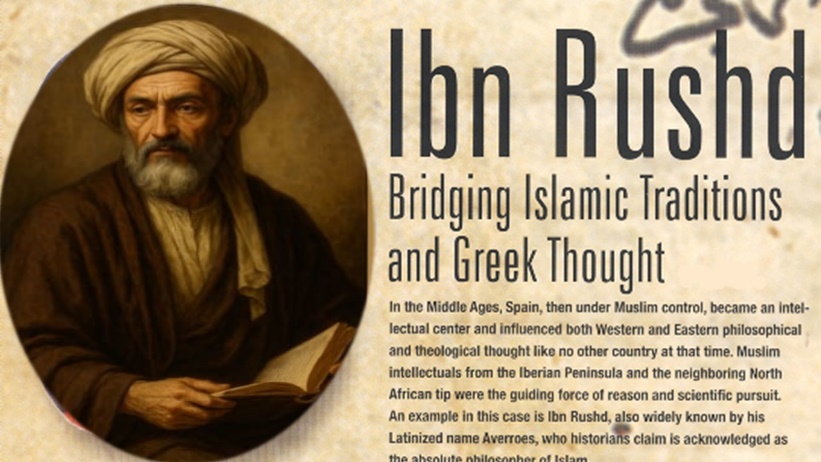
The meeting between Ibn Arabī and Ibn Rushd (Averroes) is one of the most celebrated encounters in Islamic intellectual history. It brought together two extraordinary minds: Ibn Rushd, the greatest philosopher of al-Andalus and champion of rational inquiry, and the young Ibn Arabī, whose spiritual experiences had already attracted widespread attention. Their brief conversation became a timeless dialogue between philosophy and mysticism, reason and spiritual unveiling.
1. The First Encounter: The "Yes and No" (Cordoba, ~1184 CE)
Ibn Rushd, then the Chief Justice of Cordoba and a close friend of Ibn ‘Arabi’s father, had heard rumors of a brilliant teenager who had received direct spiritual illumination (fath) without formal academic training. Curious, Ibn Rushd requested a meeting. Ibn ‘Arabi’s father sent the youth to Ibn Rushd’s home under the guise of an errand.
When the young Ibn ‘Arabi entered, the elderly philosopher embraced him warmly and asked:
Ibn Rushd: “Yes?”
Ibn ‘Arabi: “Yes.”
Ibn Rushd was delighted, realizing the youth had telepathically understood his unspoken question: Does mystical illumination yield the same truths as rational philosophy?
Seeing Ibn Rushd’s joy, Ibn ‘Arabi immediately added:
Ibn ‘Arabi: “No!”
Ibn Rushd (startled): “How?”
Ibn ‘Arabi: “Yes and no. Between the ‘yes’ and the ‘no’, spirits take flight from their matter and necks are separated from their bodies.”
The Reflection
Philosophy and mystical vision may arrive at similar theoretical conclusions about God or reality, but their mode of experience is completely different. Reason reaches a concept about truth, whereas Gnosis experiences truth directly (dhawq or “tasting”), requiring the surrender of the rational ego.
Reason and Spiritual Unveiling
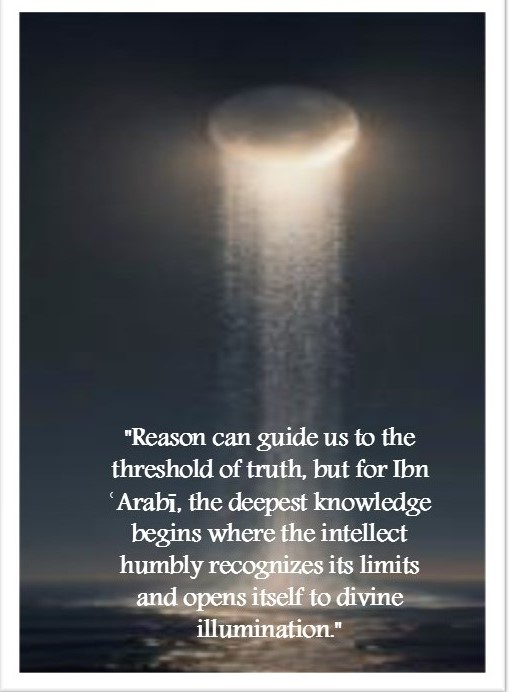
This famous exchange does not present reason and revelation as rivals. Ibn Arabi deeply respected scholarship, reflection, and intellectual inquiry. Throughout his writings, he demonstrated an extraordinary command of theology, philosophy, Qur’anic interpretation, and the Islamic sciences. However, he also believed that reason has natural limits. It can lead us toward truth, but it cannot fully comprehend the infinite reality of God without divine guidance.
For Ibn Arabi, the highest knowledge arises when disciplined reason is illuminated by revelation, spiritual purification, and divine unveiling (kashf). Intellect prepares the path; spiritual realization completes the journey.
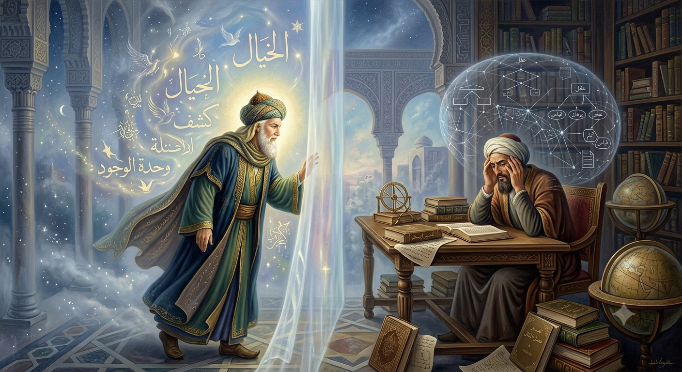
2. The Second Encounter: The Veil in Khayāl (Visionary Realm)
Later in life, Ibn ‘Arabi desired to meet Ibn Rushd again. However, this encounter occurred not in physical space, but in the intermediate world of images (‘Ālam al-Khayāl).
In this vision, Ibn ‘Arabi saw Ibn Rushd separated from him by a thin, translucent veil. While Ibn ‘Arabi could see the philosopher clearly, Ibn Rushd was so deeply immersed in his own mental thoughts and logical formulations that he was entirely unaware of Ibn ‘Arabi’s presence.
The Reflection
Ibn ‘Arabi used this visionary encounter to illustrate the ceiling of pure rationalism. Reason (‘aql) builds intricate mental models, but its very focus on conceptual categories can act as a screen, keeping the philosopher trapped inside his own mind and oblivious to the subtle, unmediated realities of the spiritual realm.
3. The Third Encounter: The Funeral and the Books (1198 CE)
Years later, Ibn Arabi witnessed another unforgettable moment connected with Ibn Rushd.
After the philosopher’s death in Marrakesh in 1198, his body was transported across the Strait of Gibraltar to Córdoba for burial. Ibn Arabi saw the funeral procession and described a scene that remained with him for the rest of his life.
Ibn Rushd’s coffin was placed on one side of a pack animal, while his books were loaded on the other side to balance the load.
Reflecting on this powerful image, Ibn Arabi wrote:
"On one side, the master; on the other, his books. Would that I knew whether his hopes had been fulfilled!"
The image is deeply symbolic. During his lifetime, Ibn Rushd devoted himself to the pursuit of knowledge. In death, his body and his books journeyed together, reminding those who watched that learning is one of humanity’s greatest legacies.
For Ibn ʿArabī, however, the scene also invited a deeper question: knowledge is valuable, but has it fulfilled its highest purpose? Has it transformed the soul and brought its seeker nearer to God? This quiet reflection transforms a funeral procession into a meditation on the ultimate purpose of knowledge itself.
Synthesis of Their Relationship
Their relationship was not one of hostility, but of profound mutual respect coupled with an epistemological boundary:
- Ibn Rushd’s Perspective: He respected the young saint immensely and thanked God that he lived in an era where he could witness someone who received direct divine knowledge without formal study. Yet, as a Aristotelian rationalist, he was deeply troubled by how to integrate direct mystical intuition into a logical framework.
- Ibn ‘Arabi’s Perspective: He regarded Ibn Rushd as the supreme master of rational reflection. However, he viewed reason as a tool with limits—it can tell you that a door exists, but only spiritual practice and divine grace can open it.
To explore this historic dialogue between the philosopher and the mystic further, watch What if They Talked? The philosopher vs Mystic.
“Khiḍr reminds us that every sincere seeker needs two teachers: one who teaches through words, and One who teaches through divine wisdom.”