

Metaphysics
The Beliefs of Ibn ʿArabī
Ibn ʿArabī’s writings cover an extraordinary range of subjects, from Qur’anic interpretation and Prophetic wisdom to metaphysics, spirituality, ethics, and cosmology. Although his ideas are often associated with the later expression Wahdat al-Wujūd (Unity of Being), Ibn ʿArabī himself consistently begins with a far more fundamental principle: the absolute Oneness of Allah (Tawḥīd). From this foundation emerges a coherent understanding of creation, prophethood, the human being, spiritual realization, and the nature of reality. The beliefs outlined below summarize the major convictions that characterize his worldview.
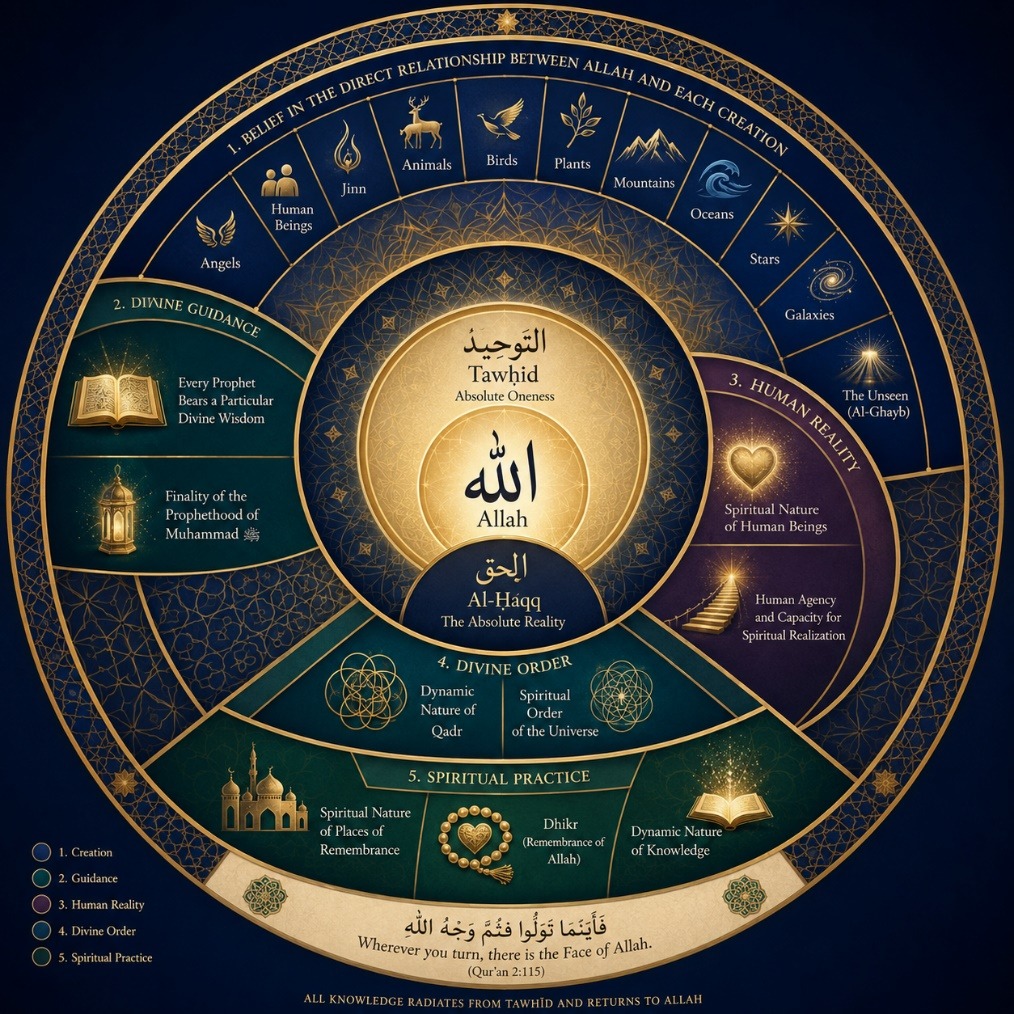
1. Belief in the Absolute Oneness of Allah (Tawḥīd)
The cornerstone of Ibn ʿArabī's thought is the absolute Oneness of Allah. Allah alone possesses independent and necessary existence, while everything else depends entirely upon Him. Nothing shares His Essence, His Lordship, or His Divinity. Every aspect of Ibn ʿArabī's spiritual vision begins with this uncompromising affirmation of Tawḥīd. Far from diminishing the distinction between the Creator and creation, his writings repeatedly reinforce it.
2. Belief in the Direct Relationship between Allah and Each Creation
Having established Tawḥīd, Ibn ʿArabī explains that every creation has a unique and direct relationship with its Creator. This relationship is not limited to humanity but extends to angels, jinn, human beings, animals, plants, the mineral world, the heavens, the stars, the galaxies, and the countless realities of the Unseen (ghayb) known only to Allah. Every creation receives its existence continuously from Allah, and nothing possesses independent existence apart from Him. Creation is therefore sustained at every moment by Allah's perpetual creative command and self-disclosure (tajallī).
3. Belief that Every Prophet was Sent with a Particular Divine Wisdom
Ibn ʿArabī viewed all the prophets as bearers of one Divine message expressed through different forms of wisdom suited to their peoples and historical circumstances. Each prophet manifested a particular aspect of Divine guidance, while together they reveal the completeness of Allah's plan for humanity. This understanding forms the foundation of his masterpiece, Fuṣūṣ al-Ḥikam (The Bezels of Wisdom).
4. Belief in the Finality of the Prophethood of Prophet Muḥammad ﷺ
Ibn ʿArabī unequivocally affirmed that Prophet Muḥammad ﷺ is the Seal of the Prophets. Revelation reached its perfection through him, and no new prophet can come after him. Although sainthood (wilāyah) and spiritual realization continue throughout history, they always remain subordinate to and within the framework of the final Prophethood of Muḥammad ﷺ.
5. Belief in the Spiritual Nature of Human Beings
Human beings are not merely physical creatures but spiritual beings entrusted with a divine purpose. Every person possesses the capacity to know Allah, purify the heart, and reflect the Divine Names according to his or her God-given potential. The journey of life is therefore a process of spiritual realization rather than simply intellectual achievement.
6. Belief in Human Agency and the Capacity to Realize Human Potential
Although Allah is the ultimate source of all existence, Ibn ʿArabī consistently affirms human responsibility. Individuals possess genuine moral agency and are accountable for their choices. Through sincere worship, knowledge, remembrance, and self-purification, they can progress toward spiritual perfection (al-insān al-kāmil). Divine grace and human effort work together in this journey.
7. Belief in the Dynamic Nature of Qadr (Divine Decree)
Ibn ʿArabī understood Divine Decree as a living reality rather than a rigid determinism. Allah's eternal knowledge encompasses all possibilities, yet prayer, repentance, intention, and sincere effort remain meaningful within His wisdom. Human freedom and Divine Decree are not opposites but complementary dimensions of Allah's all-encompassing knowledge and mercy.
8. Belief in the Spiritual Order of the Universe
The universe consists of interconnected visible and invisible realms established by Allah in perfect order. Angels, spirits, prophets, saints, and departed souls each occupy their appointed stations within this cosmic hierarchy. The unseen world is therefore neither imaginary nor detached from earthly life but forms part of Allah's comprehensive order.
9. Belief in the Spiritual Nature of Places of Remembrance
Certain places acquire spiritual significance because of the remembrance of Allah (dhikr), worship, righteous people, and Divine blessings associated with them. Ibn ʿArabī's travels repeatedly demonstrate his sensitivity to the spiritual atmosphere of particular locations, especially those connected with worship, knowledge, and the friends of Allah
10. Belief in Dhikr as the Means of Spiritual Realization
For Ibn ʿArabī, remembrance of Allah is the heart of the spiritual path. Through continual dhikr, the heart is purified, the Divine Names become manifest within the soul, and the seeker gradually acquires deeper knowledge (maʿrifah) of Allah. Spiritual realization is therefore experiential as well as intellectual.
11. Belief in the Dynamic Nature of Knowledge and Its Sources
Knowledge is a lifelong journey. Ibn ʿArabī recognizes multiple authentic sources of knowledge, including revelation, the Sunnah, reason, observation, reflection, spiritual experience, unveiling (kashf), and Divine inspiration. Yet all genuine knowledge must remain in harmony with the Qur'an and the teachings of Prophet Muḥammad ﷺ. True knowledge is not merely the accumulation of information but the transformation of the human being.
A Unifying Vision: Wahdat al-Wujūd
These beliefs lead naturally to Ibn ʿArabī’s unified vision of reality. Later scholars associated this vision with the expression Wahdat al-Wujūd (Unity of Being), although Ibn ʿArabī himself did not use this phrase as the title of a formal doctrine. His central concern was always Tawḥīd: Allah alone possesses Real Being, while every creation exists only through His continuous sustaining presence. Properly understood, this vision does not erase the distinction between the Creator and creation; rather, it deepens the believer’s awareness that all existence depends completely upon Allah. It is this profound vision that has inspired generations of scholars and mystics while also giving rise to centuries of theological debate.