
- Vision
- Metaphysics
- Tajalli 2.0
Metaphysics
About Tajallī: Suhrawardī's and Rumi's Views
Shihāb al-Dīn al-Suhrawardī (1154–1191), the founder of the Philosophy of Illumination (حكمة الإشراق), places Nūr (نور) at the centre of his metaphysical system. Like Ibn ʿArabī, he affirms that Allah is the ultimate source of all existence. However, whereas Ibn ʿArabī emphasizes Divine self-disclosure through Tajallī, Suhrawardī explains creation through the gradual unfolding of Divine Light.
The Qur'an declares: اللَّهُ نُورُ السَّمَاوَاتِ وَالْأَرْضِ "Allah is the Light of the heavens and the earth." (Qur'an 24:35)
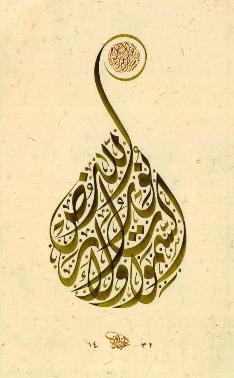
For Suhrawardī, this Divine Light is the fundamental reality from which every level of existence derives. He calls Allah Nūr al-Anwār (نور الأنوار)—the Light of Lights. From this absolute Light proceeds a hierarchy of increasingly limited lights, giving rise to the various levels of existence. The closer a being is to the Light of Lights, the more perfect and luminous its reality.
In this perspective, Tajallī is understood as the gradual illumination of creation. Divine Light does not merely create the universe; it continuously reveals and sustains it. Every created being reflects the degree of illumination it has received. Light therefore signifies knowledge, life, and reality, while darkness represents ignorance, limitation, and distance from the Divine Source.
Unlike Ibn ʿArabī, who focuses primarily on the ontological unity of existence, Suhrawardī emphasizes the hierarchical order of reality. Creation unfolds through successive degrees of illumination, with each level reflecting the Light above it while remaining distinct from its Source.
Human beings occupy a unique position within this hierarchy because they possess the capacity to ascend toward greater illumination. Through spiritual purification, contemplation, and intellectual discipline, the seeker gradually acquires deeper insight (إشراق) until Divine realities are perceived with increasing clarity. The true ʿĀrif (عارف) is one whose heart has become illuminated by the Divine Light.
Suhrawardī’s philosophy also highlights the distinction between Allah and creation. Although all existence depends upon Divine Light, created beings never become identical with Allah. The relationship is one of dependence and participation, not identity. Human beings may draw nearer to Allah through spiritual illumination, but they remain His servants.
This understanding complements Ibn ʿArabī’s doctrine of Tajallī. While Ibn ʿArabī explains how Allah continually manifests Himself throughout creation, Suhrawardī describes how that manifestation is perceived as an ordered hierarchy of light. The two perspectives therefore illuminate different dimensions of the same spiritual reality.
Summary of Suhrawardī's Understanding of Tajallī
| Aspect | Suhrawardī |
|---|---|
| Nature of Tajallī | Divine illumination flowing from the Light of Lights (نور الأنوار). |
| Ontology | A hierarchical order of lights descending from Allah to creation. |
| Perception | Reality is perceived according to the degree of Divine illumination received. |
| Goal | Spiritual purification and ascent toward greater illumination and nearness to Allah. |
Rūmī: Tajallī as Divine Love and Creative Unfolding
Jalāl al-Dīn Rūmī (1207–1273) presents Tajallī as the continual revelation of Allah’s Beauty and Love throughout creation. While accepting the essential unity of existence, Rūmī expresses this reality primarily through the language of love rather than metaphysical analysis. For him, love (عشق) is the dynamic force through which Divine Reality is revealed and experienced.
Creation is not simply an act of power or illumination; it is an expression of Divine Love. Everything originates in Allah, is sustained by His Love, and ultimately returns to Him. Every moment of existence is therefore a fresh manifestation of His Beauty and Mercy.

One of Rūmī’s most enduring symbols is that of the sun and the moth. The sun represents the inexhaustible radiance of Divine Reality, while the moth symbolizes the seeker who is irresistibly drawn toward that Light. In its longing for the Beloved, the moth willingly sacrifices itself, illustrating the Sufi ideal of فناء—the dissolution of the ego in Divine Love.
Another recurring image is that of the veils separating the seeker from Allah. These veils are not barriers created by Allah but limitations within the human self. As love deepens and the heart is purified, the veils are gradually lifted, allowing the seeker to witness ever greater degrees of Tajallī.
For Rūmī, the path to this realization is love in action. Through devotion, remembrance of Allah, poetry, music, سماع, and sincere longing, the heart becomes receptive to Divine Beauty. Every experience of genuine love becomes an opportunity to perceive another manifestation of Allah’s Presence.
Unlike Ibn ʿArabī, whose explanation of Tajallī is primarily metaphysical, or Suhrawardī, who emphasizes the hierarchy of Divine Light, Rūmī presents Tajallī as a living spiritual experience. The seeker does not merely understand Divine Reality but encounters it through love, surrender, and inward transformation.
The goal of the spiritual journey is complete absorption in Divine Love. Through فناء في العشق, the ego is dissolved, and through abiding in Allah, the seeker experiences enduring intimacy with the Beloved. In Rūmī’s vision, love is both the path and the destination, revealing the Divine Presence within every moment of existence.
Summary of Rūmī's Understanding of Tajallī
| Aspect | Rūmī |
|---|---|
| Nature of Tajallī | The continual manifestation of Divine Beauty through love. |
| Ontology | Unity of existence expressed through love and longing. |
| Perception | Divine Reality is experienced through love, devotion, and the purification of the heart. |
| Goal | Union with the Beloved through عشق, فناء, and abiding in Divine Love. |
Concluding Remarks
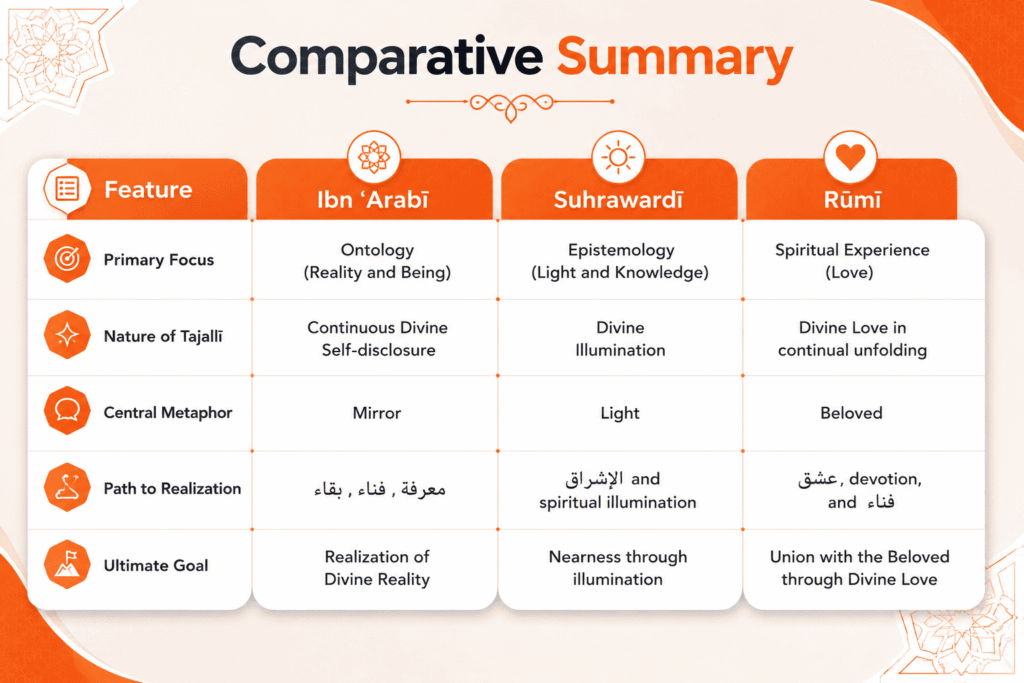
Although Ibn ʿArabī, Suhrawardī, and Rūmī all employ the concept of Tajallī (التجلّي), each approaches it from a distinct perspective while remaining firmly rooted in the Islamic doctrine of Tawḥīd.
For Ibn ʿArabī, Tajallī is primarily ontological. It explains the nature of reality itself: all existence is the continuous self-disclosure of Allah, while Allah alone possesses absolute and independent Being (الذات).
For Suhrawardī, Tajallī is primarily epistemological. It is through the illumination of Divine Light (نور) that reality is disclosed and human beings gradually acquire true knowledge of Allah.
For Rūmī, Tajallī is primarily experiential. Divine Love (عشق) removes the veils separating the seeker from the Beloved, allowing the heart to experience the continual unfolding of Divine Beauty.
These perspectives are not contradictory but complementary. Ibn ʿArabī explains what Divine manifestation is, Suhrawardī explains how it is perceived through illumination, and Rūmī explains how it is experienced through love. Together, they offer three harmonious approaches to understanding one of the central concepts of Islamic spirituality.
Comparative Summary