Metaphysics
Imagination (الخيال): The Bridge Between the Unseen and the Seen
Having explained how Allah continually manifests creation, the next question naturally arises: How do the unseen realities become visible within the created world? Ibn ʿArabī answers this through the concept of الخيال (Khayāl).
For Ibn ʿArabī, الخيال is far more than the ordinary human faculty of imagination. It is an ontological principle that bridges the spiritual and material worlds, enabling Divine realities to appear in forms that can be perceived and understood. Rather than being subjective mental activity, imagination is a fundamental mode of existence through which the unseen becomes manifest in the world of experience.
Imagination is therefore not illusion. It is the medium through which realities hidden from the senses assume symbolic and perceptible forms. Through الخيال, human beings encounter meanings that transcend ordinary reason while remaining accessible to human understanding.
This conception of imagination is closely connected with intuition, but the two are not identical. Intuition—whether experienced as الذوق (Dhawq), الكشف (Kashf), or الإلهام (Ilhām)—is the immediate reception of Divine knowledge. Imagination provides the form in which that knowledge is disclosed to human consciousness. It gives symbolic expression to truths that cannot be communicated through discursive reasoning alone.
What is Khayāl? The Realm of the In-Between
Understanding Khayāl helps to understand how Ibn ‘Arabi maps reality:
- The Realm of Pure Spirit/Intellect (‘Ālam al-Arwāḥ): Completely non-material, invisible, abstract, and light.
- The Physical/Sensory World (‘Ālam al-Shahāda): Dense, concrete, material, and tangible.
- The Intermediate Realm (‘Ālam al-Khayāl): The bridge or buffer zone between spirit and matter.
This intermediate realm is known as the World of Images or Symbols (‘Ālam al-Mithāl).
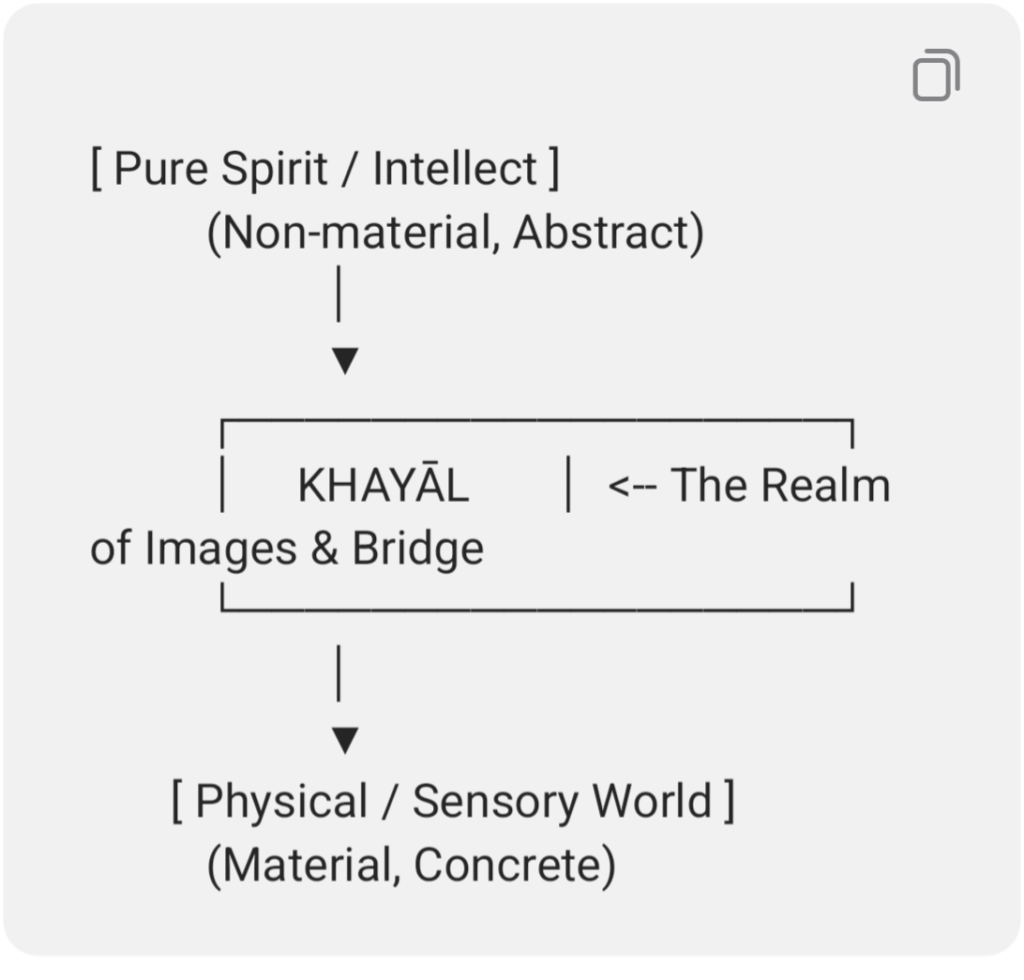
Since Ruh is neither completely physical, nor completely immaterial, it serves as a medium to receive signals from Alam al Arwah.
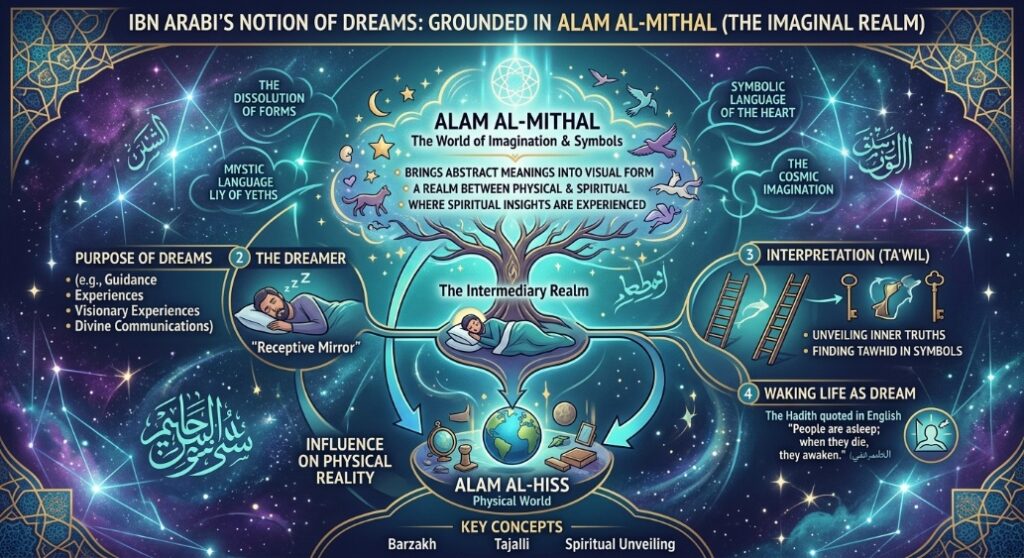
One of the most important manifestations of الخيال is the intermediate realm known as عالم المثال (ʿĀlam al-Mithāl). Here, spiritual realities assume imaginal forms without becoming material objects. It is within this realm that dreams, visions, symbolic encounters, and many spiritual experiences occur. The imaginal world is therefore neither purely physical nor merely mental. It is an intermediate mode of existence where the unseen becomes perceptible without losing its spiritual reality.
For Ibn ʿArabī, الخيال is one of the essential keys to understanding the structure of the universe. It explains how Divine realities are manifested throughout creation and how human beings can perceive meanings that lie beyond the reach of the senses and rational thought alone.
I think this chapter should be followed by a series of short sections showing the different manifestations of الخيال:
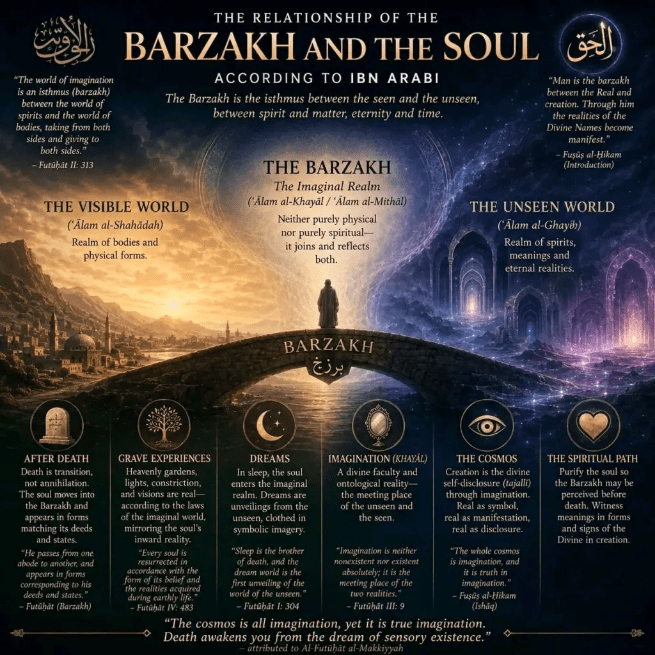
Barzakh
“The world of imagination is an isthmus (barzakh) between the world of spirits and the world of bodies, taking from both sides and giving to both sides.”
It is neither purely physical nor purely abstract. Rather, it is the realm in which meanings become clothed in forms and forms become spiritualized.
The human being stands between clay and spirit, between the world of density and the world of light. Thus man becomes a mirror between creation and the Divine.
Dreams (الرؤيا)
There is a famous saying by Hazrat Ali (RA):
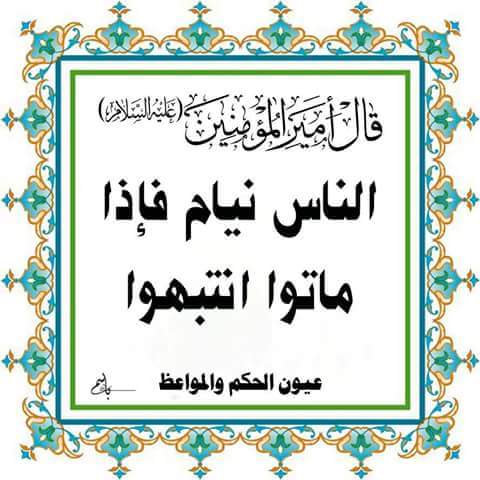
Ibn ʿArabī frequently cited this tradition to illustrate that the physical world is analogous to a dream state requiring spiritual interpretation. During dreams human beings experience an altered state of consciousness, easy to differentiate but harder to explain.
For the great Andalusian mystic Ibn ʿArabī, dreams are not mere random firings of the mind, but an ontological gateway to the World of Imagination (عالم المثال). This intermediary realm sits between the dense physical universe and the purely non-material spiritual world, functioning as a domain where abstract spiritual meanings take on visible, symbolic forms.
Qur’an says: “And he [Joseph] said, ‘O my father, this is the fulfillment of my vision of before. My Lord has made it real.'” — Surah Yusuf (12:100)
Ibn ʿArabī highlighted Prophet Joseph as the supreme master of dream interpretation, showing how symbolic visions in the imaginal realm eventually manifest in the physical world.
Through dreams, humans experience a sensory-like reality that transcends physical limitations, allowing for spiritual insights that require symbolic interpretation (taʿwīl) to unlock their true, inner meaning. Crucially, Ibn ʿArabī extended this principle beyond sleep, arguing that waking life itself is a grand, divine imagination—a dream from which humanity must spiritually awaken.
In Fatuhat he has written:
“God placed dreams in this world so that all men might witness the World of Imagination and know that there exists another world, similar to the sensory world.” — Al-Futūḥāt al-Makkīyah