Metaphysics
Creation Ex Nihilo and Ibn ʿArabī's Vision of Creation
Ibn ʿArabī held an unwavering conviction in Tawḥīd, the central belief of Islam: that Allah alone is the Creator of the universe. He has always existed, remains unchanged, and will exist forever. Allah is eternal, omnipotent, and ever-present.
This understanding raises the philosophical question of creation ex nihilo (Latin for “creation out of nothing”). The nature of creation and the relationship between Allah and the universe became one of the major ontological questions debated by Muslim philosophers and theologians. Among the most influential responses were those of Ibn Sīnā and Imām al-Ghazālī.
Ibn Sīnā’s View. Ibn Sīnā argued that because God is the eternal, perfect, and unchanging Cause, His effect—the universe—must also exist eternally with Him. Cause and effect, in his view, are simultaneous. Just as a hand moving through water causes the water to move at the very same instant, God’s eternal causality implies the eternal existence of the cosmos.
Al-Ghazālī’s Response. Al-Ghazālī rejected this analogy, arguing that it confuses a natural cause, such as fire burning cotton, with an Agent who acts through free will (فاعل مختار). A true Agent possesses choice and intention. Such an Agent may exist eternally without acting until He freely chooses to do so. Accordingly, God did not produce the universe through automatic emanation; rather, He brought it into existence by an act of Divine Will at the moment He chose.
Ibn ʿArabī’s Synthesis. Ibn ʿArabī brought these perspectives closer together by integrating them into a unified metaphysical vision rooted entirely in Tawḥīd. His understanding of creation ex nihilo explains that “nothing” (العدم) is not an empty void existing outside Allah. Before creation, all possible beings existed as immutable archetypes (الأعيان الثابتة) within Allah’s infinite knowledge.
Creation is therefore not a single historical event in which Allah produced independent external objects. Rather, through the Breath of the All-Merciful (نفس الرحمن), Allah continually manifests these latent realities into existence.
Creation “out of nothing” thus signifies that the universe has no independent existence apart from Allah. The cosmos is a perpetual process of manifestation and return, in which creation is continuously renewed (تجديد الخلق). At every instant, the world is recreated anew through the ongoing manifestation of Allah’s Names and Attributes.
Tawḥīd → Creation ex nihilo → Divine Manifestation (Tajallī) → Continuous Renewal (Tajdīd al-Khalq) → Unity of Being (وحدة الوجود).
Kindly follow the lead….!
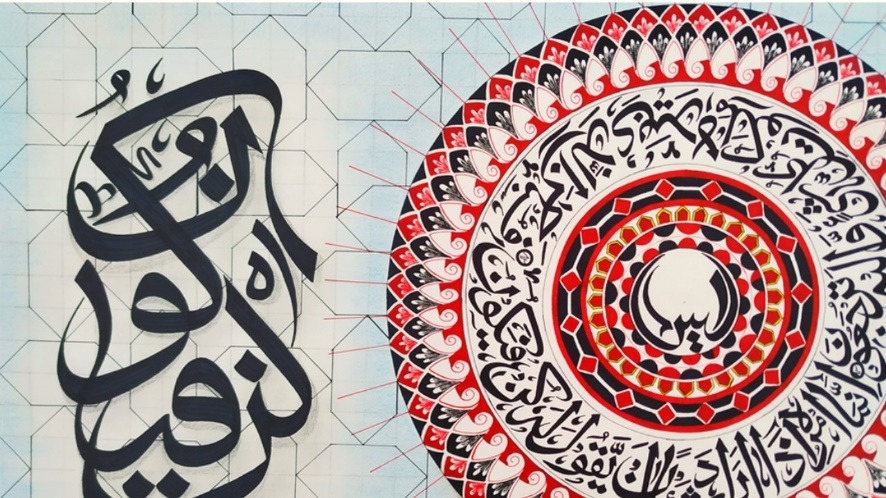
The Mystery of كُنْ ("Be")
Ibn Arabi established creation as continuous Divine manifestation, however, we also need to understand the process of creation. Ibn Arabi does not leave us perplexed and provide as with the comprehensive system of creation rooted firmly within Islamic beliefs.
- The Qur'anic command "كُنْ" as the principle of creation.
- 2. Ibn ʿArabī's esoteric interpretation of the hidden واو. This is a distinctive mystical reading and should be presented as such, rather than as the literal meaning of the Qur'anic expression.
The Qur’an repeatedly describes creation through the Divine command:
إِذَا قَضَىٰ أَمْرًا فَإِنَّمَا يَقُولُ لَهُ كُنْ فَيَكُونُ
"When He decrees a matter, He only says to it, 'Be,' and it is." (Qur'an 2:117)
For Ibn ʿArabī, كُنْ is far more than a command that brought the universe into existence at the beginning of time. It expresses the continuous relationship between Allah and creation. Every moment of existence is sustained by the ever-renewing Divine command, through which creation is continually brought forth.
Among Ibn ʿArabī’s most profound symbolic interpretations is his reflection on the word كُنْ itself. The word is written with two manifest letters, ك (Kāf) and ن (Nūn). Yet when pronounced, a hidden sound, و (Wāw), lies between them, producing Ku-n. Although this و is not written, it is indispensable to the pronunciation.
For Ibn ʿArabī, this hidden و symbolizes the unseen reality that mediates between the Divine command and the appearance of creation. It represents the mystery through which the unmanifest becomes manifest. As Salman Bashier observes, it is “the liminal entity that brings manifestation and non-manifestation together.”
In this symbolic reading, كُنْ contains both the manifest and the hidden, reflecting the entire process of creation itself. The written letters signify what appears, while the unexpressed و points to the invisible reality through which manifestation occurs.
Ibn ʿArabī associates this hidden knowledge with the wisdom granted to the saints (الأولياء). The Qur’anic encounter between الخضر and موسى illustrates that there are forms of Divine knowledge beyond ordinary prophetic legislation. When al-Khiḍr says to Mūsā, “I have knowledge that Allah has taught me which you do not know,” he points to a mode of knowing concerned with the inner realities of existence rather than revealed law.
Similarly, Shaykh ʿAbd al-Qādir al-Jīlānī is reported to have said, “We have been given what you were not given,” referring to the inner knowledge bestowed upon the friends of Allah. For Ibn ʿArabī, the hidden و in كُنْ becomes a symbol of this knowledge of the unseen—the mystery through which the Divine command unfolds into existence.
In the movement from كُنْ (“Be”) to فَيَكُونُ (“and it is”), the hidden و also symbolizes the mystery of becoming. It represents the invisible interval through which possibility is transformed into actuality—the subtle reality that connects the eternal Divine command with the continual unfolding of creation in time.