
Metaphysics
Ibn ʿArabī: Tajallī as the Self-Disclosure of Allah
For Ibn ʿArabī, Allah is the sole Actor in the universe. He alone possesses absolute power and independent agency, and nothing can influence or limit His Will. Tajallī (التجلّي) is therefore understood as Allah’s own desire to disclose Himself. No one can know Allah unless He chooses to reveal Himself, and every degree of knowledge depends upon the extent of that Divine self-disclosure.
Ibn ʿArabī describes three principal levels of Tajallī:
- The First Tajallī (التجلّي الأول): The Self-disclosure of the Divine Essence to Itself.
- The Second Tajallī: The manifestation of the Divine Names and Attributes (الأسماء والصفات).
- The Third Tajallī: The manifestation of the phenomenal world through the Divine Acts (تجلّي الأفعال).
Tajallī is thus the infinite power of Divine manifestation. Because Allah is infinite, His self-disclosure is also infinite and without limit. The entire universe exists because Allah willed to make Himself known through His manifestations. Creation is therefore not separate from Tajallī; it is its continuous expression.
Allah discloses Himself according to His Wisdom and to whomsoever He wills. Every manifestation becomes both an act of creation and an invitation to knowledge. Through Tajallī, human beings come to know both the Creator and the created order. Ibn ʿArabī therefore understands existence itself as the continuous ظهور (self-manifestation) of Allah in endlessly diverse forms.
The Qur’an describes Allah as:
اللَّهُ نُورُ السَّمَاوَاتِ وَالْأَرْضِ "Allah is the Light of the heavens and the earth." (24:35

For Ibn ʿArabī, this Divine Light is unlike any physical light experienced in the created world. It has neither form nor limitation and cannot be comprehended by the senses. As affirmed in Sūrat al-Ikhlāṣ, Allah remains absolutely unique and incomparable. Consequently, only Allah possesses true and independent Reality (الذات). Everything else derives its existence entirely from Him. This understanding forms the metaphysical foundation of وحدة الوجود.
At first glance, one might suppose that if everything proceeds from Allah, then Creator and creation must be identical. Ibn ʿArabī rejects such a conclusion. Although creation depends entirely upon Allah, it never becomes the Divine Essence. To explain this distinction, he employs the analogy of a mirror.
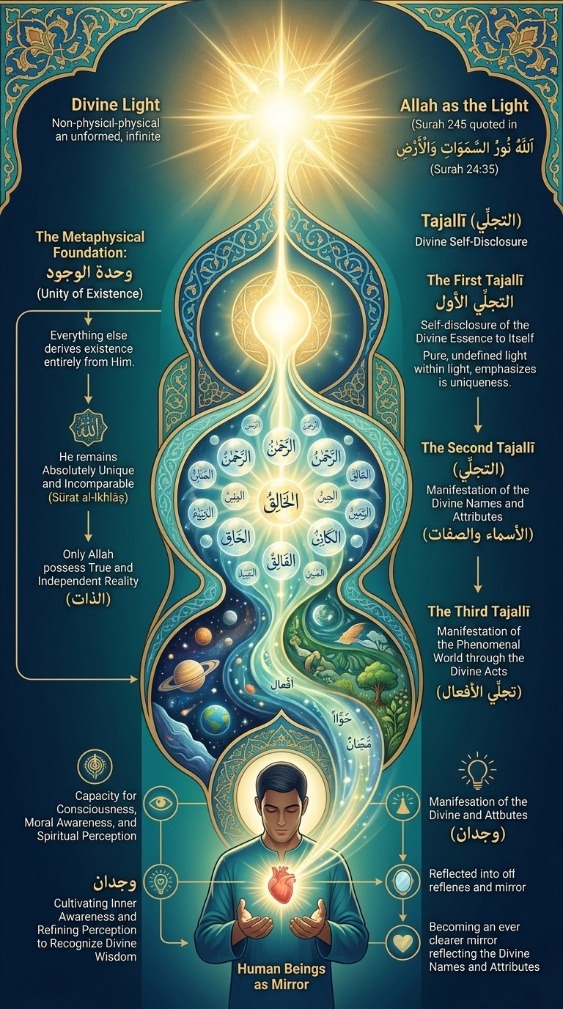
The universe is like a mirror reflecting the Divine Names and Attributes. A mirror faithfully displays an image without becoming the object it reflects. Likewise, creation reveals the signs of Allah without sharing His Essence. Through contemplating creation, human beings recognize Divine Wisdom, Mercy, Beauty, Justice, and Power, while Allah Himself always remains transcendent beyond every created form.
Human beings occupy a unique place within creation. Allah breathed into Adam from His spirit and entrusted humanity with stewardship over the earth. This Divine spirit is reflected in the human capacity for consciousness, moral awareness, and spiritual perception (وجدان). By cultivating inner awareness and refining perception, human beings gradually recognize the Divine wisdom present within themselves and throughout creation. Spiritual growth therefore consists in becoming an ever clearer mirror reflecting the Divine Names and Attributes.
This realization is not limited to qualities that people ordinarily regard as noble. Every aspect of creation ultimately serves as a locus for Divine manifestation, although human beings are called to embody those qualities that Allah Himself commands and loves.
The ultimate purpose of human life is complete surrender to Allah’s Will. The declaration لا إله إلا الله is not merely a verbal affirmation but the realization that no independent reality exists apart from Allah. This realization leads to فناء, the dissolution of the illusion of independent selfhood. In the Sufi tradition, the ego is not understood simply as self-awareness but as the false claim to an independent existence (ذات) separate from Allah. Through فناء and بقاء, the servant abandons self-centredness and lives in continual awareness of the Divine Presence.
According to Ibn ʿArabī, humanity’s greatest distinction lies in Allah’s teaching Adam the Divine Names. These Names provide the key to understanding both the Creator and creation. By contemplating each Divine Name and witnessing its reflection within creation and within oneself, the seeker gradually acquires deeper knowledge (معرفة) of Allah. As this understanding expands, the hidden realities of existence begin to unfold. This progressive unveiling is itself a manifestation of Tajallī, bestowed by Allah upon His noblest creation.
Ibn ʿArabī further teaches that Allah first created the نور محمدي (Muḥammadan Light), from which the pattern of the entire universe was derived. Understanding the reality of Prophet Muḥammad ﷺ therefore becomes the key to understanding both creation and its Creator. This doctrine is developed extensively by ʿAbd al-Karīm al-Jīlī in الإنسان الكامل.
The Divine purpose of creation reaches its fullest realization in Prophet Muḥammad ﷺ, who is the Perfect Mirror in which the Divine Names are manifested in their most complete harmony. He gathers within himself the wisdom of all previous prophets, bringing every prophetic reality to its perfection. As Ṣadr al-Dīn al-Qūnawī explains, the Prophet ﷺ encompasses the distinguishing characteristics of all the prophets who preceded him.
Aspect
Ibn ʿArabī
Nature of Tajallī
The continuous self-disclosure of Allah throughout creation.
Ontology
وحدة الوجود: Allah alone possesses absolute Reality, while creation exists through His continuous manifestation.
Perception
The universe is a mirror reflecting Divine Names and Attributes.
Goal
To realize Divine Reality through فناء, بقاء, and معرفة, culminating in the perfection exemplified by Prophet Muḥammad ﷺ.
Quick Glossary of Terms
- فناء (Fanāʾ) – The dissolution of the ego and the illusion of independent selfhood, leading to complete surrender to Allah. Resultingly the ego is purified and the illusion of independence disappears.
- بقاء (Baqāʾ) – Abiding in Allah after فناء, living in continual awareness of His Presence while fulfilling one's responsibilities in the world. The seeker lives in conscious servitude to Allah.
- معرفة (Maʿrifah) – Direct spiritual knowledge of Allah, attained through Divine grace, contemplation, and inner realization rather than through intellectual reasoning alone. The seeker comes to know Allah through His Names, Attributes, and continual تجلّي.
These ideas will be more explained in the 2nd part, Way of Ibn Arabi. The concept of tajjali is not a solo idea of Ibn Arabi; it has been propounded by Shahab ud Din Suhrawardi, and Jalal al Din Rumi as well.