- Vision
- Cosmology
- Language of Symbols
Metaphysics
Language of Symbols Alphabets and Numbers
"Our words are symbols; their meanings are found through reflection." — Ibn ʿArabī
Many readers are surprised by Ibn ʿArabī’s use of symbols. He speaks of letters, numbers, colours, dreams, mirrors, circles, light, and even individual Arabic letters as if they possess spiritual significance. These are not literary ornaments or hidden codes. They form a symbolic language through which he explains the relationship between Allah, creation, and human consciousness. For Ibn ʿArabī, the universe itself is a book written by Allah. Everything in creation is a sign (آية) pointing beyond itself to a deeper reality. To understand creation is therefore to learn how to read this Divine language.
One of the most remarkable expressions of this vision appears in Chapter 2 of the الفتوحات المكية, في معرفة الحروف (“On the Knowledge of the Letters”). Here, Ibn ʿArabī presents one of the most comprehensive cosmological theories of language in Islamic thought.
Exact quotation needed here.
He does not regard language as merely a human invention for communication. Instead, he understands the Arabic letters as the fundamental principles through which Divine meanings become manifest in creation. The universe itself is spoken into existence through the Breath of the All-Merciful (نفس الرحمن), and the letters represent the first articulations of that Divine speech.
For Ibn ʿArabī, letters are living realities with their own spiritual order. Just as human beings occupy different spiritual ranks, the letters also possess distinct functions within the Divine order. Their forms, sounds, numerical values, and places of articulation all reflect aspects of the structure of the cosmos.
Among these letters, الألف occupies a unique position as the symbol of absolute Divine Unity, while الهمزة signifies the first movement toward manifestation and الباء marks the beginning of the created world. Through these and other symbols, Ibn ʿArabī demonstrates that language is not separate from reality—it is one of the ways reality reveals itself.
Ibn ‘Arabi treats the disjoined letters (al-muqatta’at)—the mysterious letter combinations like Alif-Lam-Mim or Kaf-Ha-Ya-‘Ayn-Sad that open 29 surahs of the Quran—not as linguistic puzzles, but as the primordial codes of existence.
In Futuhat, he applies his science of letters (‘ilm al-huruf) to interpret them through three main lenses: metaphysical origins, angelology, and spiritual realization.
1. The Archetypal "NUCLEI" of the Universe
To Shaykh al-Akbar, standard Arabic words represent manifest, complex physical or conceptual entities. The disjoined letters, however, are uncompounded, simple elements (al-basā’iṭ).
Pure Potentiality: Because they stand alone without forming standard grammatical words, they represent the state of creation before it gets woven into the physical world.
Cosmic Seeds: They act as spiritual blueprints or seeds containing the spiritual DNA of the surahs—and by extension, the universe—that follow them.
2. The Great Triad: Deconstructing Alif - Lam - Mim (أ - ل - م)
One of Ibn ‘Arabi’s most famous interpretations breaks down the combination A-L-M (Alif, Lam, Mim), which opens Surah Al-Baqarah and several others. He uses the phonetic journey of the vocal breath to chart the arc of divine revelation:
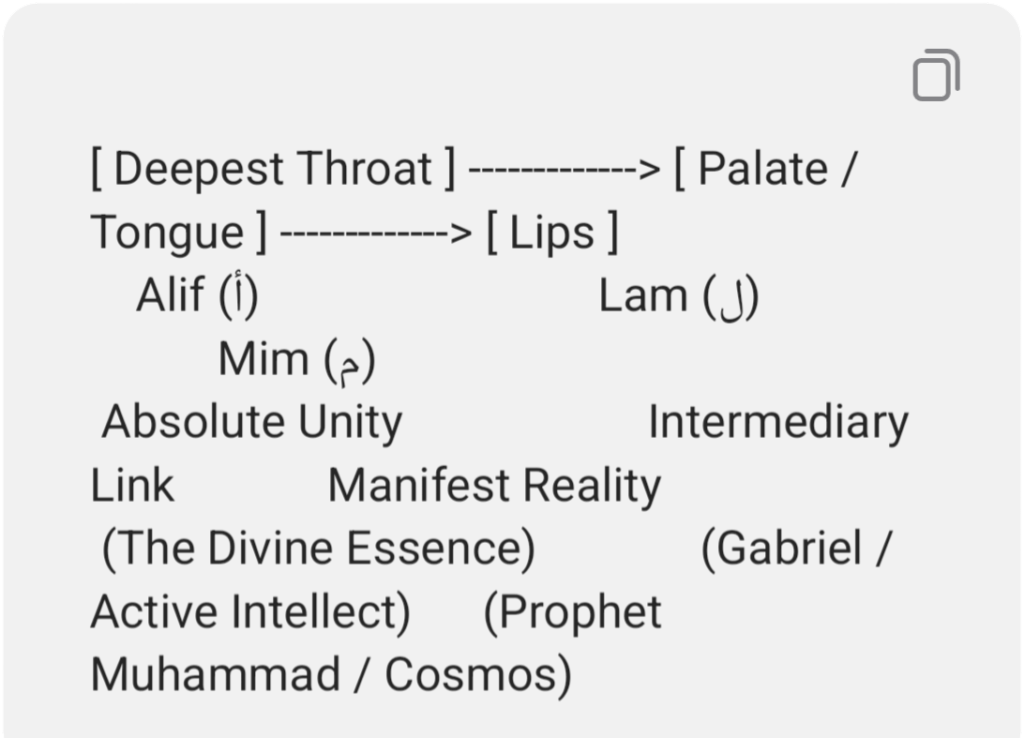
- Alif (أ): Sounds from the deepest point of the throat. It signifies the Unmanifest Divine Essence (al-Dhat), pristine and untouched by multiplicity.
- Lam (ل): Produced in the middle of the mouth, acting as an extension. It symbolizes the Intermediary Agent—the Angel Gabriel, the Logos, or the Universal Intellect that receives divine knowledge.
- Mim (م): Formed at the closure of the lips. It represents the Final Locus of Manifestation—the Perfect Human (al-Insan al-Kamil), embodied archetypally by the Prophet Muhammad, through whom revelation takes visible form.
Together, Alif-Lam-Mim spells out the entire cycle of how divine consciousness descends into creation and human awareness.
3. The 14 Unique Letters and the Spiritual Hierarchy
Out of the 28 letters in the Arabic alphabet, exactly 14 are used in the muqatta’at (half the alphabet). Ibn ‘Arabi considers this symmetry intentional:
14 Manifest / 14 Unmanifest: The 14 disjoined letters represent the spiritual, light-filled (nuraniyyah) aspect of existence, while the remaining 14 letters govern the dark or material (zulmaniyyah) aspects.
Angelic Entities: In Chapter 2, he explicitly notes that these 14 letters correspond to 14 supreme angelic spirits (arwah muhayyamah) who dwell in perpetual contemplation of the Divine, completely unaware of the physical world’s creation.
4. Keys to Spiritual Initiation (Maqamat)
Finally, Ibn ‘Arabi views these letters as direct tools for contemplation (da’wah al-huruf). Because the disjoined letters bypass conventional intellectual grammar, meditating on them bypasses the analytical mind:
“The isolated letters at the beginning of the surahs are the secret keys to the divine treasuries… None knows their true realization except those who hear with the ear of the Heart.”
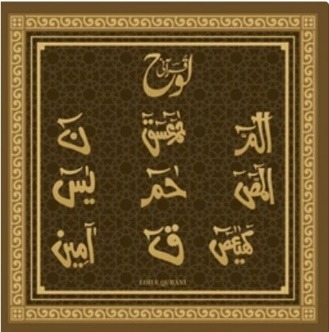
For a practitioner of his teachings, reciting Kaf-Ha-Ya-‘Ayn-Sad is not reading a sentence—it is invoking a precise combination of Divine Attributes (such as Al-Kafi [The All-Sufficient], Al-Hadi [The Guide], Al-‘Alim [The All-Knowing]) to affect the spiritual state (hal) of the seeker.
This symbolic approach extends far beyond letters. Throughout his writings, dreams, visions, colours, geometry, numbers, and sacred history all become expressions of the same underlying truth. Each symbol is a window into the unseen, helping us perceive how the One Reality is reflected throughout the many forms of creation.
Numerology
In his landmark work Al-Futuhat al-Makkiyya (“The Meccan Revelations”), he posited that creation itself is a divine discourse; the universe is composed of cosmic “words” spoken into existence by God, and numbers represent the underlying spiritual architecture of these divine manifestations. For instance, the letter Alif—shaped like a vertical line and bearing the numerical value of 1—symbolizes the Absolute Unity (Tawhid) and uncreated source of all being, while subsequent numbers represent the unfolding multiplicity of the universe. Through this numerical lens, Ibn Arabi demonstrated how sacred texts, Divine Names, and cosmic cycles share hidden metaphysical alignments, offering spiritual seekers a mathematical map to contemplate the divine order hidden beneath the surface of reality.
Even though he did not invent Abjad numerology, Ibn Arabi revolutionized it. Ibn Arabi himself viewed the science primarily as a tool for spiritual purification, divine knowledge, and understanding the Quran’s hidden architecture. In works like Al-Futūḥāt al-Makkiyya (The Meccan Revelations), he transformed what was often seen as low-level divination into a profound, unified metaphysical framework:
Ontological Building Blocks: Ibn Arabi treated letters and numbers not just as symbols for divination, but as the primordial codes of creation. In his view, God spoke the universe into existence, so letters are the “breath of the Compassionate” (Nafas al-Raḥmān) and numbers are their internal structural geometry.
Ibn Arabi’s key Contribution
Mystics like Ahmad al-Buni (d. 1225)—a contemporary of Ibn Arabi—focused heavily on the practical/theurgic side of numerology (talismanic squares, magic grids, and invoking divine names). He single-handedly elevated ʿIlm al-Ḥurūf from what was often viewed as practical magic or folk occultism into a legitimate, highly sophisticated branch of Islamic metaphysics and theology.
Cosmological Linguistics
Ibn Arabi argued that the entire universe is literally "spoken" into existence by God.
Letters as Cosmic Elements
Just as physical matter is made of physical elements, spiritual and physical reality is made of the letters of the Arabic alphabet.
Numerical Order as Divine Geometry
The numerical values of letters (Abjad) were not arbitrary human assignments to him; they represented the exact rank and spiritual weight of each sound as it emerges from the divine breath. He systematized this in Chapter 2 of Al-Futūḥāt al-Makkiyya, mapping every letter and number to specific cosmological spheres, divine attributes, and physical elements.
Page 2 Allegorical Expressions
Ibn Arabi’s symbolism reminds us that true religion is not merely a set of legal obligations but a journey of reflecting the Divine Light through knowledge, love, and righteous action. In this symbolic framework of Ibn Arabi :
Islam as the Sun
Represents the core of divine truth, illuminating and guiding the world. The sun’s light symbolizes the all-encompassing presence of Allah’s guidance”, shining on all humanity.
The Prophet as the Moon
acts as the intermediary, reflecting and transmitting this divine light to the world through his teachings, character, and example. The moon captures the reflective, compassionate role of the Prophet in guiding the Muslim community.
The 12 Schools
revolving around the Sun could represent the “12 major sources or traditions” of Islamic thought (both Sunni and Shia) orbiting around the sun (Islam), each receiving and reflecting aspects of the same divine truth and contributing to the broader understanding of Islam. These schools are part of a larger cosmic system that is interconnected, evolving, and sustained by divine wisdom.
This interpretation echoes Ibn Arabi’s belief that, while multiple paths exist within Islamic thought, they are all ultimately connected to the same divine source. Each school may have its unique perspective or interpretation, but all revolve around the central truth of Islam, guided by the prophetic example.
Ibn Arabi’s deep respect for these traditions, combined with his “cosmic vision of unity”, would indeed fit into such a model. While valuing each tradition, he would have emphasized the “divine core that unites them”, rather than rigidly adhering to one school. This idea presents a way forward to Muslim secularism, where “universal human values” and “social justice” are the bedrock of governance, transcending sectarian or ideological divisions. This vision is deeply connected to the mystical and inclusive philosophy of thinkers like Ibn Arabi, who emphasized respect for humanity and caring for human dignity as creations of the same divine reality.
Popular Analogies
To read Ibn ʿArabī, therefore, is not simply to understand his words. It is to learn a symbolic language that reveals the deeper unity underlying the visible and invisible worlds.
Excellent. Analogies are one of Ibn ʿArabī’s greatest teaching methods. He uses them not as mere illustrations but as bridges between the unseen (ghayb) and the visible world (shahādah). They enable the intellect to approach realities that cannot be grasped directly.
For your website or book, I would group the analogies into a few major categories.
| Analogy | Illustrates | Key Teaching |
|---|---|---|
| Mirror | Tajallī (Divine Self-disclosure) | The heart reflects the Divine Names according to its purity. |
| Shadow | Creation | The universe possesses no independent existence; it depends entirely upon Allah. |
| Light and Colours | Divine Names | One light appears as many colours without becoming many. |
| Ocean and Waves | Multiplicity and Unity | Waves appear separate but are never apart from the ocean. |
| Dream | The Imaginal Realm (Khayāl) | Reality resembles a dream whose true meaning lies beyond appearances. |
| Polished Heart | Spiritual Practice | Dhikr removes rust so the heart can reflect Divine Reality. |
| Eye and Vision | Perception | The eye sees forms; insight sees their Divine source. |
| Letters and Words | Creation | Individual beings resemble letters that gain meaning only within the Divine Word. |
| Circle and Centre | Tawḥīd | All existence radiates from one Centre and returns to it. |
| Breath | Creation through the Breath of the All-Merciful | Every moment existence is continually renewed by the Divine Breath. |
| Book | The Cosmos | The universe is a book whose verses reveal the signs (āyāt) of Allah. |
| Treasure | Purpose of Creation | Creation unfolds because the Hidden Treasure desired to be known. |
| Seed and Tree | Spiritual Potential | The perfected human being unfolds what was hidden within creation from the beginning. |
| Sun and Moon | Prophetic Reality | The sun symbolizes the direct source of light, while the moon reflects that light according to its capacity. |
| Journey | Spiritual Realization | The seeker journeys not towards Allah, but through ever-deeper knowledge of Him. |
Among these, a handful appear repeatedly throughout al-Futūḥāt al-Makkiyyah and Fuṣūṣ al-Ḥikam. The most important are the mirror, shadow, dream, breath, ocean, light, and the book of creation. Together they form the symbolic language of Ibn ʿArabī’s metaphysics.