
- Vision
- Way
- Alam al Mithal
ʿĀlam al Mithāl عَالَم الْمِثَال
Allah (al-Ḥaqq) → Tanzīh & Tashbīh → The Five Divine Presences → Dhikr → Tajallī → The Imaginal World → Qalb → Kashf → The Realized Person (al-Insān al-Kāmil)
فَتَمَثَّلَ لَهَا بَشَرًا سَوِيًّا
He appeared before her as a well-proportioned man. Qur’an 19:17
Between meaning and form
Tajallī explains that Allah discloses the meanings of His Names through creation. This raises another question: how can a spiritual meaning become perceptible without becoming a physical object? Ibn ʿArabī answers through ʿĀlam al-Mithāl—the Imaginal World.
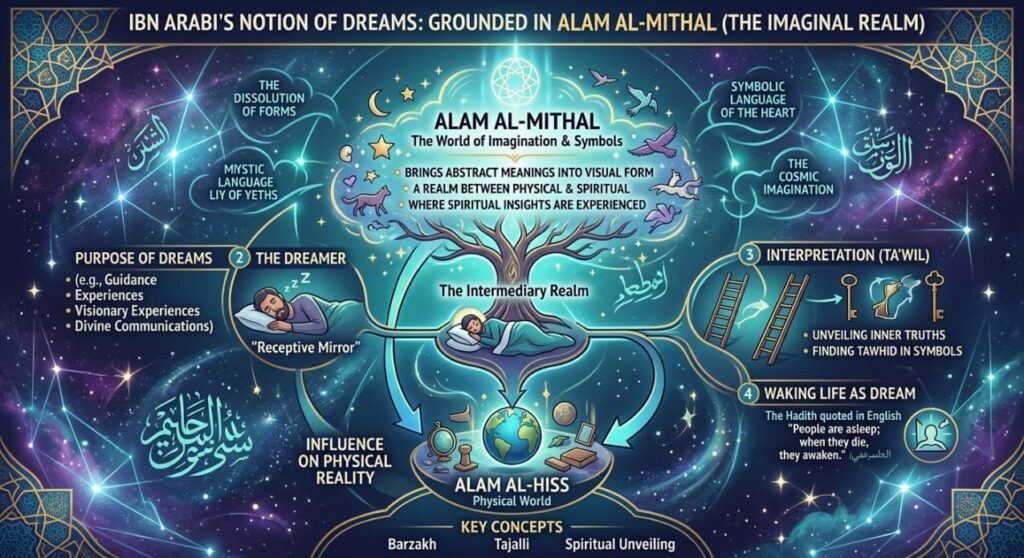
The Arabic word mithāl means an image, likeness, or form. The Imaginal World is not fantasy or make-believe. It is an intermediate dimension of creation in which unseen meanings appear through images, symbols, dreams, and visions. A meaning does not cease to be spiritual when it takes an imaginal form, just as an idea does not cease to be meaningful when expressed in words.
The imaginal realm and the faculty of imagination
It is helpful to distinguish two related meanings. The connected imagination is the faculty within a person through which images are received, remembered, or formed. The separate Imaginal World is not dependent upon one person’s private thoughts; it is an objective realm of created forms. Dreams may involve the personal imagination, while truthful dreams and authentic visions may disclose meanings through the wider imaginal realm. This distinction prevents khayāl from being confused with invention. For Ibn ʿArabī, imagination can receive as well as compose. Yet the images it presents still require discernment.
What Is the Imaginal World?
The Arabic word mithāl (مثال) means image, likeness, or symbolic form. For Ibn ʿArabī, the Imaginal World is an intermediate realm between the purely spiritual world and the physical world. It is neither material nor completely immaterial. Instead, it is a realm where spiritual meanings take symbolic forms. Just as ideas can be expressed through words, spiritual realities can be expressed through images and symbols. The Imaginal World is the realm where these symbols become meaningful. It acts as a bridge between what cannot be seen with the physical eye and what can be understood by the human heart.
The Qur'anic Foundation
The Qur'an contains many examples showing that unseen realities may be experienced through symbolic forms.
Prophet Yūsuf (Joseph)
Prophet Yūsuf (Joseph) received dreams that foretold future events, while his ability to interpret dreams became one of his greatest gifts from Allah.
Prophet Ibrāhīm (Abraham)
saw in a dream that he was sacrificing his son—a vision carrying profound spiritual meaning and a Divine test.
Jibrīl (Gabriel)
When the angel Jibrīl (Gabriel) appeared to Maryam (Mary), he came in the form of a well-proportioned human being. Likewise, Jibrīl sometimes appeared before the Prophet Muhammad ﷺ in human form to teach the Companions.

Ibn ʿArabī's Understanding
For Ibn ʿArabī, the Imaginal World is a real dimension of existence. It is where Divine meanings become symbolic forms without losing their spiritual significance. This realm connects heaven and earth, spirit and matter, meaning and image. It is where many dreams, visions, and spiritual experiences originate, although not every dream belongs to this realm. The Imaginal World teaches us that reality is richer than what can be seen by the physical eye alone. It invites us to recognize that the unseen and the visible are closely connected within Allah's creation.
A barzakh that joins and separates
Ibn ʿArabī describes this intermediate reality as a barzakh—a boundary or isthmus between two domains. A barzakh both joins and separates. The Imaginal World connects spirit and matter, meaning and image, the unseen and the visible, without reducing either side to the other. This is why imaginal forms can possess qualities that physical objects cannot. A spiritual meaning may be seen as a person, a place, a colour, or an event. The form is real as an appearance and sign, but it must not be mistaken for the full reality it conveys.

Dreams, Symbols, and Spiritual Insight
Dreams occupy an important place in Islamic tradition. The Prophet Muhammad ﷺ described truthful dreams as a part of prophethood, and the Qur'an records several dreams carrying Divine guidance. Ibn ʿArabī explains that some dreams are simply reflections of our daily thoughts and emotions, while others contain symbolic meanings that invite reflection. For this reason, not every dream should be treated as a spiritual message, nor should every symbol be interpreted literally. Wisdom, knowledge, and guidance from the Qur'an and Sunnah remain essential in understanding spiritual experiences. The purpose of dreams and symbols is not to satisfy curiosity about the unseen but to strengthen faith, deepen reflection, and draw the believer closer to Allah.
Why It Matters Today
Modern society often limits reality to what can be measured by the physical senses. Ibn ʿArabī reminds us that human experience includes imagination, symbolism, dreams, and spiritual insight—dimensions that have always been recognised within the Islamic tradition. Understanding the Imaginal World encourages us to read the Qur'an more deeply, appreciate the language of symbols, and reflect carefully upon our own experiences without falling into superstition or exaggeration. It also reminds us that Allah speaks to humanity not only through words but through signs, symbols, and the unfolding events of life.
Key Takeaways
- ʿĀlam al-Mithāl is the Imaginal World, an intermediate realm between the spiritual and physical worlds.
- It is a real dimension of creation, not a world of fantasy or illusion.
- Spiritual meanings become perceptible through symbols, dreams, and visions.
- The Qur'an provides many examples of symbolic dreams and angelic appearances.
- Not every dream is a spiritual message; discernment must always be guided by the Qur'an and Sunnah.
- The Imaginal World reminds us that reality extends beyond what the physical senses alone can perceive.
Reflective Note
Every believer lives between two worlds, the visible and the unseen. Most of the time we experience only what our physical senses reveal, yet Allah continually reminds us that reality is greater than what meets the eye. For Ibn ʿArabī, the Imaginal World is a bridge that allows the unseen to become meaningful without losing its mystery. As the heart is awakened through remembrance and becomes receptive to Allah's self-disclosure, it begins to recognize the symbolic language through which deeper truths are revealed.