
Qalb (القلب)
Allah (al-Ḥaqq) → Tanzīh & Tashbīh → The Five Divine Presences → Dhikr → Tajallī → The Imaginal World → Qalb → Kashf → The Realized Person (al-Insān al-Kāmil)
فَإِنَّهَا لَا تَعْمَى الْأَبْصَارُ وَلَٰكِن تَعْمَى الْقُلُوبُ الَّتِي فِي الصُّدُورِ
It is not the eyes that become blind, but the hearts within the breasts. Qur’an 22:46
More than emotion
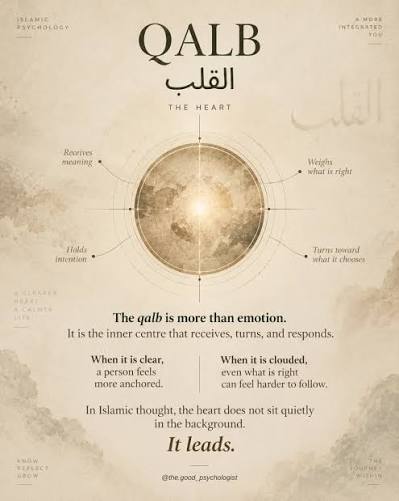
In the Qur’an and Islamic spirituality, the heart is more than the physical organ and more than the seat of emotion. It is the inward centre of the person: the place of faith, understanding, intention, remembrance, love, and moral response. A person may possess information yet fail to recognize its truth when the heart is clouded.
The Imaginal World explains how unseen meanings can appear through perceptible forms. The qalb is the inward faculty that receives, reflects, and discerns such meanings. It does not replace revelation or reason. Rather, a sound heart allows knowledge to become wisdom and guides the person toward a truthful response.
The heart that turns
The word qalb is related to turning, changing, and transformation. The heart is not static: it may turn toward Allah through faith and dhikr, or away through heedlessness, pride, and attachment. The Prophet ﷺ therefore prayed:
يَا مُقَلِّبَ الْقُلُوبِ ثَبِّتْ قَلْبِي عَلَى دِينِكَ
O Turner of the hearts, keep my heart firm upon Your religion.
For Ibn ʿArabī, this capacity to turn also enables the heart to receive ever-renewed Divine self-disclosures. Because no tajallī is simply repeated, the receptive heart must remain living, responsive, and free from confinement within a single image or assumption.
The heart as a mirror
Ibn ʿArabī frequently uses the mirror to explain spiritual perception. A mirror does not create the light or the image it reflects. It receives according to its clarity, position, and capacity. In the same way, the qalb receives Divine signs according to its preparedness, or istiʿdād. Heedlessness, self-centred desire, pride, and fixed assumptions cloud the mirror. Dhikr, repentance, worship, and sincere conduct polish it. This polishing does not produce tajallī or compel kashf; it prepares the heart to recognize and respond to what Allah discloses.
Reason and heart together
Reason and heart are not enemies. Reason analyses and distinguishes; the heart joins knowledge with love and responsibility. Spiritual understanding needs both, so that truth is carefully discerned and allowed to transform character.
A heart capable of every form
In one of his best-known poems, Ibn ʿArabī writes, ‘My heart has become capable of every form,’ and concludes, ‘I follow the religion of Love.’ Between these lines he names the pasture, monastery, temple, Kaʿbah, Torah, and Qur’an. The poem describes the receptivity of a heart enlarged by Divine love. It does not erase differences between religious forms or make every belief identical. The awakened heart recognizes signs of Allah’s wisdom and mercy across creation while remaining devoted to Allah and guided by revelation.
The states of the heart
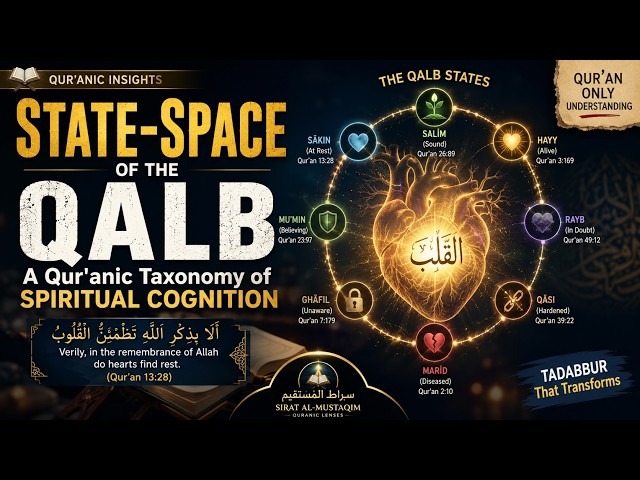
The Qur’an describes hearts in different conditions: hearts may be diseased, hardened, heedless, trembling before Allah, at rest through remembrance, or sound. These are not merely passing emotions. They describe ways of perceiving, choosing, and responding. The spiritual path is therefore a movement toward the sound heart—the qalb salīm that comes before Allah free of corruption and false attachment (Qur’an 26:88–89).
The heart at the center of the way
Dhikr turns and polishes the heart
Remembrance gathers attention and loosens heedlessness.
Tajallī is received according to capacity
The heart reflects Divine meanings without containing Allah.
Imaginal forms carry meaning
The heart must receive and interpret symbols without stopping at their outward form.
Kashf lifts a veil from perception
Unveiling clarifies the heart but does not make it infallible.
Why it matters today
Modern life develops speed, information, and outward achievement, yet the inward centre may remain scattered. Caring for the heart means allowing knowledge, worship, and experience to form wisdom, compassion, humility, and just action
Key ideas
Qalb is the inward centre of the person
It includes understanding, intention, love, faith, and moral response.
The heart is always turning
It requires remembrance, firmness, and continual renewal.
The heart is a mirror
It receives according to its clarity and preparedness.
Reason and heart are complementary
Sound perception joins discernment with spiritual receptivity.
The fruit of a sound heart is character
True receptivity appears as humility, mercy, gratitude, and responsibility.
Next: Kashf — when a veil is lifted from the heart’s perception
Reflective Note
Every spiritual journey begins with the heart. It is the place where remembrance becomes awareness, awareness becomes love, and love becomes a way of seeing the world. As the heart is purified and awakened, Allah opens it to deeper understanding. Ibn Arabi calls this opening Kashf (كشف)—spiritual unveiling. It is through kashf that the believer begins to perceive realities that were once hidden, not with the physical eye, but with the eye of the heart.
The next step in this journey is to explore Kashf (كشف)—Spiritual Unveiling—the opening of the heart to a deeper awareness of Allah's signs and guidance.