
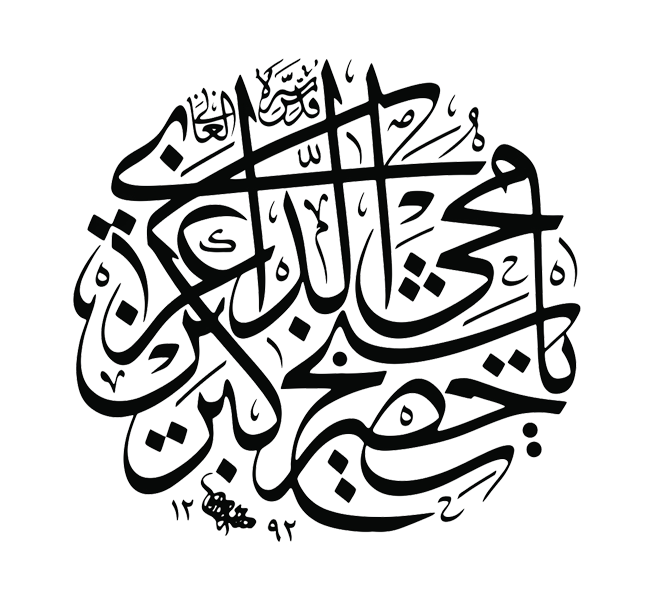
Concluding Reflection: From Al-Ḥaqq to the Realized Person
Our journey began with Al-Ḥaqq (الحق)—Allah, the Absolute Reality. From there, we explored the Unity of Being, the Divine Presences, dhikr (remembrance), tajallī (Divine Self-Disclosure), the Imaginal World, the spiritual heart (qalb), and kashf (spiritual unveiling). Each chapter revealed another dimension of Ibn ʿArabī’s vision, gradually leading us towards taḥqīq (تحقيق)—spiritual realization.
For Ibn ʿArabī, taḥqīq is much more than acquiring knowledge or understanding mystical ideas. It is the realization of truth until it transforms the whole person. As the heart awakens, one’s understanding deepens, one’s character is refined, and one’s way of seeing the world changes. This transformation leads to what may be called a unity of perception—a way of seeing beyond apparent differences to recognise the Divine wisdom that underlies all creation.
This unity of perception gives rise to a unified vision of reality. The realized person no longer sees existence as fragmented or disconnected, but as a harmonious whole sustained by Al-Ḥaqq. Diversity is no longer viewed as conflict or contradiction; rather, it is understood as one of the greatest signs of Allah’s infinite creativity and wisdom.
Human beings are wonderfully diverse. They differ in their abilities, personalities, interests, and life experiences. Some are called to become teachers, others physicians, scientists, engineers, artists, farmers, bakers, businesspeople, parents, or public servants. Their journeys are not identical, nor are they meant to be.
For Ibn ʿArabī, this diversity is not an obstacle to unity—it is its fulfilment. Every person reflects different Divine Names according to the gifts Allah has entrusted to them. Just as every organ in the human body performs a unique function while serving the life of the whole, every individual has a unique role within Allah’s greater plan. What unites humanity is not that everyone does the same work, but that every sincere vocation can become an act of worship when carried out with faith, integrity, and the intention of serving Allah and His creation.
The realized person therefore does not withdraw from the world. On the contrary, they participate in it more deeply, recognizing that every honest profession, every act of compassion, every pursuit of knowledge, and every sincere service to others has the potential to reflect the Divine Names. Unity is found not in uniformity, but in recognizing that many different paths can contribute to one Divine purpose.
Perhaps this beautifully expresses a saying cherished throughout the Sufi tradition:
من عرف نفسه فقد عرف ربه
"Whoever truly realizes the self comes to realize the Lord."
The journey begins with seeking Al-Ḥaqq, the Absolute Reality. It culminates in taḥqīq—becoming a realized person whose heart reflects Allah’s wisdom, mercy, justice, compassion, and love. Such a person sees the unity behind diversity, serves creation with humility, and discovers that the deepest knowledge of oneself is ultimately a path to knowing one’s Lord.
I hope my readers have enjoyed this spiritual ride with Ibn Arabi. I have very humbly tried to present a conceptual map of Ibn ʿArabī’s spiritual vision rather than a rigid sequence of mystical stages. It keeps its roots firmly in Tawḥīd and culminates in the transformation of the human person.