
- Vision
- Cosmology
- Language of Geometry
Metaphysics
The Language of Geometry
If symbols are Ibn ʿArabī’s vocabulary, then geometry is his grammar—the way he organizes relationships that cannot easily be expressed in ordinary prose.
Just as Ibn ʿArabī uses symbols to express spiritual realities, he also employs geometry to represent relationships that cannot easily be described through words alone. Throughout the الفتوحات المكية, he includes numerous diagrams and charts to illustrate the structure of the universe, the hierarchy of existence, and the unfolding of Divine Reality.
These figures should not be understood as scientific illustrations or artistic decorations. They are visual representations of metaphysical principles. Like his symbolic language, they invite the reader to contemplate the hidden order that underlies creation.
Among the most important are diagrams of the celestial spheres, the levels of existence, and the spiritual hierarchy of the cosmos. These diagrams portray the universe as an ordered whole, in which every level of existence reflects the wisdom and unity of Allah. Human beings are not isolated from this cosmic order but occupy a unique place within it as the meeting point between the visible and invisible worlds.
Geometry itself carries symbolic meaning in Ibn ʿArabī’s thought. The circle represents wholeness, perfection, and the all-encompassing nature of Divine Reality. Its center symbolizes the One from whom all existence proceeds, while the circumference represents the diversity of creation that remains connected to its single source. Repeating geometric patterns express harmony, balance, and the interconnectedness of all created things, reflecting the unity that permeates the multiplicity of the cosmos.
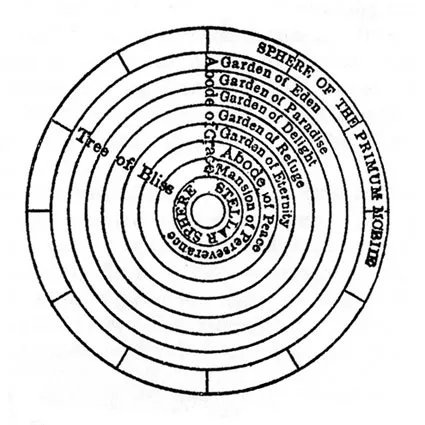
Celestial imagery also plays an important role in Ibn ʿArabī’s vision. The sun, moon, stars, and heavenly spheres are not merely astronomical objects but signs (آيات) of higher realities. They symbolize Divine Names, spiritual stations, and the ordered movement of creation under Allah’s command. Their regularity and harmony reflect the wisdom with which the universe has been fashioned.
Another recurring image is that of ascent. Whether represented through levels, circles, or symbolic ladders, these forms illustrate the spiritual journey of the human being through the مقامات toward deeper knowledge of Allah. They remind the reader that the path to realization is not a movement through physical space but an ascent in spiritual awareness.
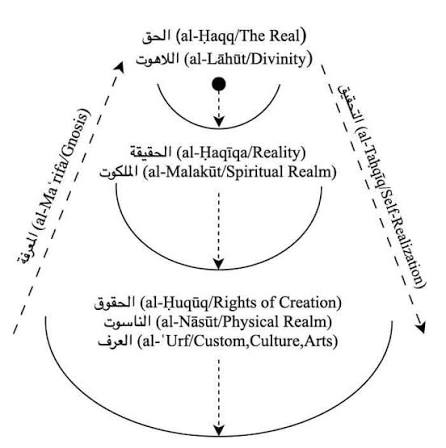
This diagram illustrates one way of representing the spiritual cosmology associated with Ibn ʿArabī. It portrays reality as a descending and ascending movement between the Absolute Reality of Allah and the world of creation. At the summit stands al-Ḥaqq (The Real), corresponding to al-Lāhūt (the Divine Realm), the level of the Absolute Being beyond all limitation and multiplicity. From this supreme Reality proceeds al-Ḥaqīqa (Reality/Truth) and al-Malakūt (the Spiritual Realm), where the Divine Names and meanings become manifest in a subtle, unseen order. Finally, these realities are reflected in al-Nāsūt (the Physical Realm), the world of human existence, creation, culture (ʿurf), and the rights and responsibilities of created beings (al-ḥuqūq). The left side of the diagram, labelled al-Maʿrifa (Gnosis), represents the seeker’s inward ascent through spiritual knowledge, while the right side, al-Taḥqīq (Self-Realization or Verification), represents the realization and embodiment of divine truth in one’s being. The arrows indicate that spiritual life is not an escape from the world but a continuous movement in which the servant ascends through knowledge of Allah and returns to creation with wisdom, justice, and compassion. In Ibn ʿArabī’s vision, the physical world is not separate from the Divine but is the final theatre in which the realities of the higher worlds are disclosed and realized.
Editor’s Note
This figure is an interpretive synthesis inspired by Ibn ʿArabī’s metaphysics rather than a diagram drawn by Ibn ʿArabī himself. It captures key themes found throughout the al-Futūḥāt al-Makkiyya and Fuṣūṣ al-Ḥikam: the hierarchy of existence, the relationship between the unseen and the seen, and the complementary paths of maʿrifa (knowing Allah) and taḥqīq (realizing that knowledge in one’s life).
For Ibn ʿArabī, geometry is therefore much more than a visual aid. It is another language through which the hidden structure of reality becomes visible. His diagrams help readers contemplate the unity, order, and harmony that pervade the cosmos, revealing creation as a coherent expression of Divine Wisdom.

This illustration presents the human being as understood in the spiritual psychology of Ibn ʿArabī and the broader Sufi tradition. At its centre lies the qalb (heart), the meeting place of the rūḥ (spirit), ʿaql (intellect), and nafs (self). The heart is the true centre of consciousness, capable of turning either upward toward Allah or downward toward the world of illusion. From above descends the Divine light from Allah, corresponding to the human fiṭrah (the innate pure nature) and the aspiration for the Ākhirah (the Hereafter). This heavenly influence nurtures the soul through the stages of the nafs al-muṭmaʾinnah (the soul at peace) and nafs al-lawwāmah (the self-reproaching soul), cultivating noble character (tahdhīb al-akhlāq) and spiritual virtues. From below rises the pull of Shayṭān, representing attachment to the Dunyā (the worldly life) and ghaflah (heedlessness), drawing the human being toward nafs al-ammārah bi-l-sūʾ (the soul commanding evil) and destructive habits. Human life is therefore a continuous struggle between these opposing attractions. For Ibn ʿArabī, this struggle is not merely moral but ontological: the heart is a barzakh (isthmus) between spirit and matter, heaven and earth, eternity and time. Through dhikr (remembrance of Allah), purification of the soul, and realization (taḥqīq), the heart becomes polished until it reflects the Divine Names without distortion. The realized person does not abandon the world but lives within it while remaining inwardly oriented toward Allah, fulfilling the purpose for which humanity was created.
Editor’s Note
Although this diagram employs concepts central to Ibn ʿArabī’s teachings, it is a modern pedagogical synthesis rather than a diagram found in his own writings. It brings together Qur’ānic concepts of the nafs, qalb, and rūḥ with Ibn ʿArabī’s vision of the human being as the locus where the Divine and created realms meet, making it a useful visual introduction to his spiritual anthropology.
Illuminated Manuscripts
Many surviving manuscripts of Ibn ʿArabī’s works contain beautifully illuminated pages, reflecting the reverence with which his writings were preserved. These artistic embellishments are not merely decorative; they create a visual setting that complements the spiritual nature of the text.
- Floral and arabesque motifs symbolize the beauty, harmony, and abundance of Divine creation, often adorning the opening pages and margins of the manuscripts.
- Illuminated headings and ornamental borders frame the text with intricate geometric and vegetal designs, emphasizing the sacred character of works such as الفتوحات المكية and فصوص الحكم. These decorations reflect the rich tradition of Islamic manuscript art and invite the reader into a contemplative engagement with the text.
The Seals of فصوص الحكم
The Seals of فصوص الحكم are symbolic designs associated with the prophets discussed in Ibn ʿArabī’s masterpiece, فصوص الحكم (The Bezels of Wisdom). In the manuscript tradition and later Sufi literature, these seals are understood as visual representations of the distinctive wisdom (حكمة) embodied by each prophet according to Ibn ʿArabī’s mystical interpretation.
Each prophet in فصوص الحكم represents a unique mode of Divine wisdom, revealing a particular aspect of Allah’s relationship with creation. The symbolic seals seek to express these spiritual realities through visual form, translating profound metaphysical concepts into patterns that invite contemplation as well as intellectual reflection.
Like Ibn ʿArabī’s symbolic language of letters, numbers, and geometry, these seals are not intended as decorative illustrations. They function as contemplative aids, encouraging the reader to perceive the deeper unity underlying prophetic wisdom and the unfolding of Divine self-disclosure throughout history.
Whether composed of geometric forms, calligraphic elements, or symbolic arrangements, the seals remind us that Ibn ʿArabī’s teachings speak through both words and images. They are another expression of his conviction that the visible world reflects invisible realities and that