
Key Concepts
Concluding Remarks
External Links
What is the Futūḥāt?
The Futūḥāt al-Makkiyya (often translated as The Meccan Openings or The Meccan Illuminations) is the monumental magnum opus of the great Andalusian Sufi scholar Shaykh al-Akbar (The Greatest Master), Ibn ‘Arabī (1165–1240 CE). Spanning 560 chapters, it is one of the most comprehensive works on Islamic spirituality, metaphysics, theology, and law ever written.
Why is it called "Openings"?
In Sufi terminology, a fatḥ (“opening”) refers to spiritual wisdom granted directly to the heart by Divine grace, rather than knowledge acquired solely through study or logical deduction. Ibn ‘Arabī wrote that these insights were given to him while residing in the holy city of Makkah near the Ka’bah. He stayed long after Hajj in Makkah, approximately three years. He took many solitary retreats, joined discussions with various Sufis, especially, disciples of Hazrat Abdul Qadir Jillani. Ibn Arabi has professed in the chapter one of Ftuhat al Makkiya, that this book dawned upon him as a divine gift.
The Structure of the Futūḥāt
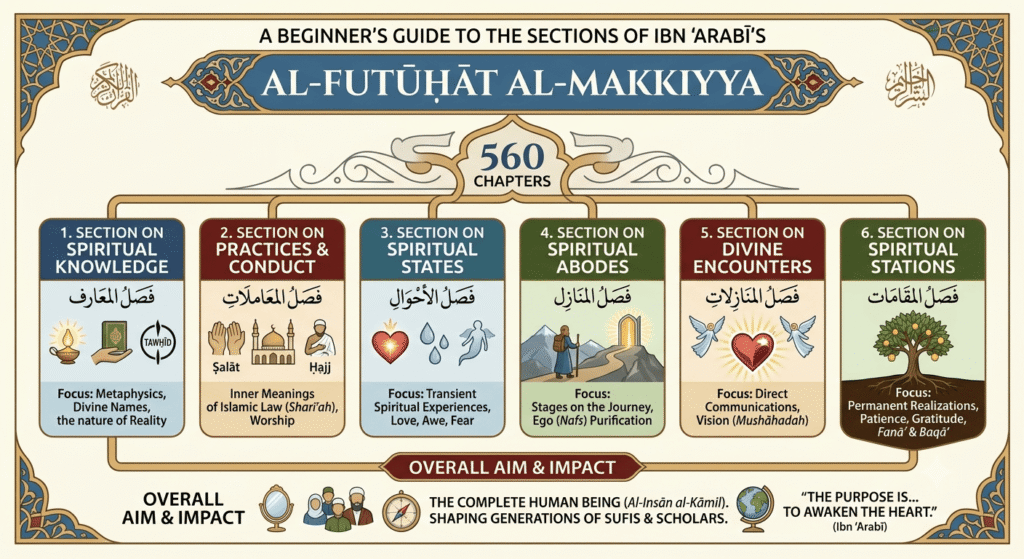
Following is the Section Breakdown Summary
- Section 1: Divine Knowledge (Faṣl al-Ma'ārif)
- What it covers: The foundational concepts of Islamic metaphysics, cosmology, and theology.
- Key Topics: The nature of God (Tawḥīd), the symbolic secrets of Arabic letters, the spiritual creation of the cosmos, angels, and the origin of human nature.
- Section 2: Spiritual Practice (Faṣl al-Mu'āmalāt)
- What it covers: The practical dimension of religion, blending outward jurisprudence (fiqh) with inner spirituality.
- Key Topics: The spiritual secrets behind religious duties—such as purification, prayer, fasting, charity, and the Hajj pilgrimage.
- Section 3: Spiritual States (Faṣl al-Aḥwāl)
- What it covers: Transient spiritual experiences granted to a seeker along the way.
- Key Topics: Understanding feelings like spiritual longing (shawq), awe (haybah), hope (rajā'), fear (khawf), and ecstasy.
- Section 4: Spiritual Abodes (Faṣl al-Manāzil)
- What it covers: The progressive spiritual stages a soul passes through during its journey toward Divine presence.
- Key Topics: The heart’s purification, night journeys of the soul, and overcoming the illusions of the ego (nafs).
- Section 5: Divine Encounters (Faṣl al-Munāzalāt)
- What it covers: Direct spiritual communications and subtle "conversations" between God and the human heart.
- Key Topics: Contemplation, direct spiritual vision (mushāhadah), and subtle insights granted during private prayer and meditation.
- Section 6: Spiritual Stations (Faṣl al-Maqāmāt)
- What it covers: Permanent, established attributes of spiritual perfection.
- Key Topics: Patience (ṣabr), gratitude (shukr), trust in God (tawakkul), and the ultimate state of selfless devotion (fanā' and baqā').
Notable Chapters to understand Ibn Arabi’s Metaphysics
- Chapter 1: The prologue detailing Ibn ‘Arabī’s spiritual encounter near the Ka’bah that inspired the work.
- Chapter 66: On the inner secrets of Islamic Law (Sharī’ah).
- Chapter 178: Famous chapter on Love (Maḥabbah), defining divine, spiritual, and natural love.
- Chapter 559: A famous summary chapter that outlines the entire scope of Sufi wisdom.
Numerology & Letter Science ('Ilm al-Ḥurūf)
Ibn ‘Arabī treats the Arabic alphabet and numbers as the fundamental “building blocks” of spiritual creation.
- The Concept: Just as spoken words are formed from letters, the entire universe is seen as a “Divine Book” spoken into existence through letters and numbers. Each letter corresponds to a Divine Attribute, a heavenly sphere, and a element of nature.
- Key Chapters to Explore:
- Chapter 2: One of the most famous sections of the Futūḥāt, dedicated entirely to the secrets, spiritual virtues, and metaphysical meanings of the individual Arabic letters and numbers.
- Chapter 198: On the secrets of the Basmalah (Bismillāh ir-Raḥmān ir-Raḥīm) and the spiritual numerical balance in prayer.
Eschatology (Life After Death & The Great Return)
Ibn ‘Arabī gives a detailed, breathtakingly symbolic account of what happens to the soul after death, the Resurrection, and the final destination of all souls.
- The Concept: The Barzakh (the intermediate realm after death) is an imaginal realm where a person’s inner thoughts, deeds, and character take on visible forms. Crucially, Ibn ‘Arabī emphasizes that God’s Mercy (Raḥmah) ultimately encompasses all of creation in the end.
- Key Chapters to Explore:
- Chapter 63: On the nature of the Barzakh (the realm between physical death and the Resurrection) and how deeds manifest as visual forms.
- Chapter 64: On the events of the Day of Gathering (al-Ḥashr), the Scales, the Bridge (al-Ṣirāṭ), and the spiritual realities of Paradise (Jannah) and Hell (Jahannam).
- Chapter 302: On the final universal triumph of Divine Mercy over Wrath.
How to Approach Reading the Futūḥāt
Reading the Futūḥāt is not like reading a standard textbook. Traditional scholars offer this advice for beginners:
- Read with Adab (Spiritual Etiquette): Approach the text with humility and an open heart, acknowledging that deep spiritual truths take time to digest.
- Focus on the Foundations First: Before diving into complex metaphysics, familiarize yourself with basic Sufi terminology and classical Islamic teachings.
- Seek Qualified Guidance: The text uses precise, layered language. Reading alongside commentaries or studying under scholars trained in the Akbari tradition helps avoid misunderstandings.
Shaping the Language of Metaphysics
Before Ibn ‘Arabī, Sufism was largely expressed through poetry, practical aphorisms (ḥikam), and personal anecdotes. The Futūḥāt introduced a precise, highly sophisticated technical vocabulary. Later giants of Sufi metaphysics—such as Ṣadr al-Dīn al-Qūnawī (Ibn ‘Arabī’s primary disciple) and ‘Abd al-Karīm al-Jīlī—built their entire intellectual frameworks on the foundations laid out in the Futūḥāt.
Standardizing the Inner Meaning of Islamic Law (Fiqh)
One of the most enduring contributions of the Futūḥāt was showing that the outward rules of Islam (Sharī’ah) and inner realization (Ḥaqīqah) are two sides of the same coin. Thinkers across schools of law—from Shāfi’ī to Ḥanafī scholars—drew upon his chapters to explain the deeper spiritual logic behind everyday worship, elevating jurisprudence from mere legal compliance to a living spiritual discipline.
Ottoman and South Asian Revival
- The Ottoman Empire: The Futūḥāt was studied at the highest levels of royal and scholarly circles. Masters like Ismā’īl Ḥaqqī Bursawī used Akbari metaphysics to write some of the most influential Quranic commentaries (Tafsīr) of the era.
- The Indian Subcontinent: Great Indian Sufi scholars, including Shāh Walīullāh al-Dihlawī, actively synthesized the teachings of the Futūḥāt with traditional Sunni orthodoxy, solidifying its place in madrasa curricula across South Asia.
A Beacon for Modern Readers
In the 20th and 21st centuries, Western and Muslim scholars alike—such as Michel Chodkiewicz, William Chittick, and Seyyed Hossein Nasr—have helped translate and contextualize the Futūḥāt for modern audiences. Today, it remains a vital bridge for anyone seeking an authentic, intellectually rigorous, and deeply spiritual understanding of Islam.
Concluding Remarks: A Living Invitation
The Futūḥāt al-Makkiyya is not meant to be read purely as an academic exercise. As Shaykh al-Akbar himself reminded his readers, its ultimate purpose is transformation: to awaken the heart, to refine human character, and to open the seeker’s eyes to the overwhelming Mercy of God present in every breath.
The Futūḥāt al-Makkiyya is ultimately an invitation to see the world differently—to recognize the divine presence in every experience, to deepen one’s devotion to the Creator, and to cultivate compassion for all of creation. Whether you read a single chapter or spend a lifetime studying its pages, the Meccan Openings remains a timeless invitation to embark on the ultimate journey back to the Divine.