Key Concepts
Shees عَلَيْهِ ٱلسَّلَامُ represents the transmission of Divine wisdom through spiritual inheritance, inspiration, and the receptive heart.
Main Idea
True wisdom is more than accumulated knowledge. While learning is acquired through study and experience, the deepest understanding comes through a heart prepared to receive Divine inspiration. Shees عَلَيْهِ ٱلسَّلَامُ symbolizes the continuity of sacred wisdom from one generation to the next.
Key Points
- Knowledge and wisdom are not identical.
- Divine inspiration complements intellectual learning
- Spiritual inheritance depends on realization rather than lineage.
- A purified heart becomes receptive to Divine guidance.
- Wisdom is preserved by living it before transmitting it.
Introduction
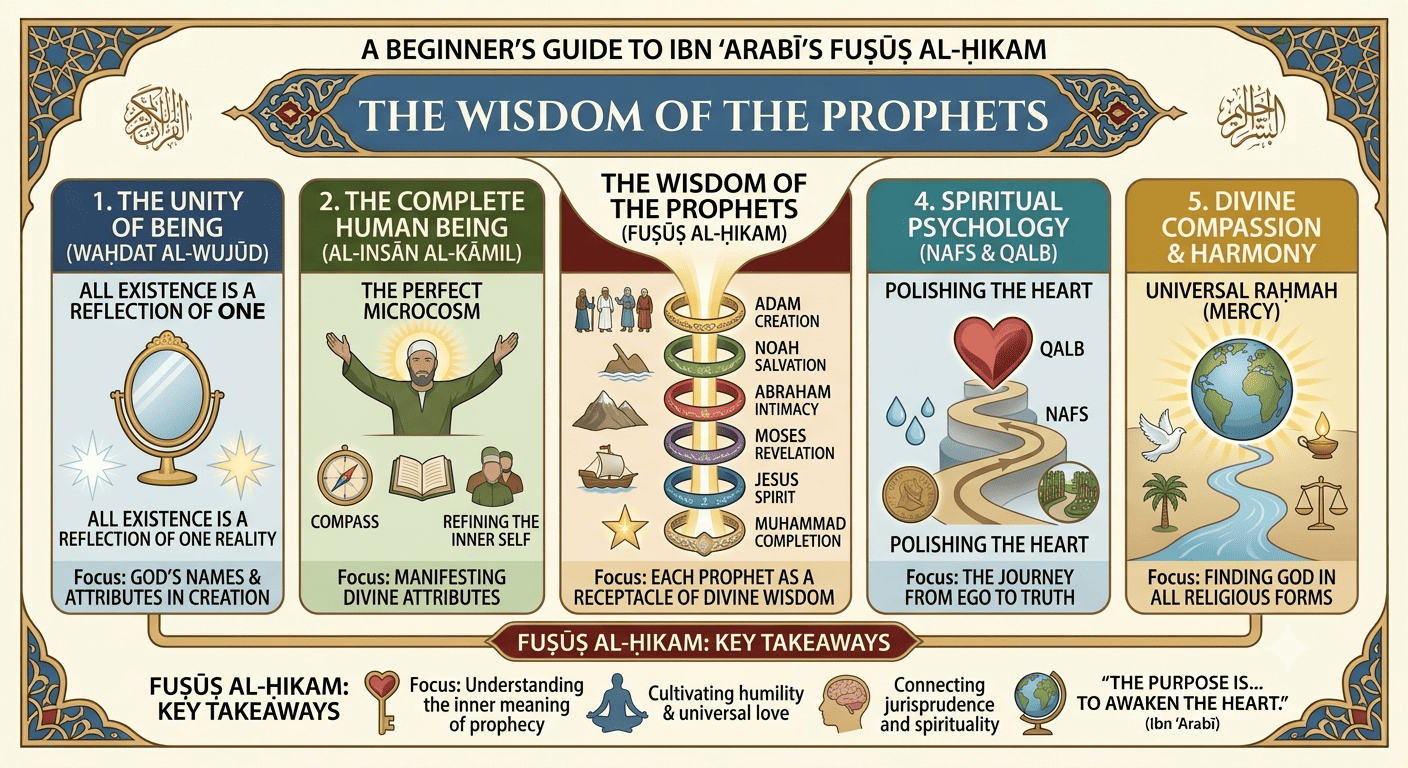
Following Adam, Ibn ʿArabi turns to Shees عَلَيْهِ ٱلسَّلَامُ, whom Islamic tradition regards as Adam’s spiritual heir. If Adam represents the complete manifestation of the Divine Names within humanity, Shees عَلَيْهِ ٱلسَّلَامُ represents the preservation and transmission of that wisdom. The movement from Adam to Shees عَلَيْهِ ٱلسَّلَامُ reflects a fundamental principle in Ibn ʿArabi’s thought: Divine wisdom is never lost but continually entrusted to those prepared to receive it.
The wisdom associated with Shees عَلَيْهِ ٱلسَّلَامُ is Ḥikmat al-Nafathiyyah—the Wisdom of Divine Inspiration or Sacred Breathing. Through this wisdom, Ibn ʿArabi introduces one of the most important themes of the Fuṣūṣ al-Ḥikam: that spiritual knowledge is not produced solely through intellectual effort but is breathed into receptive hearts by Divine grace.
The Meaning of Divine Wisdom
The Arabic word nafath literally means “to breathe gently” or “to blow softly.” Spiritually, it signifies the subtle communication of Divine knowledge into the heart.
For Ibn ʿArabi, inspiration is neither imagination nor sudden emotion. It is a gift bestowed upon hearts that have been purified through sincerity, remembrance, and spiritual discipline. Such knowledge cannot be manufactured by human effort; it is received through Divine generosity.
Reason and inspiration therefore complement one another. Reason examines, organizes, and evaluates what is known, while inspiration opens the heart to realities beyond the reach of discursive thought. Together they lead to genuine wisdom.
Shees عَلَيْهِ ٱلسَّلَامُ and Spiritual Inheritance (Wirāthah)
According to Islamic tradition, Shees عَلَيْهِ ٱلسَّلَامُ inherited Adam’s spiritual knowledge and authority. Ibn ʿArabi understands this inheritance in a profoundly spiritual sense.
True inheritance is not determined by bloodline but by inner affinity with the Divine. A person may be biologically descended from a prophet without inheriting his wisdom, while another who shares his spiritual character becomes his true heir.
The wisdom entrusted to Adam therefore continues through Shees عَلَيْهِ ٱلسَّلَامُ and, ultimately, through the succession of prophets and saints. Divine guidance remains alive because Allah continually raises individuals capable of receiving and transmitting His wisdom.
The Symbolism of Breath
Breath is one of Ibn ʿArabi’s richest metaphysical symbols.
Invisible yet indispensable, breath gives life while remaining unseen. Human speech depends upon breath, just as creation depends upon Allah’s continuous self-disclosure.
Shees’ عَلَيْهِ ٱلسَّلَامُ wisdom reminds us that existence itself is sustained by an ongoing Divine act rather than by a single event in the distant past. Every moment of creation is renewed through Allah’s continuous generosity.
Breath also symbolizes the living transmission of wisdom. Just as words are carried upon breath, spiritual knowledge passes from heart to heart through teaching, companionship, and lived example.
The Prepared Heart
One of Ibn ʿArabi’s recurring themes is that Divine inspiration is always available, but not every heart is prepared to receive it.
The heart must be purified of pride, selfishness, and distraction before it can become a vessel for Divine wisdom. Inspiration is therefore not a replacement for spiritual discipline but its fruit.
Shees عَلَيْهِ ٱلسَّلَامُ represents the seeker whose openness, humility, and sincerity make him receptive to Allah’s subtle guidance.
Acquired Knowledge and Unveiling (Kashf)
Ibn ʿArabi distinguishes between acquired knowledge and unveiled knowledge.
Acquired knowledge comes through study, observation, and rational inquiry. It is essential for understanding the world and interpreting revelation.
Unveiled knowledge (kashf) arises when Allah removes the veils that limit human perception. Through this unveiling, the seeker comes to perceive realities that cannot be reached through reasoning alone.
These two forms of knowing are not rivals but partners. Sound learning prepares the mind, while spiritual realization illuminates the heart.
The Continuity of Divine Guidance
Although prophecy reached its completion with Prophet Muhammad ﷺ, Divine guidance did not cease.
Ibn ʿArabi teaches that the saints (awliyāʾ) inherit the spiritual realities of prophecy without bringing new revelation. Their role is to embody, preserve, and transmit the truths already revealed.
Shees عَلَيْهِ ٱلسَّلَامُ therefore becomes the first symbol of this ongoing chain of spiritual inheritance—a principle that extends throughout sacred history and remains active wherever hearts are receptive to Allah.
Connection with Ibn ʿArabi's Broader System
Shees’ عَلَيْهِ ٱلسَّلَامُ chapter introduces several foundational ideas that shape Ibn ʿArabi’s entire metaphysical vision.
Divine Self-Disclosure (Tajallī)
All authentic knowledge ultimately originates in Allah's continual self-revelation.
Spiritual Inheritance (Wirāthah)
Sacred wisdom passes through realization rather than biological descent.
Unveiling (Kashf)
The deepest truths become known when Allah lifts the veils from the heart.
The Perfect Human (Al-Insān al-Kāmil)
The Perfect Human receives Divine wisdom and becomes a channel through which it benefits others. These principles illuminate Ibn ʿArabi's understanding of prophecy, sainthood, and spiritual education.
Contemporary Relevance
Modern education excels at transmitting information but often struggles to cultivate wisdom. Technical knowledge alone cannot answer questions of meaning, purpose, or moral responsibility.
Shees عَلَيْهِ ٱلسَّلَامُ reminds us that wisdom requires more than intelligence. It demands humility, reflection, ethical living, and openness to Divine guidance.
For those living in an age of constant information, Shees عَلَيْهِ ٱلسَّلَامُ asks an enduring question: How do we transform knowledge into wisdom that shapes both character and action?
Reflection
Shees’ عَلَيْهِ ٱلسَّلَامُ chapter invites us to consider the nature of genuine inspiration.
How can we distinguish authentic spiritual insight from personal imagination or wishful thinking?
Ibn ʿArabi suggests that true inspiration is never isolated from revelation, sound reason, ethical conduct, and humility. The more purified the heart, the more faithfully it reflects Divine guidance.
The chapter also redefines inheritance. To inherit wisdom is not merely to preserve the past but to embody timeless truths and communicate them in ways that speak meaningfully to each new generation.
Conclusion
The Bezel of Shees عَلَيْهِ ٱلسَّلَامُ teaches that Divine wisdom is a living trust passed from heart to heart. Through the symbolism of sacred breathing and spiritual inheritance, Ibn ʿArabi shows that knowledge becomes transformative only when it is illuminated by inspiration and embodied in character.
Shees عَلَيْهِ ٱلسَّلَامُ reminds us that every generation is entrusted with preserving and renewing wisdom. Those who cultivate receptive hearts become links in an unbroken chain through which Divine guidance continues to illuminate humanity.
Critical Question
Who has been the greatest source of wisdom in your life, and what qualities made their influence transformative rather than merely informative?