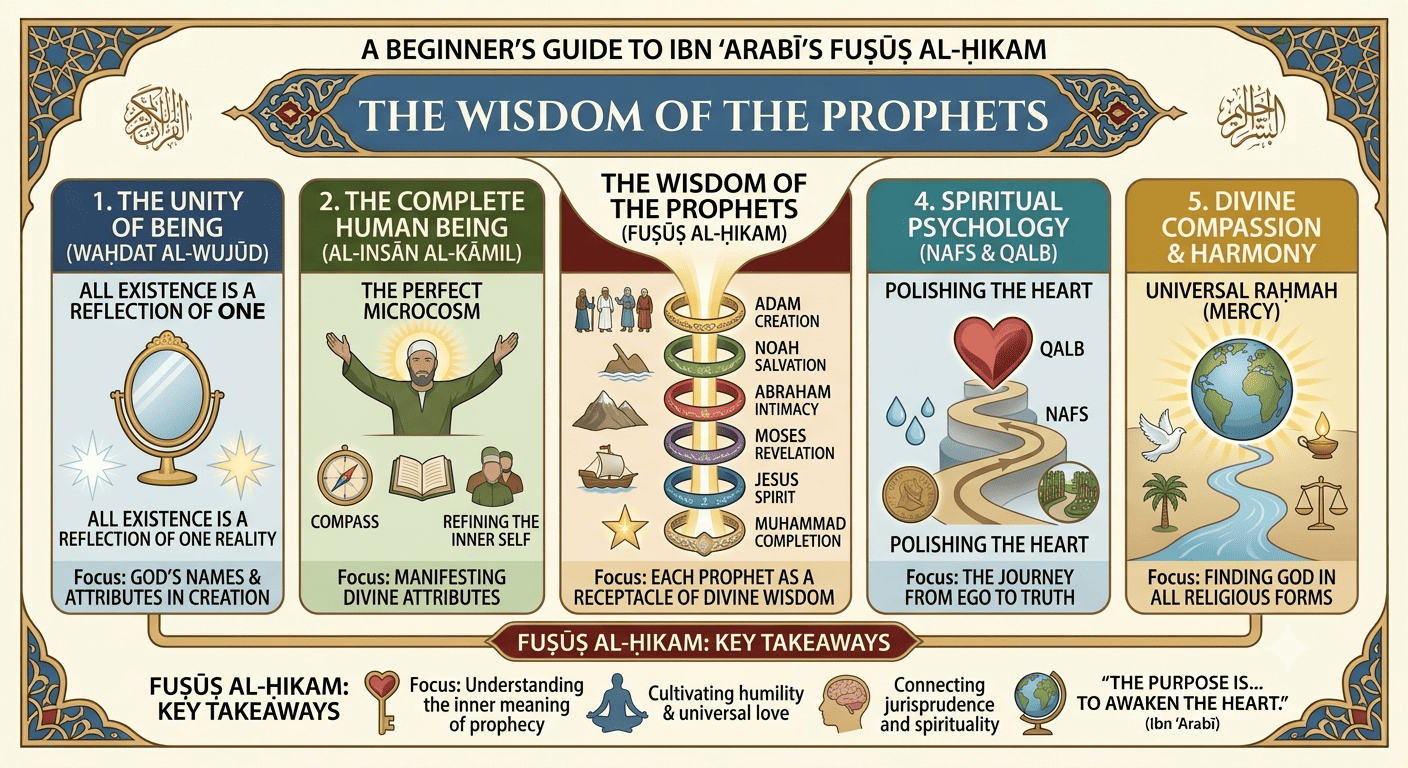


The Wisdom of Divine Illumination (Ḥikmat al-Nūriyyah)
Yusuf عَلَيْهِ ٱلسَّلَامُ represents the light that reveals hidden realities through dreams, beauty, symbols, and spiritual insight. His wisdom teaches that life itself is filled with signs whose deeper meanings are unveiled to hearts illuminated by Allah.
Main Idea
Reality is richer than what appears on the surface. Divine illumination enables the heart to perceive the deeper meanings hidden within dreams, beauty, suffering, and everyday events. Yusuf عَلَيْهِ ٱلسَّلَامُ teaches that wisdom comes not merely from observing life but from learning how to interpret its symbols.
Key Points
- Divine truth is often revealed through symbols rather than direct statements.
- Dreams belong to the imaginal realm, where spiritual realities assume symbolic forms
- Beauty awakens the soul to the Divine source of all perfection.
- Suffering may prepare the heart for greater wisdom not immediately apparent.
- Spiritual understanding requires patience, discernment, and the ability to interpret life's deeper meanings.
Introduction
Among the prophets, Yusuf عَلَيْهِ ٱلسَّلَامُ occupies a unique place as the prophet of dreams, beauty, and Divine wisdom. His Qur’anic story unfolds through a remarkable sequence of visions, jealousy, betrayal, imprisonment, patience, forgiveness, and ultimate reconciliation. Every stage of his life reveals that events which appear ordinary or painful often conceal a deeper Divine purpose.
For Ibn ʿArabī, Yusuf عَلَيْهِ ٱلسَّلَامُ is far more than a historical prophet blessed with beauty and the gift of interpreting dreams. He embodies Ḥikmat al-Nūriyyah—the Wisdom of Divine Illumination. Through him, Ibn ʿArabī introduces one of the central pillars of his metaphysical vision: the world of imagination (ʿālam al-khayāl), where spiritual realities become visible through symbolic forms.
Yusuf عَلَيْهِ ٱلسَّلَامُ teaches that Divine light enables the seeker to perceive meanings hidden beneath appearances. Reality is not exhausted by what can be seen with the physical eye; it continually reveals deeper truths to hearts illuminated by Allah.
The Meaning of Divine Light
Light (nūr) occupies a central place throughout the Qur’an and Islamic spirituality.
Allah is described as:
"Allah is the Light of the heavens and the earth." (Qur'an 24:35)
For Ibn ʿArabī, light is not merely physical brightness. It is that by which realities become known.
Just as sunlight enables the eye to perceive the visible world, Divine illumination enables the heart to perceive spiritual realities.
Yusuf عَلَيْهِ ٱلسَّلَامُ’s wisdom therefore concerns an inner light that reveals meanings hidden behind outward events. Every experience—whether joyful or painful—may become illuminated by this Divine light, allowing the seeker to perceive the wisdom it contains.
The Imaginal Realm (ʿĀlam al-Khayāl)
One of Ibn ʿArabī's most original teachings is the reality of the imaginal world (ʿālam al-khayāl). Unlike the modern understanding of imagination as fantasy, Ibn ʿArabī describes the imaginal realm as an intermediate world between the purely spiritual and the purely material. Here, meanings become visible as images, and images convey spiritual meanings. Dreams, visions, symbolic experiences, and many forms of spiritual perception belong to this realm. More profoundly, Ibn ʿArabī teaches that the created world itself possesses an imaginal character. Every created form points beyond itself to an invisible reality. Mountains, rivers, people, beauty, suffering, and even ordinary events become symbols through which Divine wisdom continually discloses itself. The spiritual seeker's task is to learn how to read these signs.
Yusuf عَلَيْهِ ٱلسَّلَامُ and the Language of Dreams
Yusuf’s عَلَيْهِ ٱلسَّلَامُ story begins with a dream. As a young boy he sees the sun, the moon, and eleven stars bowing before him. The dream is true, yet its meaning is not immediately apparent. Only years later does its fulfillment become clear. For Ibn ʿArabī, this illustrates one of the fundamental laws of spiritual life: Divine truth often appears symbolically before it manifests outwardly. Dreams therefore require interpretation rather than literal acceptance. Yusuf عَلَيْهِ ٱلسَّلَامُ becomes the model of one who understands the symbolic language through which Allah communicates hidden realities.
Interpretation (Taʾwīl)
A central theme in Yusuf’s عَلَيْهِ ٱلسَّلَامُ wisdom is taʾwīl—the interpretation or "returning" of symbols to their true origin. For Ibn ʿArabī, interpretation is not simply explaining a dream. It is the process of moving from outward appearances to their inner reality. Yusuf عَلَيْهِ ٱلسَّلَامُ understood that dreams were not ends in themselves. They were signs pointing toward deeper truths unfolding within Divine wisdom. Likewise, the seeker is called to interpret life itself. Joy and sorrow, success and failure, beginnings and endings all become symbols inviting us to discover the deeper realities they reveal.
Beauty as Divine Self-Disclosure
Yusuf عَلَيْهِ ٱلسَّلَامُ is renowned for his extraordinary beauty. The Qur'an describes how those who beheld him were overwhelmed by his appearance. For Ibn ʿArabī, Yusuf عَلَيْهِ ٱلسَّلَامُ's beauty is not merely physical attractiveness. It is a manifestation of Divine beauty (jamāl). Every experience of genuine beauty reflects the Divine Name al-Jamīl (The Beautiful). Beauty awakens the soul because it reminds it of its Divine origin. It stirs within the human heart a longing for the infinite perfection from which all beauty proceeds. Yusuf عَلَيْهِ ٱلسَّلَامُ therefore becomes a symbol of Divine self-disclosure (tajallī) through beauty.
Suffering and the Unfolding of Wisdom
Yusuf’s عَلَيْهِ ٱلسَّلَامُ life is marked by betrayal, slavery, false accusation, imprisonment, and separation from his family. Yet each hardship becomes an essential stage in the fulfillment of Allah's greater purpose. For Ibn ʿArabī, this pattern reveals that Divine wisdom often unfolds gradually. Events that appear painful or meaningless may be preparing the soul for realities that cannot yet be perceived. The light of wisdom frequently emerges through experiences of darkness. Yusuf عَلَيْهِ ٱلسَّلَامُ teaches that patience is not passive waiting but trust that Allah's hidden wisdom is continually unfolding beneath the surface of events.
Reading the Book of Creation
One of Ibn ʿArabī's deepest insights is that the universe itself resembles a vast symbolic text. Every created thing carries meaning beyond its outward form. The spiritually awakened person learns to read creation as one reads a sacred book. Dreams, nature, relationships, beauty, suffering, and daily experiences all become signs (āyāt) pointing toward Allah. Yusuf عَلَيْهِ ٱلسَّلَامُ teaches that spiritual maturity involves learning to recognize these signs and allowing them to deepen one's awareness of Divine Reality.
Connection with Ibn ʿArabī's Broader System
Yusuf’s عَلَيْهِ ٱلسَّلَامُ chapter introduces several foundational themes of Ibn ʿArabī's metaphysics.
The Imaginal Realm (ʿĀlam al-Khayāl)
Spiritual realities become visible through symbolic forms.
Divine Self-Disclosure (Tajallī)
Allah continually reveals Himself through beauty, dreams, and the unfolding events of life.
Interpretation (Taʾwīl)
The seeker learns to return symbols to the deeper realities from which they arise.
Unity of Meaning and Form
Every outward form carries an inner meaning that points toward Divine Reality.
These principles make Yusuf’s عَلَيْهِ ٱلسَّلَامُ chapter one of the central keys to understanding Ibn ʿArabī’s vision of the universe.
Contemporary Relevance
Modern culture often values measurable facts while overlooking the symbolic dimensions of human experience.
Yet people continue to encounter truth through stories, literature, art, poetry, dreams, films, and personal experiences that cannot be reduced to logical analysis alone.
Yusuf عَلَيْهِ ٱلسَّلَامُ reminds us that imagination is not the opposite of reality but one of the ways reality reveals itself.
His story also offers hope to anyone who has experienced disappointment or injustice. The deepest meaning of our lives often becomes visible only with time.
In an age that seeks immediate answers, Yusuf عَلَيْهِ ٱلسَّلَامُ teaches patience, discernment, and trust in the gradual unfolding of Divine wisdom.
Reflection
Yusuf’s عَلَيْهِ ٱلسَّلَامُ wisdom invites us to reflect on the symbolic nature of our own lives.
Do we experience events merely as isolated incidents, or do we seek the deeper meanings they may contain?
How can we distinguish genuine spiritual insight from imagination or wishful thinking?
Ibn ʿArabī teaches that authentic interpretation arises from a heart purified by revelation, humility, wisdom, and continual remembrance of Allah.
Life itself resembles a dream whose meaning unfolds gradually. The seeker’s task is not merely to experience events but to discern the Divine wisdom they reveal.
Conclusion
The Bezel of Yusuf عَلَيْهِ ٱلسَّلَامُ teaches that Divine illumination enables the seeker to perceive meanings where others see only events. Through dreams, beauty, suffering, and the imaginal realm, Ibn ʿArabī reveals a universe alive with symbols that continually point toward Allah.
Yusuf عَلَيْهِ ٱلسَّلَامُ reminds us that understanding requires more than observation. It requires patience, interpretation, and hearts illuminated by Divine light. When we learn to read the signs woven throughout creation, every moment becomes an invitation to encounter the wisdom and beauty of the One who continually reveals Himself through all things.
Critical Question
Have you ever looked back on a difficult experience and discovered that it carried a meaning you could not see at the time? How might Yusuf’s عَلَيْهِ ٱلسَّلَامُ wisdom help you view your own life not as a series of random events, but as a story whose deeper purpose is still unfolding?