The Wisdom of Prophethood (Ḥikmat al-Nubuwwiyyah)
Issa عَلَيْهِ ٱلسَّلَامُ represents the meeting of spirit and form, the unseen and the visible. His wisdom teaches that Divine guidance gives life to the human spirit, and that true prophethood is the embodiment of Allah's mercy, wisdom, and creative power within human existence.
Main Idea
Human beings are more than physical creatures. They are animated by a spirit that seeks truth, meaning, and closeness to Allah. Jesus teaches that when the spirit is awakened by Divine guidance, it transforms both the individual and the world through compassion, wisdom, and renewal.
Key Points
- Human life unites body and spirit.
- Divine guidance gives life to the human spirit.
- Jesus represents the harmony between the unseen and the visible.
- Compassion and mercy are signs of a spirit illuminated by Allah.
Introduction
Among all the prophets, Jesus occupies a unique place in the Qur’an. Born without a human father through Allah’s command, described as a Word from Allah and a Spirit from Him, and entrusted with extraordinary miracles, he stands as one of the clearest signs of Allah’s creative power and mercy.
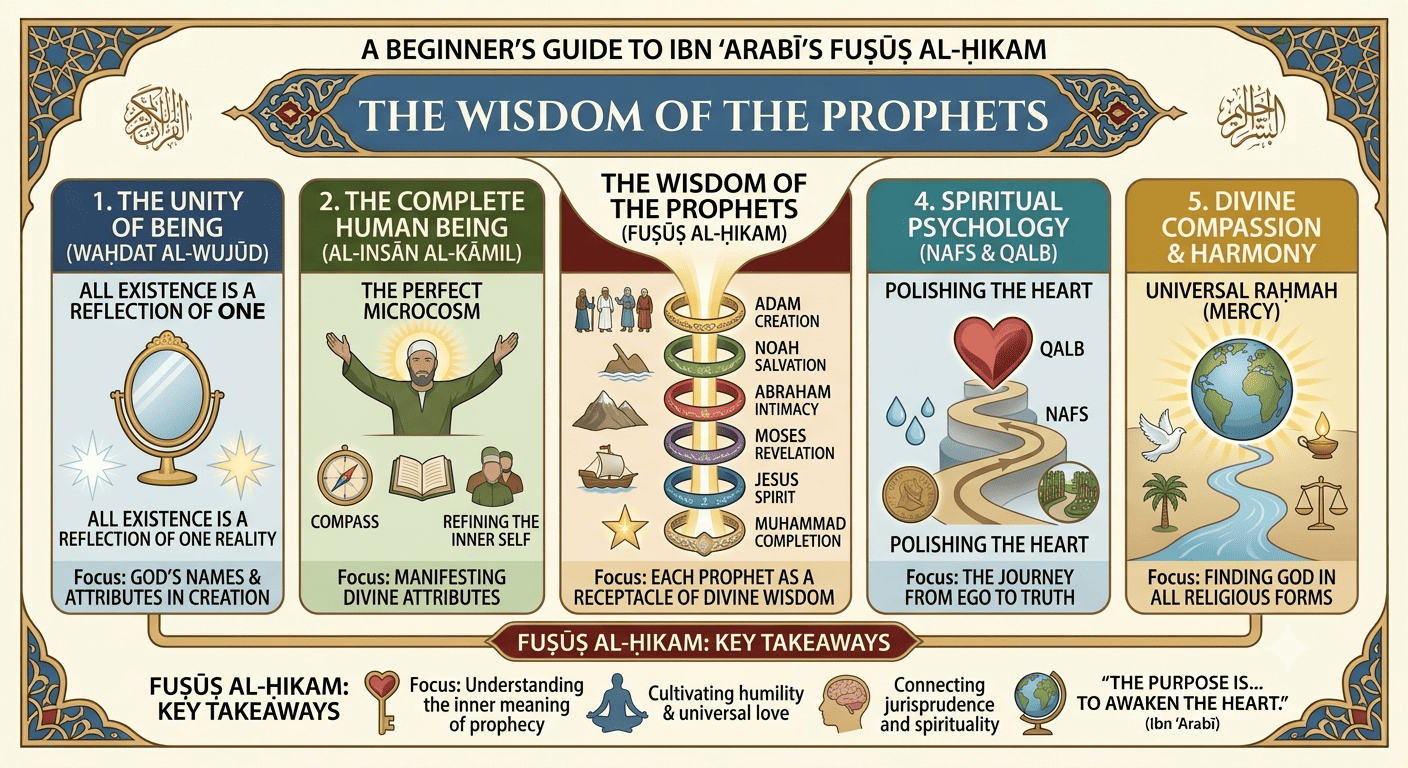
For Ibn ʿArabī, Jesus is far more than a miracle-working prophet. He embodies Ḥikmat al-Nubuwwiyyah—the Wisdom of Prophethood. Through him, Ibn ʿArabī explores the mystery of spirit (rūḥ), the Divine Word, and the relationship between the invisible and visible dimensions of existence.
Jesus teaches that Divine life continually enters the world through revelation, compassion, and the awakening of the human spirit. His life reminds us that the highest purpose of prophethood is not merely to communicate Divine truth but to embody it.
The Meaning of Prophethood
Prophethood is Allah’s gift of guidance to humanity.
A prophet serves as the meeting point between heaven and earth, receiving Divine revelation and expressing it through human words, actions, and character.
For Ibn ʿArabī, prophets are not simply teachers of religious knowledge.
They are living manifestations of Divine wisdom.
Each prophet reveals a particular aspect of Allah’s relationship with creation.
Jesus reveals the life-giving power of the spirit and demonstrates how Divine guidance transforms human existence from within.
Jesus as the Word and Spirit of Allah
The Qur’an uniquely describes Jesus as both a Word from Allah and a Spirit from Him.
For Ibn ʿArabī, these descriptions reveal profound spiritual truths.
Jesus comes into existence through Allah’s creative command:
“Be!”
His miraculous birth demonstrates that creation ultimately depends not upon ordinary causes alone but upon the Divine Will that continually brings existence into being.
The spirit breathed into Jesus reminds us that all life originates from Allah.
Every human being lives through this Divine gift, though Jesus manifests this mystery in a uniquely extraordinary way.
He therefore becomes a sign of the intimate relationship between Divine creativity and human existence.
The Divine Breath
One of Ibn ʿArabī’s most profound teachings concerns the Divine Breath (Nafas al-Raḥmān), through which creation continually receives life.
Just as human speech emerges through breath, Allah’s creative command gives existence to the universe.
Jesus symbolizes this life-giving breath more clearly than any other prophet.
His miraculous birth reminds us that creation itself is sustained by Allah’s continual act of giving life.
The spirit is therefore not something separate from daily existence.
It is the hidden reality that gives meaning, purpose, and vitality to everything that lives.
Spirit and Form
One of Ibn ʿArabī’s recurring themes is the harmony between spirit and form.
Spirit without form cannot become visible in the world.
Form without spirit remains lifeless.
Jesus perfectly illustrates this balance.
His life shows that spirituality does not require withdrawing from the world but allowing Divine life to animate every aspect of human existence.
The body becomes the instrument through which the spirit expresses compassion, wisdom, justice, and love.
True spiritual maturity therefore unites the inner and outer dimensions of life.
The Meaning of Miracles
The miracles associated with Jesus reveal more than extraordinary events.
The Qur’an describes him healing the sick, restoring sight to the blind, reviving the dead, and creating a bird from clay by Allah’s permission.
For Ibn ʿArabī, these miracles symbolize the power of Divine life.
Blindness represents spiritual ignorance.
Healing signifies the restoration of the soul.
Resurrection symbolizes awakening from heedlessness.
Life itself becomes the greatest miracle because it reflects Allah’s continual creative activity.
Jesus reminds us that Divine guidance brings life wherever hearts have become spiritually dormant.
Compassion as the Fruit of Spirit
Jesus is closely associated with mercy, compassion, and care for those who suffer.
For Ibn ʿArabī, this compassion is not merely a moral quality.
It is the natural expression of a heart animated by the Divine Spirit.
The closer a person draws to Allah, the more naturally Divine mercy becomes visible in their relationships with others.
Knowledge without compassion remains incomplete.
True spiritual realization expresses itself through kindness, forgiveness, humility, and service.
Connection with Ibn ʿArabī's Broader System
Jesus’ chapter illuminates several central themes in Ibn ʿArabī’s metaphysics.
Spirit (Rūḥ)
The spirit is the life-giving principle through which human beings remain connected to Allah.
The Divine Word
Creation itself continually comes into existence through Allah's creative command.
Divine Self-Disclosure (Tajallī)
Allah reveals His life-giving qualities through prophets and through every renewal of creation.
The Perfect Human (Al-Insān al-Kāmil)
The prophet embodies Divine guidance by harmonizing spirit and form in a fully integrated human life.
These themes make Jesus one of the clearest expressions of Divine life within the Fuṣūṣ al-Ḥikam.
Contemporary Relevance
Modern society often encourages people to define themselves through achievement, productivity, and material success.
While these pursuits have value, they can leave little room for the inner life.
Jesus reminds us that lasting fulfillment depends upon nurturing both body and spirit.
His wisdom also speaks to a world marked by conflict and division.
Where the spirit is alive, compassion overcomes hostility, mercy tempers judgment, and hope remains stronger than despair.
His example invites us to ask not only how well we live, but what kind of spirit animates our lives.
Reflection
Jesus’ wisdom invites us to reflect on the relationship between our inner and outer lives.
Do our actions express the values we claim to hold?
Are compassion, mercy, and humility becoming more visible in our relationships?
Ibn ʿArabī teaches that spiritual life is not an escape from the world but the transformation of the world through hearts enlivened by Divine guidance.
The more fully the spirit awakens within us, the more naturally Divine qualities become visible through our words and actions.
Conclusion
The Bezel of Jesus teaches that true life begins with the awakening of the spirit. Through the mysteries of the Divine Word, the Divine Breath, and the harmony of spirit and form, Ibn ʿArabī presents Jesus as the prophet through whom Allah’s life-giving wisdom becomes vividly manifest.
Jesus reminds us that the spirit is not separate from everyday life but its deepest reality. When the heart is enlivened by Divine guidance, compassion becomes action, wisdom becomes character, and the unseen becomes visible through human conduct. In this way, Jesus reveals that the highest purpose of prophethood is to embody Divine mercy so that Allah’s light may shine through the lives of His servants.
Critical Question
As you pursue your daily responsibilities and ambitions, what nourishes your inner spirit? How can you bring your deepest spiritual values more fully into your relationships, work, and service to others?