Adam عَلَيْهِ ٱلسَّلَامُ : Divine Wisdom (Ḥikmat al-Ilāhiyyah)
Main Idea
Human beings are created to reflect the Divine Names—such as knowledge, mercy, justice, beauty, creativity, and wisdom. Adam عَلَيْهِ ٱلسَّلَامُ symbolizes the highest spiritual potential inherent in every human being and serves as the archetype of humanity’s relationship with Allah.
Key Points
- Every human being possesses inherent dignity.
- Humanity reflects the Divine Names in a unique and comprehensive way.
- Self-knowledge is a path to knowledge of Allah.
- Human beings are entrusted with responsibility through vicegerency (khilāfah).
- Spiritual growth means becoming a clearer mirror of the Divine Names.
Introduction
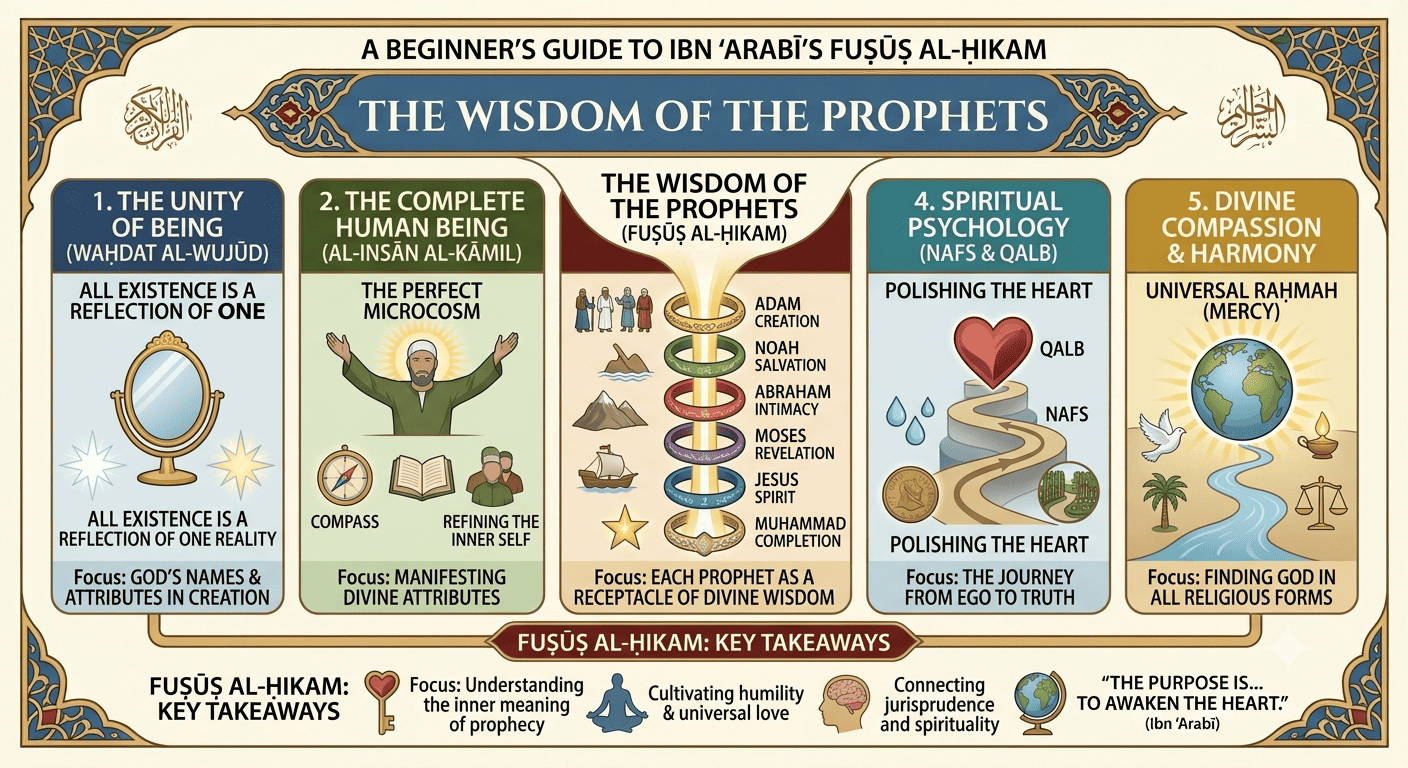
Ibn ʿArabi begins The Bezels of Wisdom (Fuṣūṣ al-Ḥikam) with Adam عَلَيْهِ ٱلسَّلَامُ because he represents the archetype of humanity and the first complete manifestation of Divine Wisdom in creation. Adam عَلَيْهِ ٱلسَّلَامُ is not merely the first human being in history; he is the prototype of what it truly means to be human. Through Adam عَلَيْهِ ٱلسَّلَامُ, Ibn ʿArabi introduces one of the central themes of his entire metaphysical system: the dynamic relationship between Allah, the cosmos, and the human being.
Every creature manifests one or more Divine Names, but the human being alone possesses the capacity to reflect them all in a balanced and comprehensive manner. Adam عَلَيْهِ ٱلسَّلَامُ therefore becomes the supreme mirror of Divine self-disclosure (tajallī). For this reason, Ibn ʿArabi associates him with Divine Wisdom (ḥikmat al-ilāhiyyah), revealing humanity’s unique vocation as the bridge between Creator and creation.
The Meaning of Divine Wisdom
Divine Wisdom concerns the way Allah reveals Himself through creation while remaining infinitely beyond it.
For Ibn ʿArabi, creation is not separate from Allah in the way an artifact is separate from its maker. Rather, the universe is a continuous manifestation of the Divine Names. Every created thing reveals something of Allah’s Reality, yet no single creature can display its fullness.
Adam عَلَيْهِ ٱلسَّلَامُ is unique because he gathers within himself the comprehensive potential of all the Divine Names. He unites spirit and matter, the heavenly and the earthly, becoming the meeting point where the unseen and the visible converge. Divine Wisdom therefore reveals humanity’s role as the living link between Allah and the cosmos.
Adam عَلَيْهِ ٱلسَّلَامُ as the Mirror of Allah
One of Ibn ʿArabi’s most celebrated teachings is that Adam عَلَيْهِ ٱلسَّلَامُ was created as the supreme mirror of Divine self-disclosure.
A mirror possesses no image of its own; it simply reflects what stands before it. Likewise, Adam عَلَيْهِ ٱلسَّلَامُ reflects the Divine Names without possessing divinity himself. He is not identical with Allah but serves as the clearest created manifestation of Divine qualities.
Through Adam عَلَيْهِ ٱلسَّلَامُ, qualities such as mercy, knowledge, justice, beauty, creativity, patience, generosity, and wisdom become visible within the created world. Human perfection lies not in claiming these qualities as one’s own, but in allowing them to shine through one’s character and actions.
The Teaching of the Divine Names
The Qur’an states:
“And He taught Adam عَلَيْهِ ٱلسَّلَامُ all the names.” (Qur’an 2:31)
For Ibn ʿArabi, these Names are far more than words or labels. They are the Divine qualities through which Allah discloses Himself in creation. To know the Divine Names is also to perceive the inner realities (ḥaqā’iq) of existence, since every created being manifests one or more of these Names.
Because Adam عَلَيْهِ ٱلسَّلَامُ was taught “all the Names,” he possesses a comprehensive capacity for knowledge that surpasses the angels, each of whom manifests only a particular aspect of Divine Reality. This comprehensive knowledge forms the basis of humanity’s role as Allah’s vicegerent (khalīfah) on earth.
The Angels' Prostration and Human Vicegerency
The Qur’an further recounts Allah’s command that the angels prostrate before Adam عَلَيْهِ ٱلسَّلَامُ (Qur’an 2:34). Ibn ʿArabi understands this event symbolically rather than as an act of worship directed toward a human being.
The angels recognized in Adam عَلَيْهِ ٱلسَّلَامُ the complete manifestation of the Divine Names. Each angel reflects a particular Divine attribute or function, whereas Adam عَلَيْهِ ٱلسَّلَامُ uniquely embraces them in their totality. Their prostration acknowledges the wisdom of Allah in creating a being capable of representing the fullness of Divine self-disclosure within the created order.
For this reason, Adam عَلَيْهِ ٱلسَّلَامُ becomes Allah’s vicegerent (khalīfah). His authority is not based on domination but on responsibility. Vicegerency means caring for creation with justice, wisdom, mercy, and compassion, reflecting the Divine qualities entrusted to humanity.
The Human Being as Microcosm
Another major theme in this chapter is the idea that the human being is a microcosm (al-ʿālam al-ṣaghīr) reflecting the macrocosm (al-ʿālam al-kabīr).
Everything present within the universe exists in some form within the human being. Humanity therefore functions as a barzakh—an isthmus or bridge that unites spirit and matter, the visible and the unseen, time and eternity.
For Ibn ʿArabi, self-knowledge becomes a path to knowledge of Allah. The famous saying often associated with this idea expresses it beautifully:
“Whoever knows himself knows his Lord.”
Whether understood as a prophetic saying or as a spiritual maxim, it captures one of the central insights of Ibn ʿArabi’s vision: by discovering the Divine signs within ourselves, we come to recognize their Source.
Connection with Ibn ʿArabi's Broader System
Adam’s عَلَيْهِ ٱلسَّلَامُ chapter provides the foundation for many of Ibn ʿArabi's most important teachings.
Divine Self-Disclosure (Tajallī)
Creation is the continual unveiling of the Divine Names in countless forms, with every creature revealing a unique aspect of Allah's Reality.
The Perfect Human (Al-Insān al-Kāmil)
Adam عَلَيْهِ ٱلسَّلَامُ is the prototype of the Perfect Human—the person who consciously reflects the harmony and balance of all the Divine Names.
Unity within Multiplicity
Although creation appears diverse and fragmented, every form ultimately points back to the One Divine Source from which it continually receives existence.
These themes become the framework upon which the remaining chapters of Fuṣūṣ al-Ḥikam are built.
Contemporary Relevance
Modern society often defines human beings primarily in biological, economic, or psychological terms. Ibn ʿArabi offers a far richer vision. Humanity is not merely a product of nature or society but a being endowed with immense spiritual capacity and moral responsibility.
Adam’s عَلَيْهِ ٱلسَّلَامُ wisdom invites us to reflect:
- What does it mean to be truly human?
- How can self-knowledge deepen our relationship with Allah?
- What responsibilities accompany the honor of being Allah's vicegerent?
- Which Divine qualities are we cultivating in our daily lives?
In an age marked by fragmentation, conflict, and environmental crisis, Adam عَلَيْهِ ٱلسَّلَامُ reminds us that true leadership begins with humility, stewardship, and the conscious embodiment of mercy, justice, and wisdom.
Reflection
The chapter raises enduring philosophical and spiritual questions. If human beings can reflect on all the Divine Names, why do they also possess the capacity for ignorance, injustice, and cruelty?
Ibn ʿArabi answers that humanity’s greatness lies not in flawlessness but in freedom. Human beings possess the capacity to manifest both Divine beauty (jamāl) and Divine majesty (jalāl). Spiritual growth is the lifelong journey of consciously aligning oneself with the Divine qualities rather than the impulses of the ego.
Another question concerns humanity’s privileged position within creation. In an age of growing ecological awareness, Adam’s عَلَيْهِ ٱلسَّلَامُ vicegerency should not be understood as domination over nature but as compassionate stewardship. Humanity’s highest honor lies in serving and protecting creation as a trust from Allah.
Conclusion
The Bezel of Adam عَلَيْهِ ٱلسَّلَامُ introduces the grand vision that underlies the entire Fuṣūṣ al-Ḥikam. Adam عَلَيْهِ ٱلسَّلَامُ represents humanity as the comprehensive mirror of the Divine Names, uniting spirit and matter, heaven and earth, and serving as the bridge between Creator and creation.
Through the teaching of the Divine Names, the trust of vicegerency, and the capacity to embody Allah’s qualities in everyday life, Adam عَلَيْهِ ٱلسَّلَامُ becomes the archetype of humanity’s spiritual vocation. His wisdom reminds us that the journey toward Allah begins not by escaping our humanity, but by realizing its deepest purpose.
Critical Question
If every human being has the potential to reflect the Divine Names, which qualities—such as mercy, wisdom, patience, justice, or generosity—are most visible in your life today, and which ones do you aspire to cultivate more fully?