Key Concepts
The Wisdom of Divine Opening (Ḥikmat al-Fātiḥiyyah)
Salih عَلَيْهِ ٱلسَّلَامُ represents the Divine opening through which hidden realities become known. His wisdom teaches that Allah continually places signs before humanity, but only hearts opened by humility and receptivity can recognize their true meaning.
Main Idea
Spiritual growth begins when the heart is opened to Allah’s guidance. Divine truth is often present before us, yet it becomes transformative only when Allah opens our inner perception to recognize its deeper significance.
Key Points
- Divine opening (fatḥ) is a gift as well as a human response.
- Every sign becomes meaningful only to the receptive heart.
- Knowledge alone is insufficient without spiritual openness.
- Pride closes the heart, while humility opens it.
- Every experience can become a doorway to deeper understanding.
Introduction
Salih عَلَيْهِ ٱلسَّلَامُ was sent to the people of Thamūd, a civilization admired for its engineering, prosperity, and remarkable achievements. They carved homes into mountains and possessed every outward sign of success. Yet despite their intelligence and accomplishments, they failed to recognize the Divine signs placed before them.
For Ibn ʿArabī, the story of Salih عَلَيْهِ ٱلسَّلَامُ is not primarily about an ancient community destroyed for disbelief. It is a meditation on why human beings often fail to recognize truth even when it stands directly before them.
The wisdom associated with Salih عَلَيْهِ ٱلسَّلَامُ is Ḥikmat al-Fātiḥiyyah—the Wisdom of Divine Opening. Through this wisdom, Ibn ʿArabī teaches that spiritual understanding begins not merely with acquiring knowledge but with allowing Allah to open the heart to realities that have always been present.
The Meaning of Divine Opening (Fatḥ)
The Arabic word fatḥ means opening, unlocking, or granting access.
In spiritual life, it refers to the opening of the heart, the mind, and the soul to Divine wisdom.
For Ibn ʿArabī, this opening cannot be produced by intellectual effort alone. Human study and reflection prepare the seeker, but true understanding ultimately comes as a Divine gift.
The heart does not create the light that illuminates reality.
It becomes capable of receiving it.
Thus, Divine opening is less about discovering something entirely new than about seeing familiar realities with newly awakened vision.
Salih عَلَيْهِ ٱلسَّلَامُ and the People of Thamūd
The people of Thamūd possessed remarkable knowledge and technical skill.
Their error was not ignorance but self-sufficiency.
They trusted their own achievements while neglecting the Divine source from which every blessing ultimately flows.
Salih عَلَيْهِ ٱلسَّلَامُ called them to remember that knowledge without gratitude and power without humility inevitably become obstacles to spiritual growth.
For Ibn ʿArabī, the greatest barrier to Divine opening is the illusion that one already sees clearly.
Only the humble heart remains capable of receiving new light.
The She-Camel as a Divine Sign
The miraculous she-camel occupies the center of Salih’s عَلَيْهِ ٱلسَّلَامُ story.
The Qur’an describes her as an āyah—a sign from Allah.
For Ibn ʿArabī, her significance lies not merely in her miraculous appearance, but in what she represents.
The she-camel stands before the people as an undeniable invitation to awaken.
She becomes the visible expression of Divine mercy, offering an opportunity for recognition rather than condemnation.
The tragedy of Thamūd is not that the sign was absent.
It is that their hearts remained closed to its meaning.
Reading the Signs of Allah
The Qur’an repeatedly describes creation as filled with āyāt—signs pointing toward Allah.
Mountains, stars, history, relationships, beauty, suffering, and even ordinary events become invitations to deeper understanding.
Yet signs never compel belief.
Two people may witness the same event.
One sees coincidence.
The other recognizes Divine wisdom.
Salih عَلَيْهِ ٱلسَّلَامُ teaches that the world itself is a sacred text whose meanings become visible only through hearts opened by Allah.
From Knowledge to Recognition
One of Ibn ʿArabī’s recurring themes is the distinction between possessing knowledge and truly recognizing reality.
Information may fill the mind while leaving the heart unchanged.
Divine opening transforms knowledge into recognition (maʿrifah).
The seeker begins to encounter Allah not only in acts of worship but throughout the ordinary experiences of daily life.
Every moment becomes an opportunity for deeper awareness.
Spiritual Blindness
The people of Thamūd illustrate one of the greatest spiritual dangers.
They possessed intelligence but lacked receptivity.
Their blindness did not arise from lack of evidence.
It arose from attachment to their own assumptions.
For Ibn ʿArabī, the ego often resists truth not because truth is hidden but because accepting it requires transformation.
The closed heart sees only facts.
The opened heart perceives meaning.
Connection with Ibn ʿArabī's Broader System
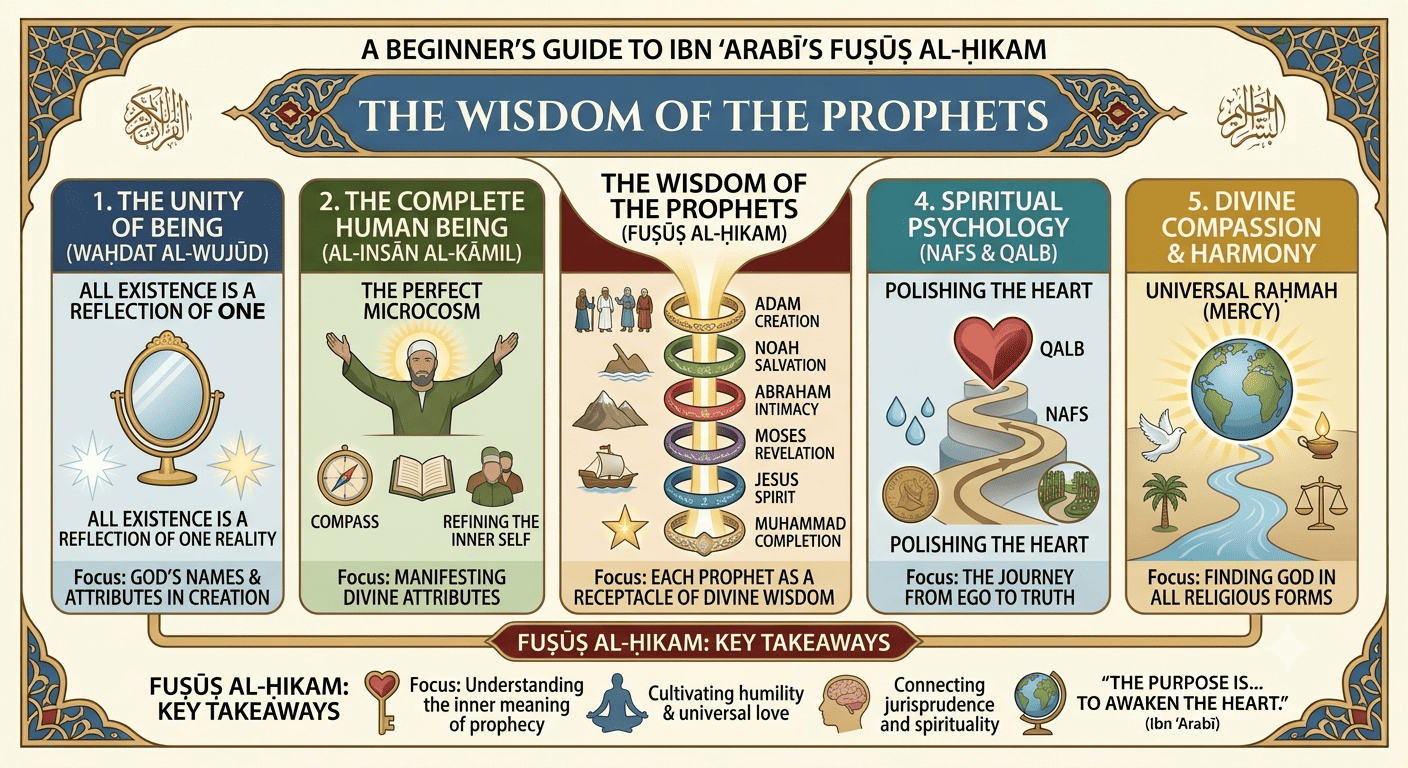
Salih’s عَلَيْهِ ٱلسَّلَامُ chapter introduces several central themes of Ibn ʿArabī's metaphysics.
Divine Opening (Fatḥ)
Allah opens the heart to realities beyond the reach of unaided reason.
Divine Signs (Āyāt)
Creation continually reveals Allah's wisdom through countless signs.
Divine Self-Disclosure (Tajallī)
Every event may become a fresh manifestation of Divine guidance.
Spiritual Recognition (Maʿrifah)
The seeker's knowledge matures into direct recognition through Divine grace.
These principles explain why spiritual realization depends as much upon receptivity as upon learning.
Contemporary Relevance
Modern society provides unprecedented access to information, yet genuine wisdom often remains elusive.
Many people seek more data while overlooking the deeper meanings already present in their lives.
Salih عَلَيْهِ ٱلسَّلَامُ reminds us that the greatest obstacle to wisdom is not lack of information but lack of openness.
In an age of distraction and constant stimulation, spiritual growth begins by slowing down, paying attention, and allowing ordinary experiences to become occasions for reflection and gratitude.
Reflection
Salih’s عَلَيْهِ ٱلسَّلَامُ wisdom invites us to examine the openness of our own hearts.
Are we willing to recognize truth when it challenges our assumptions?
What prevents us from seeing the signs that Allah continually places before us?
Ibn ʿArabī teaches that Divine opening is both a gift and a responsibility.
The more the seeker cultivates humility, sincerity, and remembrance of Allah, the more the heart becomes capable of receiving new light.
Spiritual blindness is therefore not the absence of signs but the refusal to let them transform us.
Conclusion
The Bezel of Salih عَلَيْهِ ٱلسَّلَامُ teaches that Allah continually opens pathways toward truth through the signs woven into every aspect of creation. Through the story of the she-camel and the people of Thamūd, Ibn ʿArabī reveals that Divine wisdom is never absent; it awaits hearts prepared to receive it.
Salih عَلَيْهِ ٱلسَّلَامُ reminds us that true understanding begins when the heart is opened by humility and illuminated by Divine grace. The world then becomes a living book of signs, and every moment offers a fresh invitation to recognize the presence and wisdom of Allah.
Critical Question
How often do you pause to ask what your everyday experiences might be teaching you? If every encounter, challenge, and blessing could be a sign from Allah, what might your life be inviting you to recognize today?