Key Concepts
The Wisdom of the Heart (Ḥikmat al-Qalbiyyah)
Shoaib عَلَيْهِ ٱلسَّلَامُ represents the heart as the center of spiritual awareness and Divine knowledge. His wisdom teaches that the heart is not merely the seat of emotion but the place where Allah continually reveals Himself. A living heart remains open, receptive, and balanced, enabling it to recognize Divine truth in its ever-renewed forms.
Main Idea
True wisdom arises when the heart is purified and opened to Divine guidance. While the intellect explains and analyzes, the heart recognizes, receives, and responds to Allah’s continual self-disclosure. Spiritual maturity requires both clear thinking and an expansive heart.
Key Points
- The heart is the primary organ of spiritual perception.
- Allah continually reveals Himself in new ways, and the heart must remain receptive to these manifestations.
- A rigid heart limits understanding; a living heart continues to grow.
- Divine justice begins with an inward balance before it shapes outward actions.
- Spiritual realization requires sincerity, humility, and continual remembrance of Allah.
Introduction
The Prophet Shoaib عَلَيْهِ ٱلسَّلَامُ was sent to the people of Madyan, a prosperous trading community known for its commercial success but also for dishonest business practices. They manipulated weights and measures, exploited others for personal gain, and allowed economic interests to override justice and integrity.
For Ibn ʿArabī, however, Shoaib عَلَيْهِ ٱلسَّلَامُ’s mission extends far beyond correcting dishonest trade. It reveals the deeper condition of the human heart. Outward corruption begins with inward imbalance.
The wisdom associated with Shoaib عَلَيْهِ ٱلسَّلَامُ is Ḥikmat al-Qalbiyyah—the Wisdom of the Heart. Through this wisdom, Ibn ʿArabī presents the heart as the center of spiritual knowledge, the meeting place of Divine self-disclosure (tajallī), and the faculty through which human beings come to know Allah.
Shoaib عَلَيْهِ ٱلسَّلَامُ teaches that true transformation begins not with external actions alone but with the purification and expansion of the heart.
The Meaning of the Heart (Qalb)
The Arabic word qalb literally means “that which turns” or “that which continually changes.”
For Ibn ʿArabī, this is no accident.
The heart is called qalb because it continually turns from one state to another, remaining capable of receiving ever-new manifestations of Divine Reality.
Unlike the intellect, which often seeks fixed definitions and certainty, the heart possesses the flexibility to respond to Allah’s infinite self-disclosures.
Its continual movement is therefore not a weakness but a sign of its living nature.
The more open the heart becomes, the more capable it is of recognizing the richness and diversity of Allah’s wisdom.
The Heart and Divine Self-Disclosure
One of Ibn ʿArabī’s most profound teachings is that Allah continually reveals Himself through ever-renewed manifestations.
No two moments are identical.
Every instant discloses another aspect of Divine wisdom.
The heart is the place where these manifestations are received.
If the heart becomes rigid through pride, prejudice, or attachment, it loses the capacity to recognize Allah’s continual activity.
But when purified through humility and remembrance, it becomes increasingly receptive to Divine guidance.
The living heart therefore remains open because Divine Reality is infinitely inexhaustible.
Shoaib عَلَيْهِ ٱلسَّلَامُ and the People of Madyan
The people of Madyan were merchants.
Their dishonesty in trade reflected more than economic corruption.
It revealed hearts that had lost their inner balance.
They measured goods unfairly because they had first measured life according to greed rather than truth.
For Ibn ʿArabī, this symbolism is significant.
Every human being continually “measures” life—judging success, relationships, and personal worth.
When the heart becomes dominated by self-interest, these measurements become distorted.
Shoaib’s عَلَيْهِ ٱلسَّلَامُ message restores the proper balance by teaching the heart to measure all things according to Divine justice rather than personal desire.
The Heart as a Mirror
Ibn ʿArabī frequently compares the heart to a polished mirror.
A clear mirror reflects whatever appears before it without distortion.
A tarnished mirror reflects imperfectly.
The same is true of the human heart.
When clouded by pride, greed, resentment, or attachment, it no longer perceives reality clearly.
When polished through remembrance of Allah, sincerity, and humility, it becomes capable of reflecting Divine wisdom with increasing clarity.
The seeker’s task is therefore not to create the light but to polish the mirror that receives it.
The Expanding Heart
One of Ibn ʿArabī’s most celebrated teachings is that the perfected heart becomes capable of embracing every genuine manifestation of Divine truth.
Because Allah reveals Himself in endlessly diverse ways, the heart must become spacious rather than narrow.
Spiritual maturity is therefore marked not by rigidity but by increasing openness, humility, and compassion.
The heart that truly knows Allah does not become confined by prejudice or arrogance.
Instead, it grows in its capacity to recognize Divine wisdom wherever it appears.
Balance (Mīzān) and Integrity
Balance is one of the central themes of Shoaib’s عَلَيْهِ ٱلسَّلَامُ message.
The Qur’an repeatedly associates justice with maintaining the proper balance.
For Ibn ʿArabī, this outward balance reflects an inward reality.
A balanced heart harmonizes:
- Reason and spiritual insight.
- Justice and mercy.
- Individual responsibility and concern for others.
- Material pursuits and spiritual purpose.
When this inner balance is restored, outward integrity naturally follows.
Ethics begin not merely with rules but with a heart rightly ordered before Allah.
Connection with Ibn ʿArabī's Broader System
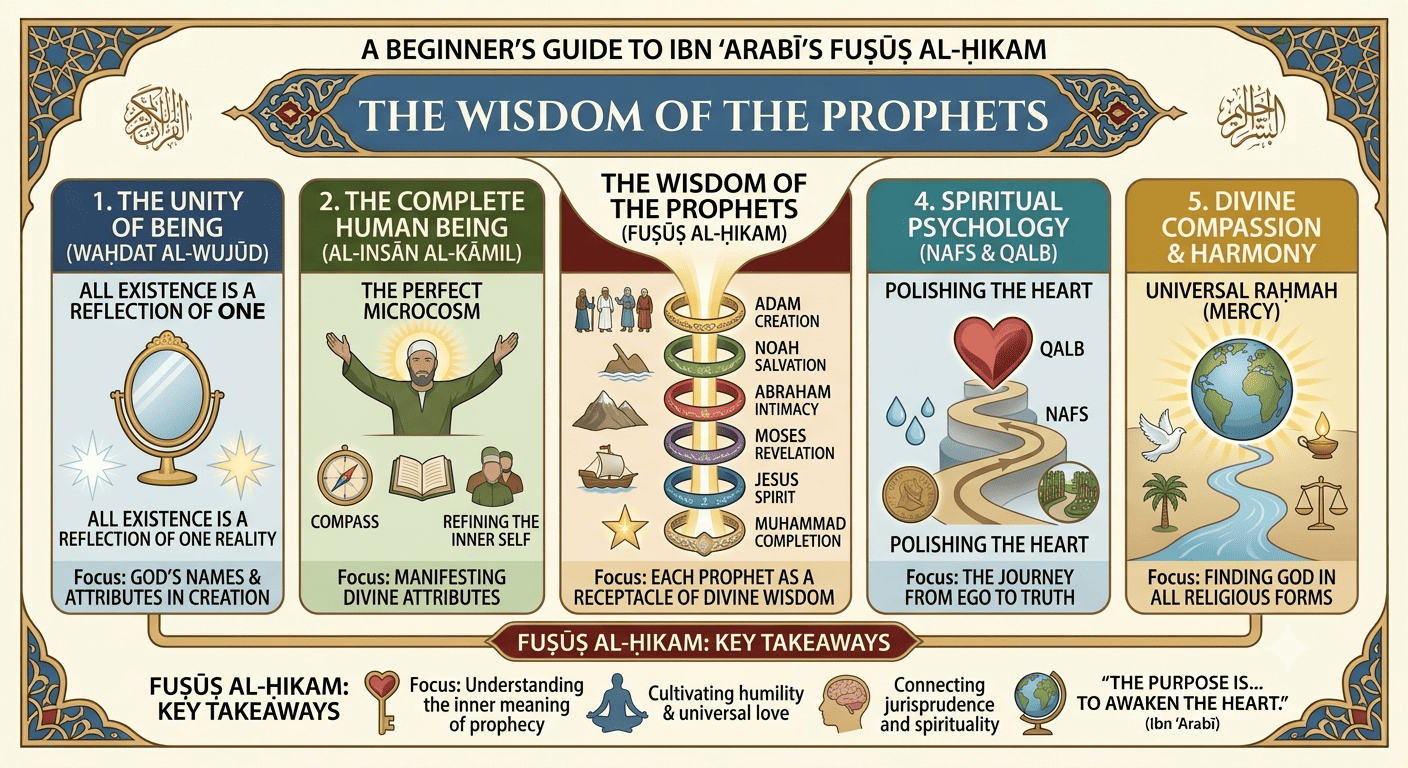
Shoaib’s عَلَيْهِ ٱلسَّلَامُ chapter illuminates several central themes of Ibn ʿArabī’s metaphysical vision.
The Heart (Qalb)
The heart is the primary organ of spiritual perception and Divine knowledge.
Divine Self-Disclosure (Tajallī)
Allah continually reveals Himself in ever-new manifestations received by the receptive heart.
Spiritual Transformation
Because the heart continually turns, it remains capable of continual growth and renewal.
The Perfect Human (Al-Insān al-Kāmil)
The perfected human being possesses a heart spacious enough to receive the infinite richness of Divine manifestations.
These themes make Shoaib’s عَلَيْهِ ٱلسَّلَامُ chapter one of the most important introductions to Ibn ʿArabī’s understanding of the spiritual heart.
Contemporary Relevance
Modern society has unprecedented access to information, yet wisdom often remains scarce.
Knowledge can increase while hearts become increasingly narrow, anxious, or divided.
Shoaib عَلَيْهِ ٱلسَّلَامُ reminds us that education alone cannot produce wisdom.
The heart must also be cultivated.
His message is especially relevant in an age of economic competition, social polarization, and constant distraction.
True success depends not only on what we achieve but on the condition of the heart through which we engage the world.
Reflection
Shoaib’s عَلَيْهِ ٱلسَّلَامُ wisdom invites us to examine the condition of our own hearts.
Has my heart become more open or more rigid?
Do I remain willing to recognize truth when it appears in unexpected forms?
How do I “measure” success, relationships, and the value of others?
Ibn ʿArabī teaches that the heart grows through continual remembrance of Allah, sincere self-examination, and openness to His ever-renewed guidance.
The more spacious the heart becomes, the more fully it reflects Divine wisdom.
Conclusion
The Bezel of Shoaib عَلَيْهِ ٱلسَّلَامُ teaches that the heart is far more than the seat of emotion. It is the center of spiritual perception where Divine wisdom continually enters human experience. Because Allah reveals Himself in ever-new ways, the heart must remain open, balanced, and receptive if it is to recognize His presence.
Through the symbolism of honest measure, the polished mirror, and the ever-turning heart, Ibn ʿArabī presents Shoaib عَلَيْهِ ٱلسَّلَامُ as the guide to inward transformation. His wisdom reminds us that spiritual maturity is not measured by the amount we know but by the spaciousness of the heart that receives, reflects, and responds to Divine truth.
Critical Question
As you reflect on your life, has your heart become more open to learning, compassion, and new insights, or has it grown more rigid in its assumptions? What practices might help you cultivate a heart that is balanced, receptive, and continually open to Allah’s guidance?