Key Concepts
The Wisdom of Divine Power (Ḥikmat al-Malakiyyah)
Lut عَلَيْهِ ٱلسَّلَامُ represents the wisdom of recognizing the difference between human power and Divine sovereignty. His story teaches that true strength does not lie in controlling events but in remaining faithful to Allah while trusting Him with the outcomes.
Main Idea
Human beings possess only limited power, while Allah alone holds absolute authority. Spiritual maturity lies in acting with sincerity and courage while recognizing that ultimate control belongs to Allah. True strength is found not in domination but in dependence upon the Divine.
Key Points
- Human power is real but always limited.
- Divine sovereignty embraces every event and outcome.
- Faithfulness is more important than visible success.
- Divine help often appears in unexpected ways.
- Trust in Allah transforms weakness into spiritual strength.
Introduction
The Prophet Lut عَلَيْهِ ٱلسَّلَامُ was sent to a people who had become deeply immersed in moral corruption and were unwilling to respond to his guidance. Despite his sincerity and perseverance, he witnessed little outward success and found himself increasingly isolated from the society he sought to reform.
For Ibn ʿArabī, however, Lut’s عَلَيْهِ ٱلسَّلَامُ story is not primarily about the sins of his people. It is a profound reflection on the nature of power, human limitation, and Divine sovereignty.
The wisdom associated with Lut عَلَيْهِ ٱلسَّلَامُ is Ḥikmat al-Malakiyyah—the Wisdom of Divine Power. Through Lut عَلَيْهِ ٱلسَّلَامُ, Ibn ʿArabī explores one of the enduring questions of spiritual life:
How should we act when we cannot control the outcome of our efforts?
His answer is both liberating and challenging. We are responsible for faithfulness, not for mastery over events.
The Meaning of Divine Power (Malakiyyah)
The Arabic root m-l-k is associated with kingship, dominion, authority, and sovereignty.
For Ibn ʿArabī, this wisdom reminds us that all created power is relative.
Human beings possess intelligence, influence, and the ability to choose.
Yet every form of human power depends upon the One who continually grants existence.
Only Allah possesses absolute sovereignty.
The wisdom of Lut عَلَيْهِ ٱلسَّلَامُ therefore begins with humility.
The seeker learns to distinguish between what belongs to human responsibility and what belongs to Divine decree.
Lut عَلَيْهِ ٱلسَّلَامُ and Human Limitation
Lut عَلَيْهِ ٱلسَّلَامُ faithfully conveyed Allah’s message despite persistent rejection.
He warned.
He advised.
He pleaded.
Yet he could not compel his people to change.
For Ibn ʿArabī, this illustrates one of the deepest truths of the spiritual life.
Human beings may guide, but they cannot force guidance.
They may speak truth, but they cannot guarantee its acceptance.
Recognizing these limits is not a failure of faith.
It is an acknowledgment of reality.
The Desire for Strength
At one point in the Qur’anic narrative, Lut عَلَيْهِ ٱلسَّلَامُ expresses his longing for greater strength and support.
His words reveal deeply human experience.
Faced with overwhelming opposition, he naturally desires the power to protect what is right.
Ibn ʿArabī does not criticize this longing.
Instead, he redirects it.
The deepest strength is not found in worldly influence or external authority but in complete reliance upon Allah.
What appears to be weakness before people may conceal immense spiritual power.
Divine Help in Unexpected Forms
One of the turning points in Lut’s عَلَيْهِ ٱلسَّلَامُ story is the arrival of the angels.
They appear as if their ordinary travelers.
Lut عَلَيْهِ ٱلسَّلَامُ initially sees only vulnerable guests in need of protection.
Only later does he realize that they are the very means through which Allah will rescue him and fulfill His decree.
For Ibn ʿArabī, this episode reveals an important spiritual principle.
Divine assistance often arrives hidden within ordinary appearances.
The seeker should therefore avoid judging reality solely by what is immediately visible.
Allah’s wisdom frequently unfolds through means that human reason could never anticipate.
Strength Through Surrender
The deepest paradox of Lut’s عَلَيْهِ ٱلسَّلَامُ wisdom is that surrender becomes a source of strength.
Modern culture often equates power with control.
Ibn ʿArabī offers a different understanding.
The person who surrenders to Allah is freed from the exhausting illusion of controlling every outcome.
This freedom allows the seeker to act with courage, integrity, and peace.
Lut عَلَيْهِ ٱلسَّلَامُ teaches that steadfastness in truth is a greater victory than outward domination.
Divine Sovereignty and Human Responsibility
One of Ibn ʿArabī’s central themes is the harmony between human effort and Divine action.
Human beings are called to act sincerely.
Allah alone determines the ultimate results.
This understanding protects the seeker from two extremes.
The first is arrogance, imagining that success belongs entirely to oneself.
The second is despair, believing that one’s efforts are meaningless.
Between these lies the path of trust (tawakkul): wholehearted effort combined with complete reliance upon Allah.
Connection with Ibn ʿArabī's Broader System
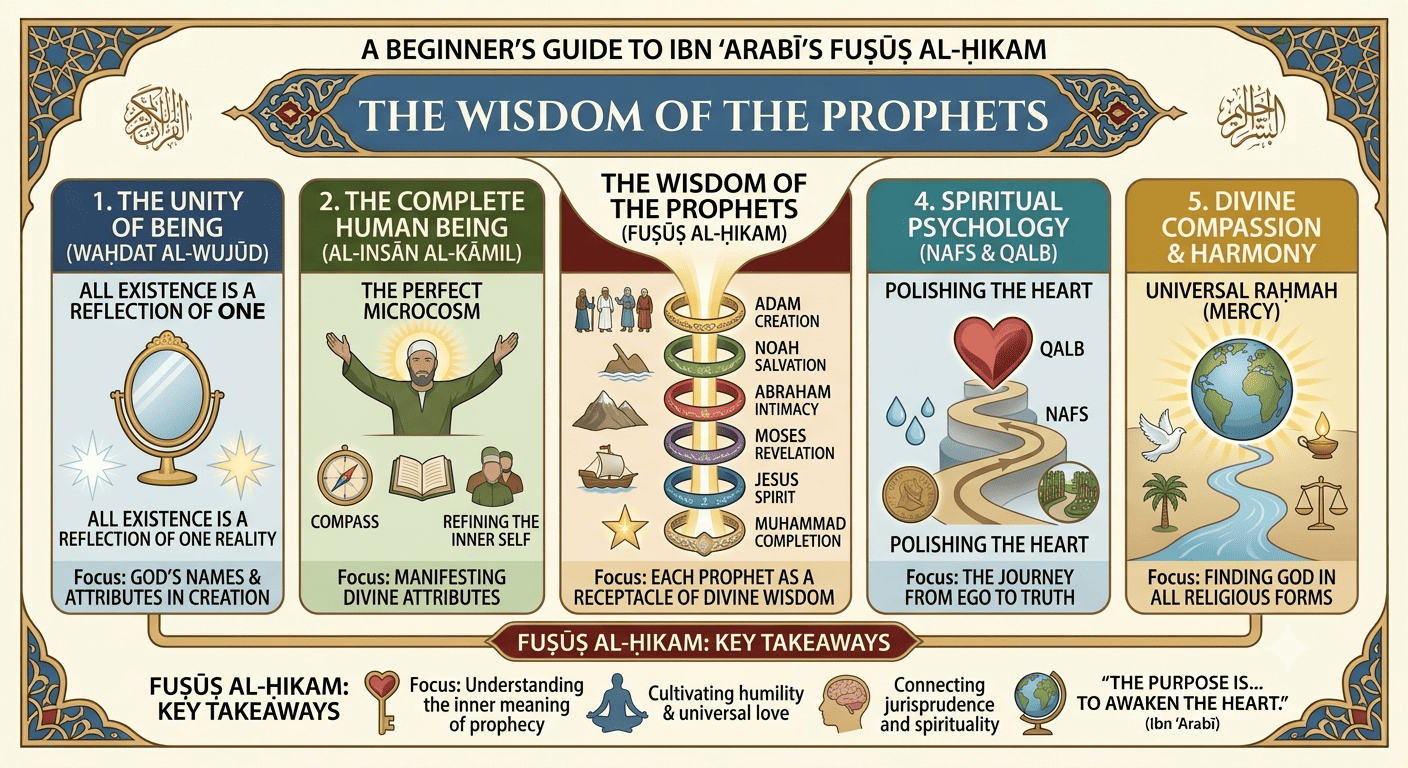
Lut’s عَلَيْهِ ٱلسَّلَامُ’s chapter illustrates several central principles of Ibn ʿArabī’s metaphysics.
Divine Sovereignty
All power and authority ultimately belong to Allah
Divine Self-Disclosure (Tajallī)
Allah's assistance often appears through unexpected people, events, and circumstances.
Trust (Tawakkul)
The seeker acts wholeheartedly while entrusting the outcome to Allah.
Spiritual Realization (Taḥqīq)
The mature believer recognizes both the dignity of human effort and its dependence upon Divine grace.
These themes reveal that genuine strength is inseparable from humility.
Contemporary Relevance
Many people today carry burdens they cannot resolve.
Parents cannot determine the choices of their children.
Teachers cannot guarantee their students’ success.
Leaders cannot control every decision.
Professionals cannot predict every outcome.
Lut عَلَيْهِ ٱلسَّلَامُ reminds us that responsibility is not the same as control.
We are called to speak truth, act justly, and remain faithful to our principles.
The results ultimately rest with Allah.
This wisdom frees us from unnecessary anxiety while encouraging sincere effort.
Reflection
Lut’s عَلَيْهِ ٱلسَّلَامُ wisdom invites us to examine our understanding of power.
Do we measure strength by influence, achievement, and control?
Or do we recognize that the deepest strength lies in remaining faithful even when success seems uncertain?
Ibn ʿArabī teaches that surrender does not diminish human dignity.
Rather, it liberates the seeker from the burden of trying to accomplish what belongs only to Allah.
The strongest heart is not the one that controls everything, but the one that trusts Allah through every circumstance.
Conclusion
Lut’s عَلَيْهِ ٱلسَّلَامُ wisdom invites us to examine our understanding of power.
Do we measure strength by influence, achievement, and control?
Or do we recognize that the deepest strength lies in remaining faithful even when success seems uncertain?
Ibn ʿArabī teaches that surrender does not diminish human dignity.
Rather, it liberates the seeker from the burden of trying to accomplish what belongs only to Allah.
The strongest heart is not the one that controls everything, but the one that trusts Allah through every circumstance.
Critical Question
Think of a situation in your life where you tried to control an outcome that ultimately lay beyond your power. What changed when you focused on doing what was right instead of trying to control the result?