The Wisdom of Divine Uniqueness (Ḥikmat al-Aḥadiyyah)
Hud عَلَيْهِ ٱلسَّلَامُ represents the realization that behind the countless forms of creation stands the Absolute Oneness of Allah. His wisdom teaches that diversity does not diminish Divine Unity but continually reveals it through the many signs of creation.
Main Idea
The world appears diverse, fragmented, and ever-changing, yet every form of existence derives its being from the One Divine Reality. Spiritual wisdom lies in perceiving the unity that underlies multiplicity without denying the richness of creation.
Key Points
- Allah's Oneness is absolute and incomparable.
- Diversity is an expression of Divine creativity, not a contradiction of Divine Unity.
- Human power becomes destructive when it forgets its dependence upon Allah.
- Every created thing reflects one or more Divine Names.
- The seeker learns to recognize the One through the many.
Introduction
Following Joseph’s exploration of Divine illumination and symbolic perception, Ibn ʿArabī turns to Hud عَلَيْهِ ٱلسَّلَامُ, the prophet sent to the powerful people of ʿĀd. The Qur’an describes them as a civilization blessed with strength, prosperity, and remarkable achievements. Yet these very blessings became the source of their downfall because they attributed their greatness to themselves rather than to Allah.
For Ibn ʿArabī, Hud’s عَلَيْهِ ٱلسَّلَامُ mission is not simply a warning against arrogance. It reveals one of the deepest truths of existence: all multiplicity depends upon the Absolute Oneness of Allah.
The wisdom associated with Hud عَلَيْهِ ٱلسَّلَامُ is Ḥikmat al-Aḥadiyyah—the Wisdom of Divine Uniqueness. Through Hud عَلَيْهِ ٱلسَّلَامُ, Ibn ʿArabī explores how the One Divine Reality continually manifests through countless forms without ever becoming divided or diminished.
The Meaning of Divine Uniqueness (Aḥadiyyah
The Arabic word aḥad means "One," but in the Qur'anic expression Allāhu Aḥad (Qur'an 112:1), it signifies an absolute and incomparable Oneness that admits no division, partner, or equal. For Ibn ʿArabī, Aḥadiyyah is not simply numerical unity. Allah is not one being among many beings. Rather, He is the unique source of all existence, upon whom every created thing depends. At this highest level of reality, all distinctions disappear before the Divine Reality. Yet this does not negate the world. Creation remains wonderfully diverse because the One continually reveals Himself through an infinite variety of forms. Thus, Divine Uniqueness does not abolish multiplicity—it makes it possible.
Hud عَلَيْهِ ٱلسَّلَامُ and the People of ʿĀd
The people of ʿĀd became captivated by their own strength. Their cities, buildings, and material achievements convinced them that they possessed lasting power. Hud عَلَيْهِ ٱلسَّلَامُ reminded them that every blessing, every talent, and every achievement originates with Allah. Their error was not that they possessed strength, but that they imagined it belonged to them independently. For Ibn ʿArabī, this is one of humanity's enduring temptations. Whenever the ego forgets the Divine source of its gifts, apparent strength becomes spiritual weakness.
The One and the Many
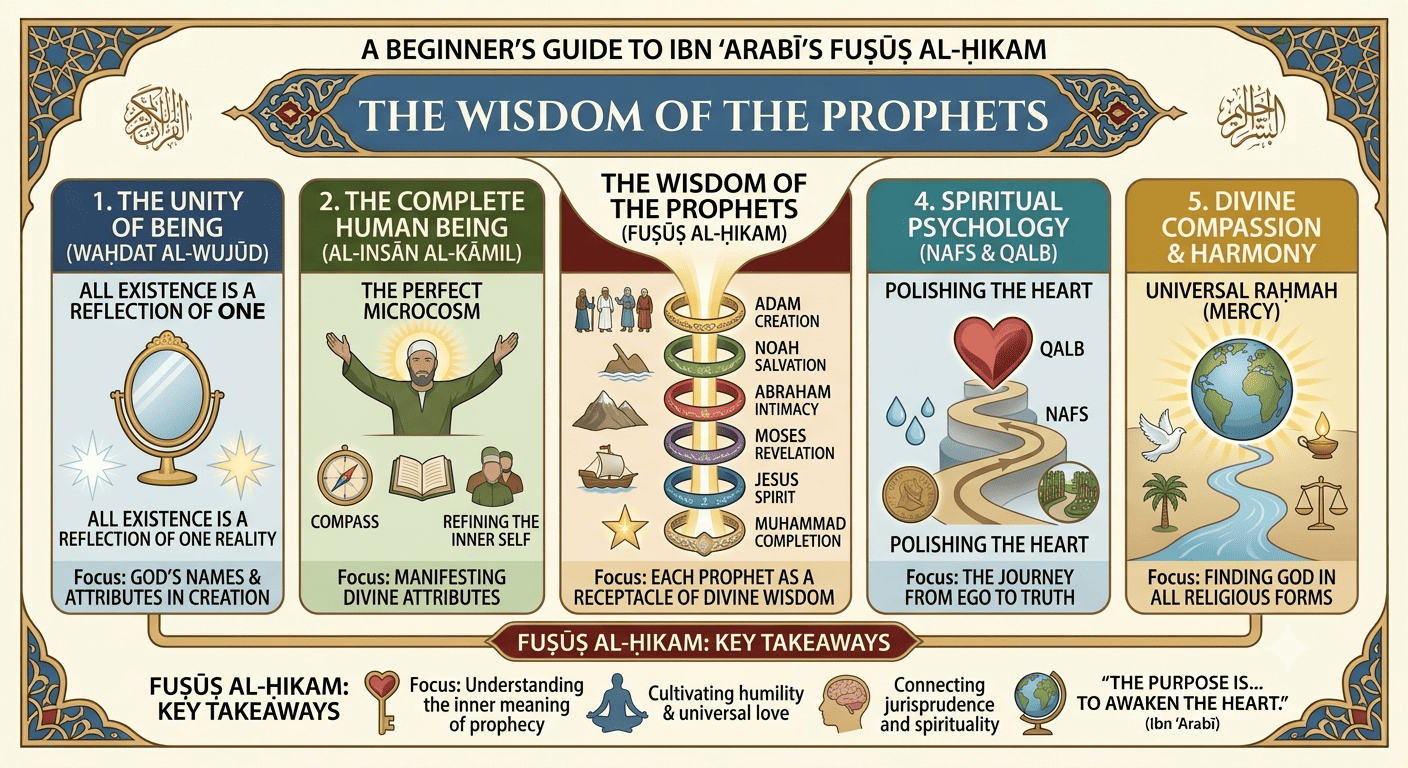
One of Ibn ʿArabī's central metaphysical teachings appears in Hud’s عَلَيْهِ ٱلسَّلَامُ wisdom. Creation displays endless diversity. Every person possesses a unique character. Every creature reflects different qualities. Every moment unfolds differently from the one before. Yet none of these differences exists independently. Each reflects one or more Divine Names while remaining rooted in the same Divine Reality. The many are like countless reflections appearing within a single mirror. The reflections differ, but the light illuminating them remains one. The spiritually awakened person learns to appreciate diversity without losing sight of the Unity from which it continually arises.
Divine Self-Disclosure in Creation
For Ibn ʿArabī, creation exists through continual Divine self-disclosure (tajallī). Every flower reveals beauty. Every mountain manifests majesty. Every act of forgiveness reflects mercy. Every expression of wisdom reflects Divine knowledge. No single creature displays the fullness of Allah, yet together they reveal the inexhaustible richness of the Divine Names. Hud عَلَيْهِ ٱلسَّلَامُ teaches that the seeker's task is to recognize the One speaking through the many voices of creation.
True Strength
The story of ʿĀd invites us to reconsider the meaning of strength. Modern societies often measure power through wealth, influence, technology, or military capability. Hud عَلَيْهِ ٱلسَّلَامُ reminds us that all forms of created power remain dependent upon the One who continually grants existence. The strongest person is therefore not the one who dominates others but the one who lives in conscious dependence upon Allah. Humility is not weakness. It is the deepest form of realism.
The Wind of Divine Judgment
The destruction of ʿĀd comes through a mighty wind. Invisible yet irresistible, the wind symbolizes forces that lie beyond human control. For Ibn ʿArabī, it reminds us that the unseen world continually shapes visible reality. Human beings often trust only what they can observe directly, yet the greatest realities remain hidden from ordinary perception. The wind therefore becomes both a symbol of Divine judgment and a reminder that ultimate power belongs to Allah alone.
Connection with Ibn ʿArabī's Broader System
Hud’s عَلَيْهِ ٱلسَّلَامُ chapter reveals several foundational principles of Ibn ʿArabī's metaphysics.
Divine Uniqueness (Aḥadiyyah)
Allah alone possesses absolute and indivisible Oneness.
Divine Self-Disclosure (Tajallī)
The One continually reveals Himself through the countless forms of creation.
Unity within Multiplicity
Diversity does not oppose Divine Unity but expresses its infinite richness.
Spiritual Realization (Taḥqīq)
The seeker learns to recognize Divine Reality within every manifestation while never confusing the manifestation with Allah Himself.
These themes stand at the very heart of Ibn ʿArabī’s understanding of existence.
Contemporary Relevance
Modern life often encourages us to define ourselves through nationality, profession, ideology, ethnicity, or personal achievement.
While these identities have value, Hud عَلَيْهِ ٱلسَّلَامُ reminds us that they are secondary to the deeper unity shared by all creation.
His wisdom also speaks powerfully to a world divided by conflict and polarization.
Recognizing our common origin in the One Divine Reality encourages humility, compassion, and respect without erasing genuine differences.
Unity does not demand uniformity.
Rather, it enables diversity to flourish within a deeper harmony.
Reflection
Hud’s عَلَيْهِ ٱلسَّلَامُ wisdom invites us to ask how we perceive ourselves and others.
Do we see only differences, or do we also recognize the deeper unity that sustains every human being?
How easily do we mistake our abilities, achievements, or status as possessions rather than gifts?
Ibn ʿArabī teaches that the closer we come to Allah, the more clearly we perceive both the uniqueness of every creature and the single Divine Reality that gives life to them all.
True humility arises naturally from this vision.
Conclusion
The Bezel of Hud عَلَيْهِ ٱلسَّلَامُ teaches that Divine Uniqueness is the hidden foundation of all existence. Through the story of Hud عَلَيْهِ ٱلسَّلَامُ and the people of ʿĀd, Ibn ʿArabī reveals that every created form, however diverse, derives its existence from the One who alone possesses absolute Reality.
Hud عَلَيْهِ ٱلسَّلَامُ reminds us that authentic wisdom lies in seeing both the many and the One simultaneously. When we recognize the Divine source shining through the diversity of creation, pride gives way to humility, division gives way to harmony, and every encounter becomes an opportunity to witness the infinite richness of Allah’s self-disclosure.
Critical Question
When you encounter people whose beliefs, cultures, or experiences differ from your own, do you focus first on the differences or on the shared humanity that unites you? How might Hud’s عَلَيْهِ ٱلسَّلَامُs wisdom help you appreciate diversity while remaining rooted in the deeper unity of all creation?