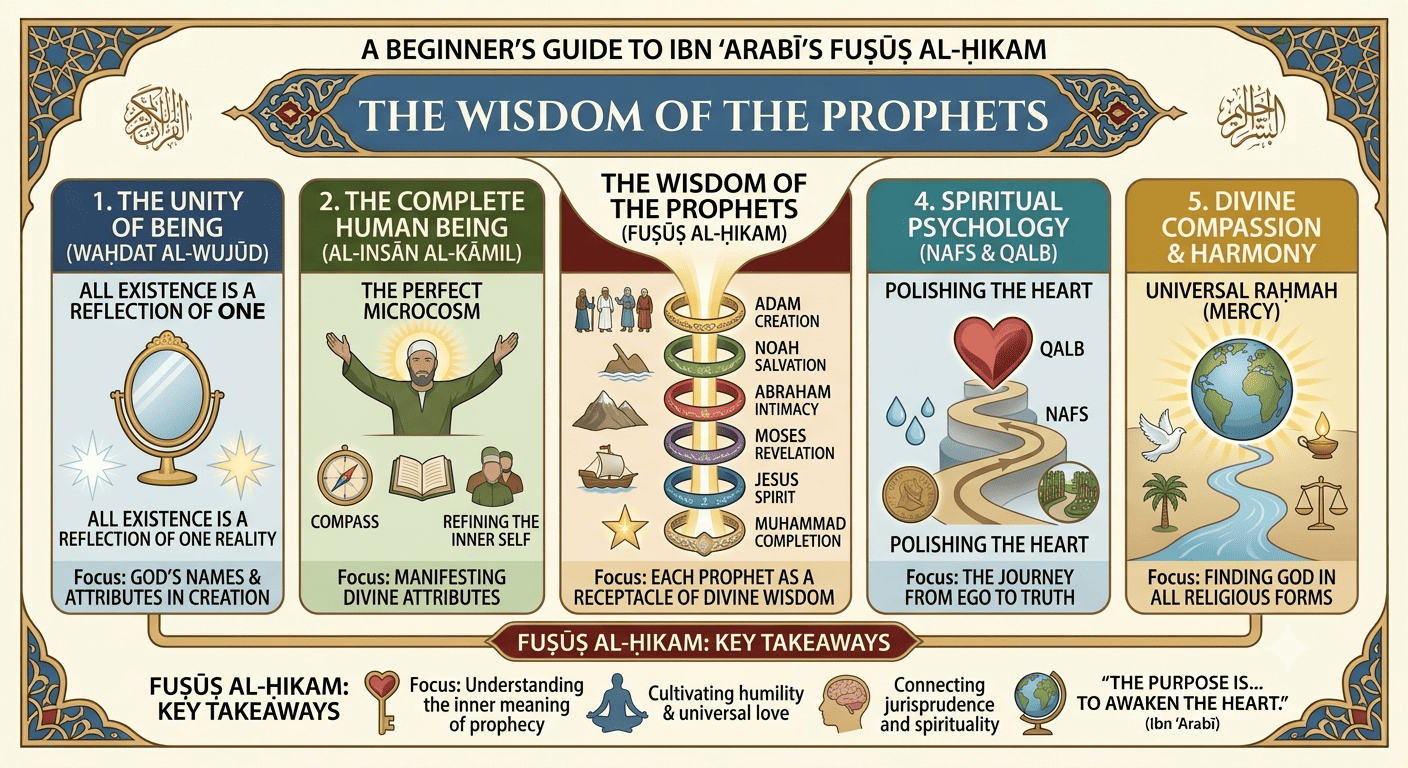

Key Concepts
The Wisdom of Divine Communication (Ḥikmat al-Kalāmiyya)
Musa عَلَيْهِ ٱلسَّلَامُ represents the wisdom of Divine communication, guidance, and the continual search for deeper understanding. As the prophet who spoke directly with Allah, he reminds us that revelation is not simply information to be received but a living dialogue that transforms both the mind and the heart.
Main Idea
Divine guidance is both a gift and a responsibility. True understanding requires listening, reflection, humility, and the willingness to let Divine wisdom shape our lives. The closer we draw to Allah, the more we realize that His wisdom is infinite and our understanding is always growing.
Key Points
- Divine guidance calls for both understanding and action.
- Listening is as important as speaking.
- Knowledge grows through humility and continual learning.
- The ego must give way to dependence upon Allah.
- Law and inner wisdom complement one another.
- Every encounter with truth opens the door to deeper understanding.
Introduction
Among all the prophets mentioned in the Qur’an, Musa عَلَيْهِ ٱلسَّلَامُ occupies a unique position. His story appears more frequently than that of any other prophet and encompasses themes of revelation, liberation, leadership, law, struggle, and spiritual realization. He is known as Kalīm Allāh—the one who spoke directly with Allah.
For Ibn Arabi, Musa عَلَيْهِ ٱلسَّلَامُ represents far more than a lawgiver or leader. He embodies the Wisdom of Divine Communication (Ḥikmat al-Kalāmiyya), exploring the meeting between Divine Wisdom and the human mind. Musa عَلَيْهِ ٱلسَّلَامُ is the seeker who continually listens, questions, learns, and discovers that every answer opens the door to deeper understanding.
His life reminds us that revelation is not merely received once; it continually unfolds as human understanding grows. Through Musa عَلَيْهِ ٱلسَّلَامُ, Ibn Arabi invites us to see Divine communication as a lifelong journey rather than a single event.
The Meaning of Divine Communication (Kalām)
The Arabic word kalām means speech, communication, or discourse.
For Ibn Arabi, Divine communication extends far beyond spoken words or written revelation. Allah communicates through revelation, creation, history, symbols, inspiration, and the unfolding events of everyday life.
The universe itself becomes a form of Divine discourse.
The seeker’s task is therefore not simply to hear words but to recognize the countless ways Allah continually addresses creation.
The wisdom of Musa عَلَيْهِ ٱلسَّلَامُ teaches that true listening is itself a spiritual discipline.
Musa عَلَيْهِ ٱلسَّلَامُ and the Burning Bush
One of the defining moments in Musa عَلَيْهِ ٱلسَّلَامُ’ life is his encounter with Allah at the burning bush.
While travelling through the wilderness, Musa عَلَيْهِ ٱلسَّلَامُ noticed what appeared to be an ordinary fire. As he approached, the fire became the place of Divine communication.
For Ibn Arabi, this event is one of the clearest examples of Divine Self-Disclosure (tajallī).
The bush did not become Allah, nor was Allah confined within it. Rather, it became the place where Divine Speech was manifested.
This illustrates one of Ibn Arabi’s central teachings: Allah reveals Himself through created forms without ever being limited by them.
The burning bush reminds us that ordinary moments may become extraordinary when the heart is prepared to perceive the Divine.
Revelation and Responsibility
Receiving revelation transformed Musa عَلَيْهِ ٱلسَّلَامُ’ life.
Knowledge immediately became responsibility.
For Ibn Arabi, this principle applies to every seeker.
The more understanding a person receives, the greater the responsibility to live according to it.
Wisdom cannot remain an intellectual possession.
It must become character, action, and service.
Musa عَلَيْهِ ٱلسَّلَامُ teaches that every insight carries an invitation to transformation.
Musa عَلَيْهِ ٱلسَّلَامُ and Pharaoh
The confrontation between Musa عَلَيْهِ ٱلسَّلَامُ and Pharaoh is one of the Qur’an’s most enduring narratives.
Historically, it represents the struggle between prophecy and tyranny.
Spiritually, it represents an inner struggle within every human being.
For Ibn Arabi, Pharaoh symbolizes the ego that imagines itself independent of Allah. Musa عَلَيْهِ ٱلسَّلَامُ represents the awakening that reminds the soul that all power, knowledge, and existence ultimately belong to Allah.
The real liberation of the Exodus therefore begins within the human heart.
The journey toward Allah requires confronting the inner Pharaoh—our pride, self-sufficiency, and attachment to control.
Law and Inner Transformation
Musa عَلَيْهِ ٱلسَّلَامُ received the Torah and established Divine law.
For Ibn Arabi, however, the purpose of law extends far beyond regulating outward behaviour.
Law disciplines the soul and prepares it for spiritual realization.
External obedience and inner transformation belong together.
Law without spiritual awareness becomes rigid.
Spirituality without guidance loses direction.
The wisdom of Musa عَلَيْهِ ٱلسَّلَامُ teaches that outward practice and inward realization complete one another.
Musa عَلَيْهِ ٱلسَّلَامُ and Khidr: The Humility of Knowledge
One of the most profound episodes in the Qur’an describes Musa عَلَيْهِ ٱلسَّلَامُ’ journey with Khidr.
Although Musa عَلَيْهِ ٱلسَّلَامُ was one of the greatest prophets, he sought knowledge from someone whom Allah had granted a different kind of wisdom.
Throughout the journey, Musa عَلَيْهِ ٱلسَّلَامُ questioned actions that appeared unjust or irrational. Only later were their hidden purposes revealed.
For Ibn Arabi, this story illustrates the different levels of Divine knowledge.
Musa عَلَيْهِ ٱلسَّلَامُ represents prophetic knowledge rooted in revelation and Divine law.
Khidr represents direct spiritual unveiling (kashf), through which hidden wisdom becomes known.
Neither form of knowledge is superior to the other.
Rather, they reveal different dimensions of Divine Wisdom.
The story teaches that even the greatest scholars and prophets remain students before the infinite knowledge of Allah.
True knowledge matures through humility.
The Desire to See Allah
Another remarkable moment occurs when Musa عَلَيْهِ ٱلسَّلَامُ asks to see Allah directly.
Allah tells him that he will not be able to endure such a vision.
When Divine manifestation touches the mountain, it crumbles, and Musa عَلَيْهِ ٱلسَّلَامُ falls unconscious.
For Ibn Arabi, this event reveals both the greatness of the seeker’s longing and the transcendence of Allah.
The Infinite can never be fully contained within finite perception.
Yet Musa عَلَيْهِ ٱلسَّلَامُ’ longing is not a mistake.
It reflects the deepest desire of every soul—to know its Creator more completely.
The chapter teaches that the journey toward Allah is sustained by longing as much as by knowledge.
Musa عَلَيْهِ ٱلسَّلَامُ and Continual Learning
One of the most remarkable aspects of Musa عَلَيْهِ ٱلسَّلَامُ’ life is that he never stopped learning.
Even after speaking directly with Allah, he travelled in search of Khidr to gain further understanding.
For Ibn Arabi, this teaches that no human being ever exhausts Divine wisdom.
The closer one comes to Allah, the greater one’s awareness of how much remains to be discovered.
Spiritual maturity therefore produces humility rather than certainty.
Musa عَلَيْهِ ٱلسَّلَامُ reminds us that the path to Allah is not a destination but an ongoing journey of listening, learning, and transformation.
Connection with Ibn ʿArabī's Broader System
The wisdom of Musa عَلَيْهِ ٱلسَّلَامُ reflects several central themes in Ibn Arabi’s thought.
Divine Communication (Kalām)
Allah continually communicates through revelation, creation, history, and the human heart.
Divine Self-Disclosure (Tajallī)
The burning bush illustrates how Allah reveals Himself through created forms without being confined by them.
Spiritual Realization (Taḥqīq)
Knowledge reaches completion only when it transforms the person who receives it.
The Perfect Human (Al-Insān al-Kāmil)
Musa عَلَيْهِ ٱلسَّلَامُ embodies courage, humility, leadership, and an unending desire for Divine knowledge.
Together these themes reveal that revelation is not merely information but an ongoing relationship between Allah and humanity.
Contemporary Relevance
Modern societies possess unprecedented access to information but often struggle with wisdom.
People seek certainty, quick answers, and immediate solutions.
Musa عَلَيْهِ ٱلسَّلَامُ offers a different model.
He reminds us that genuine wisdom grows through continual learning, honest questioning, and humility before truths greater than ourselves.
His encounter with Khidr teaches intellectual humility.
His confrontation with Pharaoh reminds us to challenge the ego before attempting to change the world.
His conversation with Allah encourages us to remain lifelong seekers of truth.
Reflection
Musa’s عَلَيْهِ ٱلسَّلَامُ story invites us to reflect on our own relationship with knowledge.
Do we assume that learning ends once we have acquired information?
Or do we remain open to deeper understanding?
Ibn Arabi teaches that every new insight reveals further horizons.
The closer we come to Divine wisdom, the more we recognize the mystery that still lies beyond our understanding.
Conclusion
The Bezel of Musa عَلَيْهِ ٱلسَّلَامُ teaches that Divine communication is an ongoing invitation rather than a finished conversation. Through the burning bush, the giving of the Law, the encounter with Khidr, and his longing to see Allah, Ibn Arabi presents Musa عَلَيْهِ ٱلسَّلَامُ as the seeker who continually grows in understanding.
Musa عَلَيْهِ ٱلسَّلَامُ reminds us that revelation calls not only for belief but also for humility, courage, and continual transformation. His wisdom encourages us to keep listening, keep learning, and remain open to the infinite depths of Divine wisdom.
Critical Question
Think about a time when you realized that there was more to learn than you had first imagined. How did that experience change your understanding, and what did it teach you about humility, growth, and the lifelong search for wisdom?