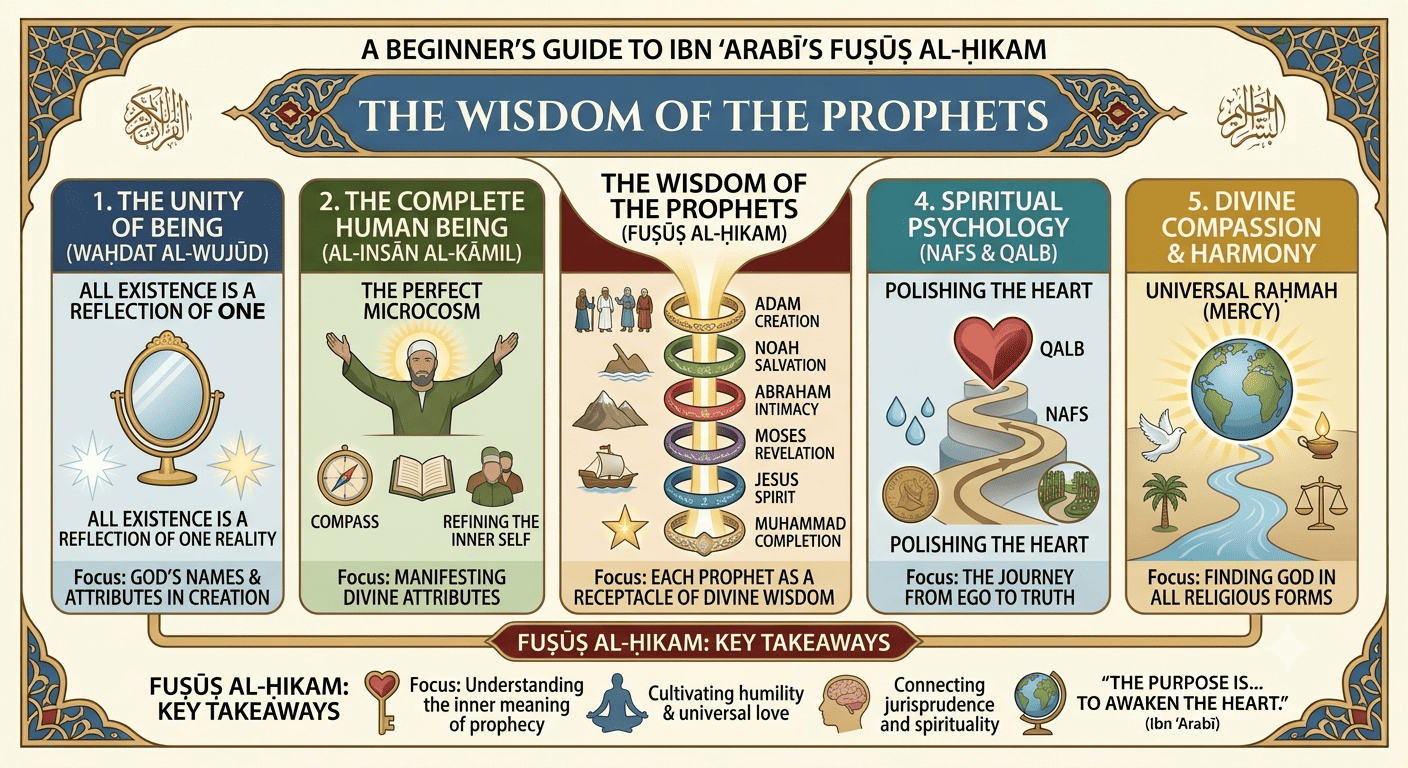

Key Concepts

The Wisdom of Purity (Ḥikmat al-Ṭahāriyya)
Yahya عَلَيْهِ ٱلسَّلَامُ represents the wisdom of purity, sincerity, and spiritual transparency. His life shows that true purity begins within the heart, allowing Divine wisdom and compassion to shine through every thought, intention, and action.
Main Idea
Purity is more than outward cleanliness or moral behavior. It is the purification of the heart from ego, hypocrisy, and worldly attachment so that it becomes receptive to Divine guidance. A pure heart sees more clearly, loves more deeply, and lives more sincerely.
Key Points
- Purity begins with sincerity of intention.
- The heart must be cleansed before it can reflect Divine wisdom.
- Integrity means harmony between belief, intention, and action.
- Spiritual clarity grows as the heart becomes purified.
- Compassion naturally flows from a heart connected to Allah.
- True success lies in authenticity rather than public approval.
Introduction
Among the prophets mentioned in the Qur’an, Yahya عَلَيْهِ ٱلسَّلَامُ is distinguished by his purity, wisdom, and devotion from an early age. Allah describes him as gentle, compassionate, and righteous, granting him wisdom while he was still a child. His life reflects an extraordinary harmony between inner sincerity and outward conduct.
For Ibn ʿArabī, Yahya عَلَيْهِ ٱلسَّلَامُ represents Ḥikmat al-Ṭahāriyya—the Wisdom of Purity. His story is not simply about moral excellence but about the purification of the heart so that it becomes receptive to Divine light.
Through Yahya عَلَيْهِ ٱلسَّلَامُ, Ibn ʿArabī invites us to consider a fundamental question:
What prevents the human heart from recognizing Allah's presence, and how can it become clear enough to reflect Divine truth?
The Meaning of Purity (Ṭahāra)
The Arabic word ṭahāra means purity and cleanliness.
Islam recognizes both outward and inward purity.
Outward purity prepares the body for worship.
Inward purity prepares the heart for Allah.
For Ibn ʿArabī, this inner purification is the greater journey.
The heart becomes clouded by pride, selfishness, resentment, and attachment to worldly recognition.
Purification gradually removes these veils until the heart becomes a clear mirror reflecting Divine light.
Purity is therefore not perfection but transparency before Allah.
Yahya عَلَيْهِ ٱلسَّلَامُ and the Gift of Early Wisdom
The Qur’an tells us that Yahya عَلَيْهِ ٱلسَّلَامُ received wisdom while still a child.
For Ibn ʿArabī, this wisdom represents more than exceptional intelligence.
It symbolizes a heart naturally receptive to Divine guidance.
Knowledge can be acquired through study.
Wisdom, however, is a gift that descends upon a prepared heart.
Yahya عَلَيْهِ ٱلسَّلَامُ reminds us that genuine understanding depends not only on learning but also on spiritual openness.
Sincerity and Integrity
One of Yahya عَلَيْهِ ٱلسَّلَامُ’s defining qualities is sincerity (ikhlāṣ).
The sincere person acts for Allah’s sake rather than seeking praise, recognition, or personal advantage.
For Ibn ʿArabī, sincerity unifies the human being.
Thoughts, intentions, words, and actions begin to reflect the same truth.
This harmony gives the heart both peace and clarity.
Integrity is therefore not merely ethical consistency; it is the outward expression of an inwardly purified soul.
The Heart as a Mirror
A central theme in Ibn ʿArabī’s writings is the symbolism of the heart as a mirror.
A dusty mirror cannot reflect clearly.
Likewise, a heart clouded by ego or attachment struggles to perceive reality as it truly is.
As the heart is purified through remembrance, humility, and sincerity, it becomes capable of reflecting Divine attributes with increasing clarity.
Yahya عَلَيْهِ ٱلسَّلَامُ represents this polished heart.
His purity is not withdrawal from life but openness to Allah’s continual self-disclosure (tajallī).
Freedom from Worldly Attachment
Yahya عَلَيْهِ ٱلسَّلَامُ’s life also illustrates freedom from the need for worldly recognition.
Many people seek approval, status, or influence.
Yahya عَلَيْهِ ٱلسَّلَامُ teaches a different way.
His worth comes from his relationship with Allah rather than the opinions of others.
For Ibn ʿArabī, this freedom allows the seeker to act with courage and authenticity.
Purity liberates the heart from dependence on praise or fear of criticism.
Compassion as the Fruit of Purity
The Qur’an describes Yahya عَلَيْهِ ٱلسَّلَامُ as compassionate and gentle.
This connection is significant.
True purity does not isolate people from others.
Instead, it opens the heart to mercy.
As selfishness decreases, compassion naturally increases.
For Ibn ʿArabī, the purified heart recognizes traces of Allah’s presence throughout creation.
This recognition transforms relationships, replacing judgment with kindness and domination with service.
Connection with Ibn ʿArabī's Broader System
Yahya عَلَيْهِ ٱلسَّلَامُ’s wisdom reflects several central themes in Ibn ʿArabī’s spiritual vision.
Purification of the Heart
The heart becomes capable of receiving Divine wisdom through inner purification.
Divine Self-Disclosure (Tajallī)
A purified heart serves as a clearer mirror for the manifestation of Divine attributes.
Spiritual Realization (Taḥqīq)
The seeker grows through sincerity, self-knowledge, and continual inner refinement.
The Perfect Human (Al-Insān al-Kāmil)
Yahya عَلَيْهِ ٱلسَّلَامُ exemplifies the qualities of purity, integrity, and compassion that contribute to spiritual perfection.
Together, these themes show that purification is not merely preparation for the spiritual journey—it is an essential part of realizing one’s true nature.
Contemporary Relevance
Modern culture often values appearance more than authenticity.
Success is frequently measured by visibility, popularity, or achievement.
Yahya عَلَيْهِ ٱلسَّلَامُ’s wisdom challenges these assumptions.
He reminds us that lasting character grows quietly within the heart.
In a world shaped by public image and constant comparison, his example calls us back to sincerity, integrity, and inner peace.
Real transformation begins where no one else can see.
Reflection
Yahya عَلَيْهِ ٱلسَّلَامُ’s wisdom encourages us to examine the condition of our own hearts.
Do our actions reflect our deepest values, or are they driven by the desire for approval and recognition?
Ibn ʿArabī teaches that purification is a lifelong process.
As the heart becomes freer from ego and attachment, it grows more capable of recognizing Allah’s presence and expressing His mercy in everyday life.
Conclusion
The Bezel of Yahya عَلَيْهِ ٱلسَّلَامُ teaches that purity is the foundation of spiritual realization. Through the example of a prophet known for wisdom, sincerity, and compassion, Ibn ʿArabī shows that the heart becomes a mirror for Divine light only when it is cleansed of ego and attachment.
Yahya عَلَيْهِ ٱلسَّلَامُ reminds us that true spirituality begins within. As the heart is purified, knowledge becomes wisdom, sincerity becomes action, and compassion becomes the natural expression of a life centered on Allah. His example encourages every seeker to cultivate a heart that reflects truth with clarity, humility, and love.
Critical Question
What habits, attitudes, or attachments most cloud the mirror of your own heart? What small step could you take today to cultivate greater sincerity, clarity, and openness to Allah’s guidance?