
External Links
Fusus al-Hikam (The Bezels of Wisdom)
Written during the final years of Ibn Arabi’s life, Fusus al-Hikam (The Bezels of Wisdom) is widely regarded as his most important and influential work. While much shorter than his monumental al-Futuhat al-Makkiyyah (The Meccan Openings), it presents the essential ideas of his spiritual vision in a concise and carefully structured form. According to Ibn Arabi, the book was inspired by a vision in which the Prophet Muhammad ﷺ entrusted him with its transmission, making it not merely a scholarly work but a spiritual legacy.
The title Fusus al-Hikam (The Bezels of Wisdom) reflects one of Ibn Arabi’s most beautiful symbols. A faṣṣ is the gemstone or bezel set in a ring. Just as each gemstone displays a different colour while reflecting the same light, each chapter presents a prophetic or sacred figure as the clearest manifestation of a particular divine wisdom (ḥikmah). The wisdom does not belong exclusively to that figure; rather, it finds one of its most perfect expressions through him. As the reader moves from Adam to Muhammad ﷺ, these wisdoms unfold progressively, culminating in the Muhammadan reality, which gathers and perfects the truths manifested in all previous prophets. In this way, the book presents prophecy as a single, continuous revelation of divine wisdom expressed through different human exemplars.
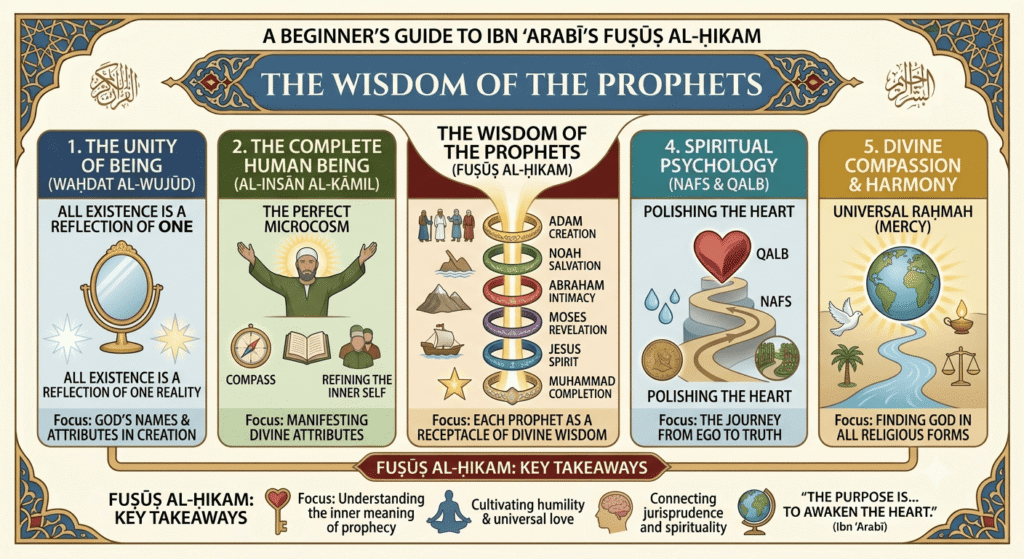
The book contains 27 chapters, each devoted to a particular figure in the history of divine guidance. Most chapters focus on prophets mentioned in the Qur’an, beginning with Adam and concluding with Muhammad ﷺ. However, Ibn Arabi also includes Luqman, who is presented in the Qur’an as a wise man rather than explicitly as a prophet, and Khalid ibn Sinan, whom Ibn Arabi regards as a prophet although his prophetic status has been debated by Muslim scholars. Their inclusion reflects Ibn Arabi’s spiritual purpose rather than an attempt to list only universally accepted prophets.
Rather than narrating the lives of these figures, Ibn Arabi explores the unique wisdom (ḥikmah) associated with each one. Adam represents the wisdom of humanity, Noah perseverance, Abraham intimate friendship with Allah, Moses divine speech, Jesus the mystery of the Spirit, and Muhammad ﷺ the all-encompassing perfection of prophecy. Each chapter reveals a different facet of divine knowledge while contributing to a unified vision of Allah’s relationship with creation.
Readers may notice that several Qur’anic figures, including Dhul-Kifl, Al-Yasa’ (Elisha), and Dhu al-Qarnayn, do not have separate chapters. Ibn Arabi never explains the reason for his selection. Most scholars understand that Fusus al-Hikam is not intended to be a complete history of the prophets. Instead, it is a symbolic work in which each chapter represents a distinct spiritual reality or mode of divine wisdom. Once a particular wisdom has been illustrated through one figure, there is no need to repeat it through another.
For more than seven centuries, Fusus al-Hikam has been one of the most influential works of Islamic spirituality, studied by scholars across the Muslim world and the subject of hundreds of commentaries. At the same time, it is one of the most challenging books in Islamic literature. Ibn Arabi writes in a highly symbolic style, weaving together Qur’anic verses, Prophetic traditions, metaphors, and subtle theological insights. His language often moves between literal and symbolic meanings, inviting readers to reflect rather than simply to read.
For this reason, Fusus al-Hikam is best approached with patience and within the wider framework of the Qur’an, the Sunnah, and the classical Islamic scholarly tradition. It is not a book of stories or systematic theology, but a guide to contemplating the many ways in which divine wisdom is revealed through Allah’s chosen servants. Each chapter offers a new perspective, and together they form one of the richest explorations of prophecy and spiritual knowledge in the Islamic intellectual tradition.
Reading Fusus al-Hikam Today
Fusus al-Hikam was originally written in classical Arabic, a language renowned for its precision, symbolism, and multiple layers of meaning. Ibn Arabi’s style is concise and often assumes a deep familiarity with the Qur’an, the Hadith, and the vocabulary of Islamic theology and Sufism. As a result, no translation can fully capture the richness of the original text, and readers are encouraged to consult the Arabic whenever possible.
Over the centuries, Fusus al-Hikam has inspired hundreds of commentaries, making it one of the most extensively studied works in the Islamic intellectual tradition. Among the most influential are the commentaries of Mu’ayyid al-Din al-Jandi, ‘Abd al-Razzaq al-Kashani, Dawud al-Qaysari, Jami, ‘Abd al-Ghani al-Nabulusi, and Isma’il Haqqi Bursawi (Bosanavi), whose Ottoman Turkish commentary helped preserve and explain Ibn Arabi’s teachings for later generations.
Several English translations are now available, each reflecting a different scholarly approach. The translation by Ralph Austin remains the most widely read and includes helpful notes for general readers. Caner Dagli’s annotated translation, published by the Great Books of the Islamic World series, provides extensive references to the Qur’an, Hadith, and classical Islamic scholarship. Other English studies and translations continue to enrich the understanding of this remarkable work. Throughout this website, references to the Arabic text and to the classical commentarial tradition are used whenever they help clarify Ibn Arabi’s intended meaning.
Editorial Note
This website is based primarily on the Arabic text of Fusus al-Hikam. English translations are used for comparison, while interpretations are informed by the classical commentarial tradition, especially al-Jandi, al-Kashani, al-Qaysari, Jami, and Bursawi, together with modern scholarship where appropriate. ChatGpt is used to convey the meaning in easy and authentic English.
Major Themes in Fuṣūṣ al-Ḥikam
The Spiritual Journey
The Fuṣūṣ describes the gradual transformation of the human being. Each prophetic wisdom represents another step toward spiritual maturity, culminating in the realization of the Perfect Human.
Symbolic Interpretation
Ibn ʿArabī reads the Qur’anic stories on multiple levels. Historical events become symbols of inner spiritual realities, inviting readers to discover deeper meanings within familiar narratives.
Unity in Diversity
One of the book’s central insights is that diversity is not opposed to unity. Different prophets, religions, personalities, and experiences all reflect aspects of the same Divine Reality.
Knowledge Through Realization
True knowledge is more than information. It becomes complete only when it transforms character, perception, and one’s relationship with Allah.
Why Fuṣūṣ al-Ḥikam Still Matters Today
Why Fuṣūṣ al-Ḥikam Still Matters Today
Although written in the thirteenth century, Fuṣūṣ al-Ḥikam continues to speak to modern readers.
In an age marked by fragmentation, polarization, and uncertainty, Ibn ʿArabī offers a vision of integration rather than division. His teachings encourage readers to balance intellect and compassion, spirituality and daily life, individuality and community.
The book reminds us that every human being possesses the capacity for spiritual growth and that every moment offers an opportunity to recognize the Divine presence more deeply.
For these reasons, Fuṣūṣ al-Hikam remains one of the most influential works of Islamic mysticism and continues to inspire scholars, philosophers, and spiritual seekers around the world.
Influence Beyond the Islamic World
Ibn Arabī’s writings have attracted scholars and seekers from many religious traditions.
His reflections on Divine love, symbolism, the unity underlying religious diversity, and the inner meaning of revelation have found resonance among Christian theologians, philosophers, and students of comparative mysticism.
Organizations such as the Muhyiddin Ibn Arabi Society have played a significant role in introducing his works to an international audience, fostering scholarly dialogue across cultures and faiths.
The Spiritual Journey
The Fuṣūṣ describes the gradual transformation of the human being. Each prophetic wisdom represents another step toward spiritual maturity, culminating in the realization of the Perfect Human.
Symbolic Interpretation
Ibn ʿArabī reads the Qur’anic stories on multiple levels. Historical events become symbols of inner spiritual realities, inviting readers to discover deeper meanings within familiar narratives.
Unity in Diversity
One of the book’s central insights is that diversity is not opposed to unity. Different prophets, religions, personalities, and experiences all reflect aspects of the same Divine Reality.
Knowledge Through Realization
True knowledge is more than information. It becomes complete only when it transforms character, perception, and one’s relationship with Allah.
Why Fuṣūṣ al-Ḥikam Still Matters Today
Although written in the thirteenth century, Fuṣūṣ al-Ḥikam continues to speak to modern readers.
In an age marked by fragmentation, polarization, and uncertainty, Ibn ʿArabī offers a vision of integration rather than division. His teachings encourage readers to balance intellect and compassion, spirituality and daily life, individuality and community.
The book reminds us that every human being possesses the capacity for spiritual growth and that every moment offers an opportunity to recognize the Divine presence more deeply.
For these reasons, Fuṣūṣ al-Hikam remains one of the most influential works of Islamic mysticism and continues to inspire scholars, philosophers, and spiritual seekers around the world.
Influence Beyond the Islamic World
Ibn Arabī’s writings have attracted scholars and seekers from many religious traditions.
His reflections on Divine love, symbolism, the unity underlying religious diversity, and the inner meaning of revelation have found resonance among Christian theologians, philosophers, and students of comparative mysticism.
Organizations such as the Muhyiddin Ibn Arabi Society have played a significant role in introducing his works to an international audience, fostering scholarly dialogue across cultures and faiths.
The Spiritual Journey
The Fuṣūṣ describes the gradual transformation of the human being. Each prophetic wisdom represents another step toward spiritual maturity, culminating in the realization of the Perfect Human.
Symbolic Interpretation
Ibn ʿArabī reads the Qur’anic stories on multiple levels. Historical events become symbols of inner spiritual realities, inviting readers to discover deeper meanings within familiar narratives.
Unity in Diversity
One of the book’s central insights is that diversity is not opposed to unity. Different prophets, religions, personalities, and experiences all reflect aspects of the same Divine Reality.
Knowledge Through Realization
True knowledge is more than information. It becomes complete only when it transforms character, perception, and one’s relationship with Allah.
Why Fuṣūṣ al-Ḥikam Still Matters Today
Conclusion
Fuṣūṣ al-Hikam is far more than a collection of reflections on the prophets. It is a comprehensive vision of spiritual life in which every prophet reveals a unique aspect of Divine Wisdom and every human being is invited to participate in that wisdom.
Through its exploration of Divine Self-Disclosure, the Divine Names, the Perfect Human, the Imaginal Realm, and the Muhammadan Reality, the Fuṣūṣ presents a profound understanding of the relationship between Allah, creation, and the human soul.
Ultimately, Ibn ʿArabī invites readers to move beyond fragmented ways of seeing the world toward a vision of reality grounded in unity, balance, compassion, and the continual remembrance of Allah