Key Concepts
The Wisdom of Wholeness (Ḥikmat al-Jāmiʿiyya)
Muhammad ﷺ represents the wisdom of wholeness, the integration of all Divine wisdoms within a single perfected human reality. In Ibn ʿArabī's vision, every prophet reflects a particular Divine attribute, but Muhammad ﷺ gathers them all into a harmonious whole. Through him, human beings discover that the goal of spiritual life is not perfection in one quality alone, but the balanced integration of every dimension of existence under the guidance of Allah.
Main Idea
Human life often feels divided between body and spirit, work and worship, justice and mercy, knowledge and action. The wisdom of Muhammad ﷺ teaches that true fulfillment comes when these apparent opposites are brought into harmony. Spiritual maturity is not choosing one dimension over another but allowing every part of life to reflect Divine wisdom.
Key Points
- Every prophet reveals a particular aspect of Divine wisdom.
- Muhammad ﷺ gathers all prophetic wisdom into a unified whole.
- Human perfection lies in balance rather than extremes.
- Spirituality should embrace every aspect of life.
- Knowledge reaches completion when expressed through action.
- True wholeness is found by orienting every part of life toward Allah.
Introduction
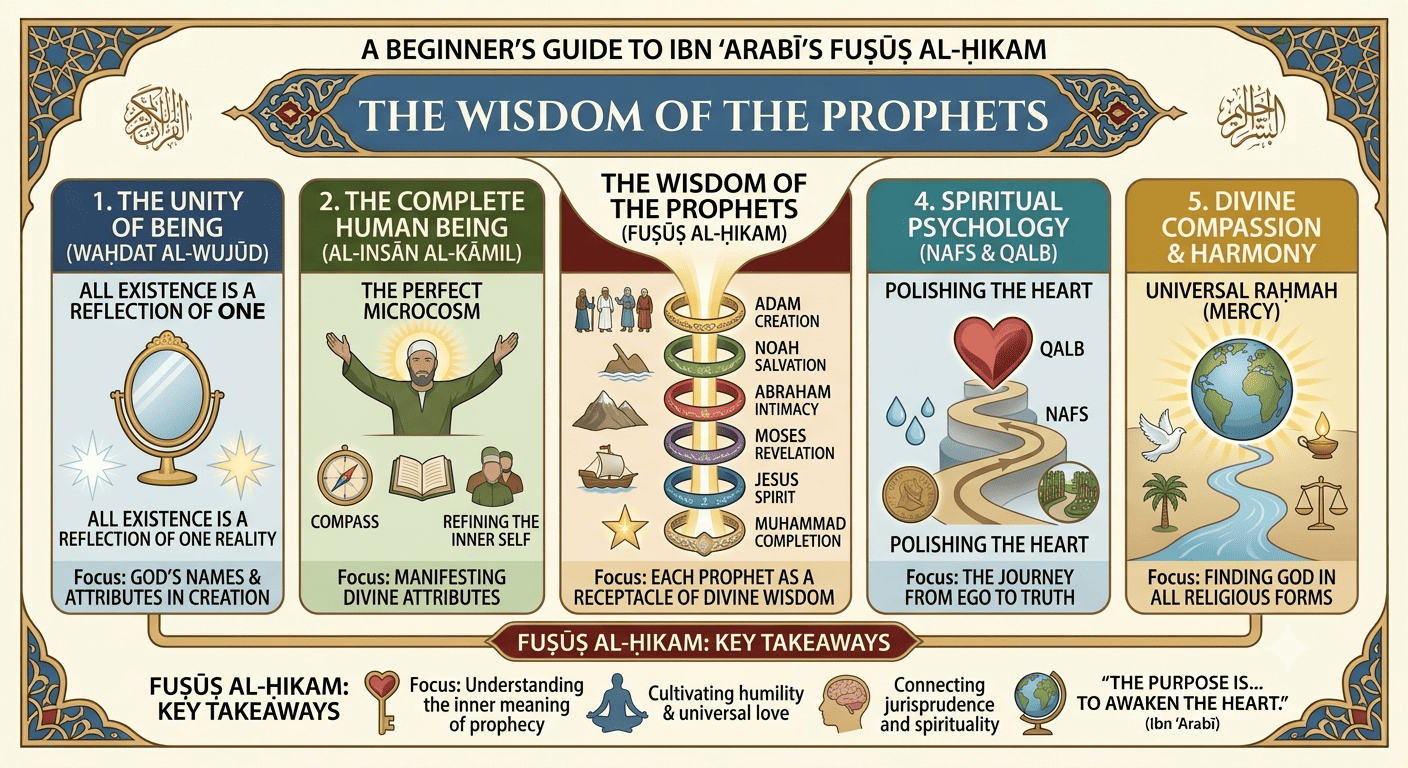
The final chapter of Fuṣūṣ al-Ḥikam brings together everything that has come before it. Each prophet introduced throughout the book reveals a unique aspect of Divine wisdom: Adam reflects the complete human being, Noah teaches transcendence, Abraham embodies friendship, Joseph reveals imagination, Moses represents direct speech with Allah, Jesus manifests spirit, and every other prophet discloses another facet of the Divine Reality.
For Ibn ʿArabī, Muhammad ﷺ is the prophet in whom all these wisdoms are united. He represents the Wisdom of Wholeness (Ḥikmat al-Jāmiʿiyya), the wisdom that gathers diversity into unity without erasing its richness.
Through Muhammad ﷺ, Ibn ʿArabī presents the highest expression of the Perfect Human (al-Insān al-Kāmil), whose life reflects the harmony of all Divine attributes.
The Meaning of Wholeness (Jāmiʿiyya)
The Arabic word jāmiʿ means “that which gathers,” “unites,” or “embraces.”
For Ibn ʿArabī, wholeness does not mean sameness.
Instead, it means bringing many different realities into harmony.
Human life contains many dimensions:
- intellect and love,
- contemplation and action,
- justice and mercy,
- individuality and community,
- body and spirit.
The wisdom of Muhammad ﷺ teaches that none of these should dominate at the expense of the others.
Spiritual maturity lies in allowing each to find its proper place within a balanced and integrated life.
The Muhammadan Reality
One of Ibn ʿArabī’s most profound teachings is the idea of the Muhammadan Reality (al-Ḥaqīqa al-Muhammad ﷺiyya).
This does not refer only to the historical Prophet Muhammad ﷺ.
Rather, it describes the primordial spiritual reality through which Allah first discloses His wisdom to creation.
Every prophet participates in this reality.
Each reflects one particular aspect of its fullness.
Muhammad ﷺ alone manifests that fullness completely.
For this reason, Ibn ʿArabī describes him as both the culmination of prophecy and the comprehensive mirror of the Divine Names.
The Seal of Prophecy
The Qur’an describes Muhammad ﷺ as the Seal of the Prophets.
For Ibn ʿArabī, this title signifies completion rather than mere succession.
The seal completes what came before it.
Nothing essential is left unfinished.
The wisdom of earlier prophets is neither replaced nor cancelled.
Instead, it is gathered into a higher unity.
Every prophetic wisdom finds its proper place within the Muhammadan reality.
Mercy as the Principle of Wholeness
The Qur’an describes Muhammad ﷺ as:
“A mercy to all the worlds.”
For Ibn ʿArabī, this verse expresses the deepest character of the Muhammadan Reality.
Mercy is not simply one Divine attribute among many.
It is the atmosphere within which all the Divine Names operate.
Justice without mercy becomes harshness.
Knowledge without mercy becomes pride.
Power without mercy becomes oppression.
Mercy allows every Divine attribute to find its proper balance.
This is why Muhammad ﷺ’s life represents the harmony of all virtues rather than the dominance of any single one.
The Perfect Human
Throughout Fuṣūṣ al-Ḥikam, Ibn ʿArabī gradually develops his doctrine of the Perfect Human (al-Insān al-Kāmil).
Each prophet reveals one aspect of human perfection.
Muhammad ﷺ gathers them all.
He becomes the complete mirror through which the Divine Names are reflected within creation.
For Ibn ʿArabī, this perfection is not exclusive to prophets.
Every human being possesses the potential to reflect Divine qualities according to his or her capacity.
The spiritual journey is therefore a journey toward greater integration rather than greater fragmentation.
The Goal of the Spiritual Journey
The wisdom of Muhammad ﷺ brings the entire Fuṣūṣ to its conclusion.
Every earlier chapter described one stage of spiritual development.
Adam revealed human potential.
Abraham taught trust.
Joseph revealed symbolic perception.
Moses demonstrated intimacy with Allah.
Jesus embodied spiritual life.
Each wisdom prepared the seeker for wholeness.
Muhammad ﷺ represents the completion of that journey.
The seeker no longer sees separate virtues but discovers their unity within Divine wisdom.
Connection with Ibn ʿArabī's Broader System
Muhammad ﷺ’s wisdom brings together the central themes of Ibn ʿArabī’s thought.
The Muhammadan Reality (Al-Ḥaqīqa al-Muhammad ﷺiyya)
The primordial reality from which prophetic wisdom flows.
The Perfect Human (Al-Insān al-Kāmil)
The complete mirror of the Divine Names.
Divine Self-Disclosure (Tajallī)
All Divine attributes find their fullest manifestation in the Muhammadan reality.
Unity within Diversity
The many prophetic wisdoms are gathered into one harmonious whole.
These ideas represent the culmination of Ibn ʿArabī’s metaphysical vision.
Contemporary Relevance
Modern life often feels fragmented.
People struggle to balance work and family, ambition and contentment, spirituality and practical responsibilities.
The wisdom of Muhammad ﷺ offers a different vision.
Rather than separating these dimensions, it seeks to integrate them.
A balanced life allows knowledge to shape action, worship to inspire service, justice to be guided by mercy, and success to remain rooted in humility.
Wholeness is not achieved by withdrawing from the world but by living every aspect of life with awareness of Allah.
Reflection
Muhammad’s ﷺ life invites us to reflect on our own search for balance.
Which parts of our lives feel disconnected from one another?
Are we developing one aspect of ourselves while neglecting others?
Ibn ʿArabī reminds us that the spiritual journey is not about becoming less human.
It is about becoming fully human, allowing every dimension of life to reflect Divine wisdom.
Conclusion
The Bezel of Muhammad ﷺ brings Fuṣūṣ al-Ḥikam to its culmination. Through the Muhammadan Reality, Ibn ʿArabī presents the complete vision of human perfection, where every Divine wisdom revealed through the earlier prophets is gathered into a single harmonious whole.
Muhammad ﷺ reminds us that spiritual life is not a collection of isolated virtues but an integrated way of being. Knowledge, love, justice, mercy, contemplation, and action all find their proper place when the heart is oriented toward Allah.
In this way, Muhammad ﷺ becomes the supreme guide to the wisdom of wholeness, inviting every seeker to move beyond fragmentation toward a life of balance, harmony, and complete surrender to the Divine.
Critical Question
Reflect on the different parts of your life—your work, relationships, beliefs, responsibilities, and inner aspirations. Where do you experience tension or imbalance? How might bringing these dimensions into greater harmony help you become a more complete and authentic person?