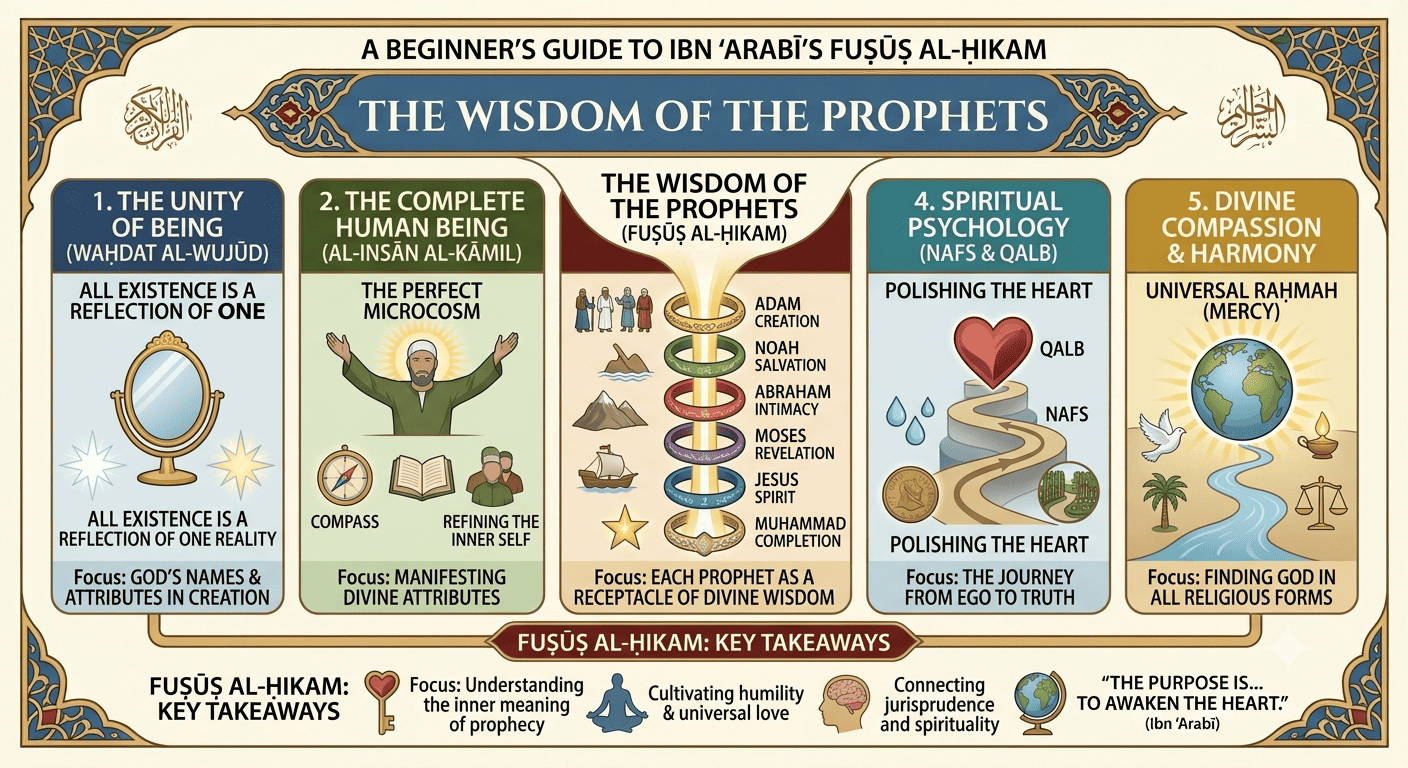

Key Concepts
What Ibn ʿArabī Wants Us to Learn through Journey of Divine Wisdom
Fuṣūṣ al-Ḥikam is not simply a collection of stories about prophets. Nor is it a book of theology or philosophy alone. Ibn ʿArabī invites readers to see each prophet as revealing one aspect of Divine wisdom. Together, these prophetic wisdoms form a complete picture of the relationship between Allah, humanity, and the universe.
The prophets differ in their personalities, missions, and circumstances, but they all point toward the same ultimate Reality. Their lives reveal different ways of knowing Allah, understanding ourselves, and living wisely.
After exploring these chapters, several key lessons emerge.
1. Allah Is Infinite
Perhaps the most important lesson of Fuṣūṣ is that Allah can never be confined to human concepts.
Every prophet reveals one aspect of Divine wisdom.
No single perspective is complete by itself.
The more we learn about Allah, the more we realize that His Reality always exceeds our understanding.
This calls us to humility rather than certainty.
2. Diversity Is Part of Divine Wisdom
One prophet teaches patience.
Another teaches courage.
Another teaches love.
Another teaches justice.
Another teaches hope.
Ibn ʿArabī does not present these differences as contradictions.
Instead, diversity itself reflects the richness of Divine wisdom.
Just as white light contains many colours, Divine Reality is expressed through many prophetic personalities.
3. Every Human Being Reflects Something Divine
One of Ibn ʿArabī’s most beautiful ideas is that every person reflects certain Divine Names.
Some people naturally express compassion.
Others express wisdom.
Others express justice.
Others express creativity.
Spiritual growth is not becoming someone else.
It is discovering the Divine qualities that Allah has entrusted to you and expressing them responsibly.
4. The World Is Full of Signs
Nothing in creation is meaningless.
Nature…
History…
Dreams…
Relationships…
Beauty…
Joy…
Even suffering…
All can become signs pointing toward Allah.
The challenge is not that Allah hides Himself.
The challenge is learning how to see.
5. Knowledge Must Become Transformation
Throughout Fuṣūṣ, knowledge is never merely intellectual.
Real wisdom changes how we live.
Knowing that compassion is different from becoming compassionate.
Knowing about trust is different from trusting.
Knowing about humility is different from becoming humble.
True knowledge transforms character.
6. The Spiritual Journey Never Ends
No prophet reveals the whole picture alone.
Likewise, no human being ever reaches complete understanding.
Spiritual life is an ongoing journey of learning, reflection, and growth.
Each new experience may reveal another aspect of Divine wisdom.
7. The Perfect Human
All the prophetic wisdom finally points toward one ideal.
The human being who reflects Divine wisdom with balance.
This is what Ibn ʿArabī calls al-Insān al-Kāmil (The Realized Human).
The Realized Human is not someone without weaknesses.
Rather, it is someone whose life increasingly reflects Allah’s mercy, justice, wisdom, generosity, patience, and love.
For Ibn ʿArabī, Prophet Muhammad represents the fullest realization of this ideal, gathering within himself the wisdom revealed through all the previous prophets.
8. The Journey Returns to Allah
The prophets begin with Allah.
They guide humanity toward Allah.
And they remind us that every human journey ultimately returns to Allah.
The purpose of life is therefore not simply success, knowledge, or achievement.
It is coming to know the One who is the source of all existence.
These ideas represent the culmination of Ibn ʿArabī’s metaphysical vision.
Final Reflection
Ibn ʿArabī’s Fuṣūṣ al-Ḥikam does not ask us merely to admire the prophets.
It asks us to learn from them.
Each prophet becomes a mirror reflecting one aspect of Divine wisdom.
As we contemplate their lives, we begin to see our own lives differently.
The world becomes richer with meaning.
Other people become reflections of Divine creativity.
Our successes become opportunities for gratitude.
Our struggles become opportunities for growth.
The journey through Fuṣūṣ is therefore not only a journey through the lives of the prophets—it is a journey toward understanding ourselves, the world, and ultimately Allah.